
Last updated 29 November 2026. Official sources opened and checked on 27 November 2026.
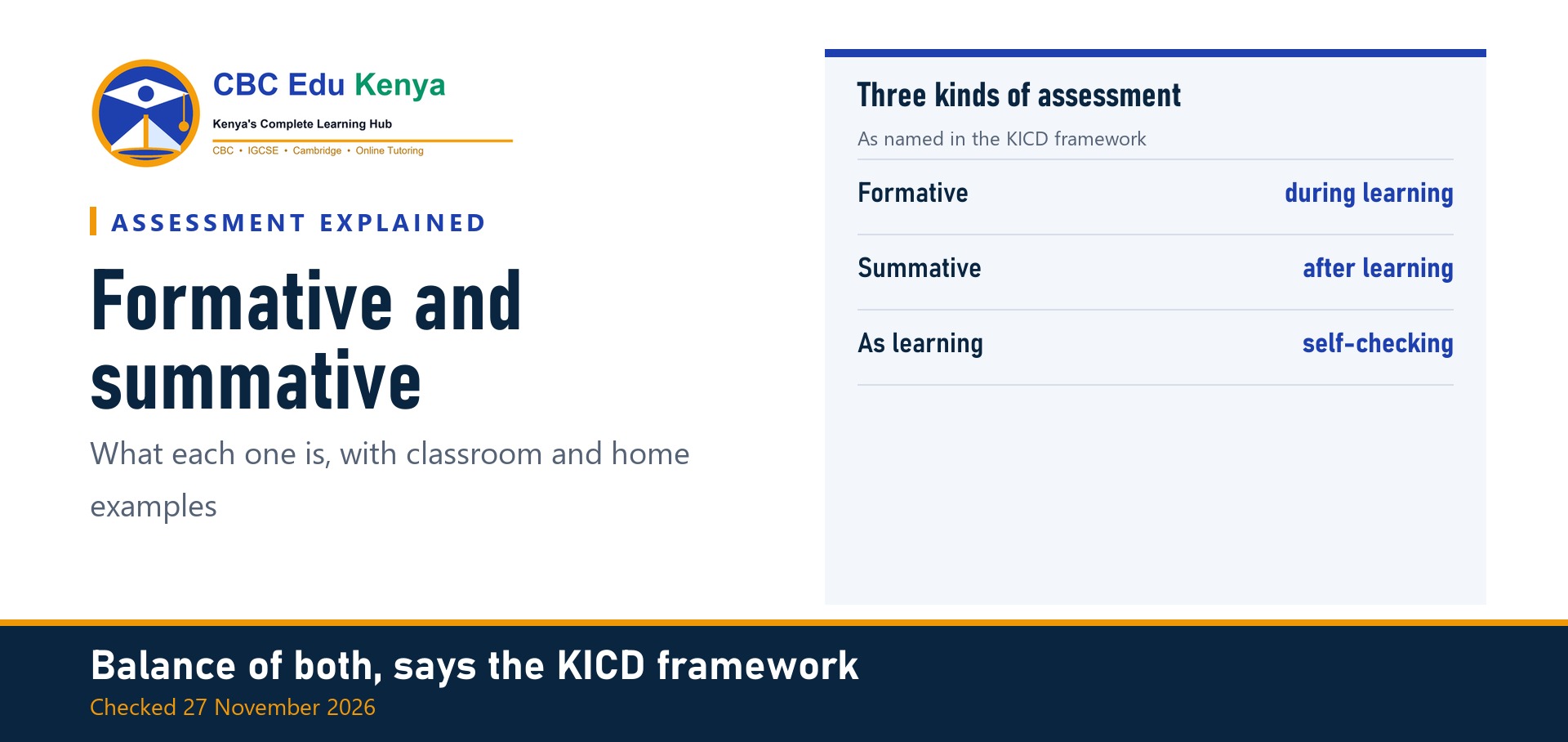
Direct answer: Formative assessment happens during learning to show what a learner can and cannot yet do, so the teacher and learner can fix gaps. Summative assessment happens after a block of learning to sum up what has been achieved, and can be used for grading and progression. KICD's curriculum framework asks for a balance of both, and adds a third idea, assessment as learning, where learners check and correct their own work.
"Assessment" at a CBC school is not one thing. A learner may answer three oral questions on Monday, hand in a short task on Wednesday, be observed in a group activity on Thursday, and sit an end-of-term paper in the last week. These are different kinds of assessment with different purposes, and mixing them up is behind many parent worries. This guide explains the three kinds KICD names, shows them in one worked example, and says what you can do at home for each.
The three kinds in one worked example
A Grade 5 class is learning fractions over four weeks. Here is how each kind of assessment appears:
| When | What the teacher does | Kind of assessment | What happens with the result |
|---|---|---|---|
| Week 1, Monday | Asks five quick oral questions: "Which is bigger, 1/2 or 1/4? How do you know?" | Formative (assessment for learning) | The teacher notices that six learners confuse the bigger denominator with the bigger fraction and reteaches with paper folding the next day |
| Week 2, Wednesday | Gives a short task: shade fractions of a shape; checks with a checklist | Formative | Notes kept as a record; learners correct their own errors |
| Week 3, Thursday | Learners swap books and mark a partner's work with a simple answer key, then write one thing to improve | Assessment as learning (self and peer) | Learner sets a personal goal; teacher sees what they notice |
| Week 4, Friday | End-of-unit written task covering the whole unit | Summative (assessment of learning) | Recorded as evidence of the performance level reached in that unit |
Notice two things. First, most of the assessment in the four weeks is not a test: it is conversation, short tasks and observation. Second, the formative results did not get a rank or a mark to compare with others. They changed what the teacher did next. That is the whole point.
What KICD says about each kind
Formative assessment (assessment for learning)
KICD's Basic Education Curriculum Framework describes formative assessment as information "that will help to guide a learner's development towards a certain desired outcome", carried out "during the learning process to provide immediate feedback to both the learner and the teacher". It says formative assessment "uses both formal and informal methods" and is carried out "on a continuous basis". It is used for "the diagnosis of learning gaps, for corrective measures, retesting, feedback of evidence to teachers, and learners' self-evaluation".
The framework also says the assessments "should be made on recorded evidence based on anecdotal records" kept by the teacher, followed by descriptive remarks "about positive and significant achievements, avoiding negative assessment even by implication". In other words, a good formative comment tells a learner what they did well and what to do next.
Summative assessment (assessment of learning)
The framework says summative assessment "takes place after the learning has been completed and provides information and feedback that sums up the teaching and learning process". It is used "for placement and certification" and "for the ranking or grading of learners and for deciding on progression into the next level of education". It should be "synoptic", meaning learners show that they can integrate and apply skills and knowledge across a whole subject, not only recall a single page.
Assessment as learning
The framework adds a third idea: assessment as learning, which "fosters skills and habits such as self-assessment, self-monitoring, and self-correction among learners". Teachers can use self-reflection questions and examples of good work. This links to the core competency of learning to learn; see our guide on the seven core competencies.
Side by side
| Formative | Summative | |
|---|---|---|
| Plain meaning | Checking during learning | Summing up after learning |
| Purpose | Guide the next step; find and fix gaps | Judge what was achieved; grading, placement, progression |
| Usual tools | Oral questions, observation, checklists, rating scales, rubrics, short tasks, projects, portfolios, journals | End-of-unit or end-of-term tasks and papers, national assessments at set stages |
| Feedback | Immediate, descriptive, positive | After the unit; a performance level and comment |
| Stakes | Low; no ranking needed | Higher; recorded and reported |
| What a parent can do | Talk about the feedback; practise the one thing to improve | Read the report; ask what the level means and what to do next |
How it differs by level of school
The framework sets different emphases by level. At Early Years level (pre-primary and lower primary) it says assessment is "a continuous process and not a one-off procedure", gathered through portfolios, progress records and observation. It says teachers at pre-primary level "should desist from exposing learners to written formal tests" and that progress records "should not be scored for purposes of comparing him or her with others". In middle school, assessment is meant to give learners feedback on their interests and progress and to help them become autonomous learners, using tools such as portfolios, observation schedules, checklists, journaling and projects. At senior school, formative, synoptic and summative assessment are planned at three levels: skills, knowledge and competency.
For young learners, our guide to PP1 and PP2 assessment portfolios and observation checklists shows what this looks like.
Where national bodies fit
The Kenya National Examinations Council (KNEC) runs competency based assessment (CBA) and publishes guidelines and schedules for school-based assessment each year. Its website lists, for example, guidelines and a schedule for the September 2026 school-based assessments for Grades 3, 4, 5, 7 and 8, and a school report guide. Schools carry out the assessment; KNEC sets the guidelines and the national assessments. Read the notice for your grade directly on knec.ac.ke instead of relying on forwarded WhatsApp messages. Our guide on how to read the CBC report card and the explanation of the four performance levels show how results reach families.
What parents can do at home
- Treat feedback as information, not judgement. When a marked exercise returns, ask "What did the teacher say to do next?"
- Look for the pattern. One low result is a data point; the same error across weeks is a learning gap. Our guide on learning gaps gives a 10-minute check and a four-week plan.
- Practise self-checking. After homework, let your child mark with an answer key and write one thing to improve. That is assessment as learning.
- Ask the right questions at the school meeting: What is my child's level in this strand? Which tool shows it? What is one thing we can practise at home?
- Keep the end-of-term paper in proportion. It sums up one stage; it does not describe the child.
What teachers can do
- Plan the formative tools in the scheme of work (oral questions, checklist, rubric) so they are not left to chance; see our guide on writing a scheme of work for Term 1 2027.
- Write comments that say what was done well and what to do next.
- Keep short records. The framework asks for recorded evidence, not memory.
- Make the summative task match the strand outcomes; see how to set a CBC exam that measures strands.
- Use mistakes from formative checks to reteach before the summative task.
Key facts
| Fact | Detail | Source (opened 27 Nov 2026) |
|---|---|---|
| Formative assessment | During learning; formal and informal methods; continuous; used to diagnose gaps and correct | KICD Basic Education Curriculum Framework (BECF), 2019 edition, assessment chapter, page 128 |
| Summative assessment | After learning is completed; synoptic; used for placement, certification, grading and progression | BECF, page 129 |
| Assessment as learning | Self-assessment, self-monitoring, self-correction | BECF, page 130 |
| Formative instruments named | Observation schedules, checklists, rating scales, rubrics, questionnaires, project method, journaling and others | BECF, pages 130 to 132 |
| Pre-primary rule | Teachers should not expose learners to written formal tests; progress records should not be scored to compare learners | BECF, page 136 |
| KNEC role | Publishes school-based assessment guidelines and schedules and a school report guide | KNEC website, downloads and notices |
Common mistakes
- "Only the end-of-term paper counts." The framework describes assessment as continuous and based on recorded evidence.
- "A low formative result is a failure." It is a signal for the next lesson.
- "Pre-primary children should sit tests." The framework says the opposite.
- "CBC has no exams." It has both continuous assessment and national assessments at set stages; check KNEC for the current ones.
Where CBC Edu Kenya fits, stated once
Everything above is free to use. If you also want ready-made practice for Grade 5, our Grade 5 page lists the packs, and the Grade 5 whole-grade bundle holds the subjects together. Normal prices are KSh 100 per subject and KSh 300 for the whole-grade bundle; check the product page for any offer that is running. Our free samples are at free sample. For live classes (Grades 4 to 10), the CBC Holiday Academy has already started and a learner can join in any week; the class group and timetable are confirmed on WhatsApp before you pay.
Official sources used
- KICD: Basic Education Curriculum Framework (2019 edition, PDF): formative, summative and self-assessment; instruments; assessment by level
- KICD: Basic Education Curriculum Framework page: official page for the framework
- KNEC: Kenya National Examinations Council: competency based assessment, school-based assessment guidelines and school report guide
- Ministry of Education: national policy and circulars
Questions people ask
What is the difference between formative and summative assessment?
Formative assessment happens during learning to guide the next step and fix gaps. Summative assessment happens after learning to sum up what was achieved and may be used for grading and progression.
What is assessment as learning?
It is when learners check and correct their own work, for example by marking against an answer key and writing one thing to improve. KICD's framework says it builds self-assessment, self-monitoring and self-correction.
Does CBC have exams?
CBC uses continuous assessment in class and national assessments at set stages run by KNEC. Check the KNEC website for the current guidelines and schedules for your grade.
Should pre-primary children sit written tests?
No. KICD's framework says teachers at pre-primary level should desist from exposing learners to written formal tests, and progress records should not be scored to compare learners.
How are formative results recorded?
KICD's framework asks for recorded evidence such as anecdotal records kept by the teacher, followed by descriptive remarks that avoid negative assessment even by implication.
How can I use formative feedback at home?
Ask what the teacher said to do next, practise that one thing for a short time each day, and let your child mark and correct their own work with an answer key.
The Grade 5 fractions example is an illustration, not an official lesson. CBC Edu Kenya is not part of the Ministry of Education, KICD, KNEC or TSC. Where this page says "our suggestion", it is our own advice and not an official rule.
Keep your child learning this holiday
Live online classes: 4 lessons a week, 2 hours each, KSh 2,500 a week. December holiday revision materials: Whole Grade Bundle KSh 250 (PP1 to Grade 9), or KSh 100 for one subject.
KSh 2,500 a week · Get it now → 📱 Pay by M-Pesa · printable packs are sent to your email after paymentHave a CBC question this article didn't answer?
Ask Somo, Kenya's first AI tutor. CBC-grounded, Kenyan examples, instant feedback. Five free questions a day with no signup, or start a 7-day free trial for 30 questions a day.
Try Somo Free →