
Last updated 28 November 2026. Official sources opened and checked on 27 November 2026.
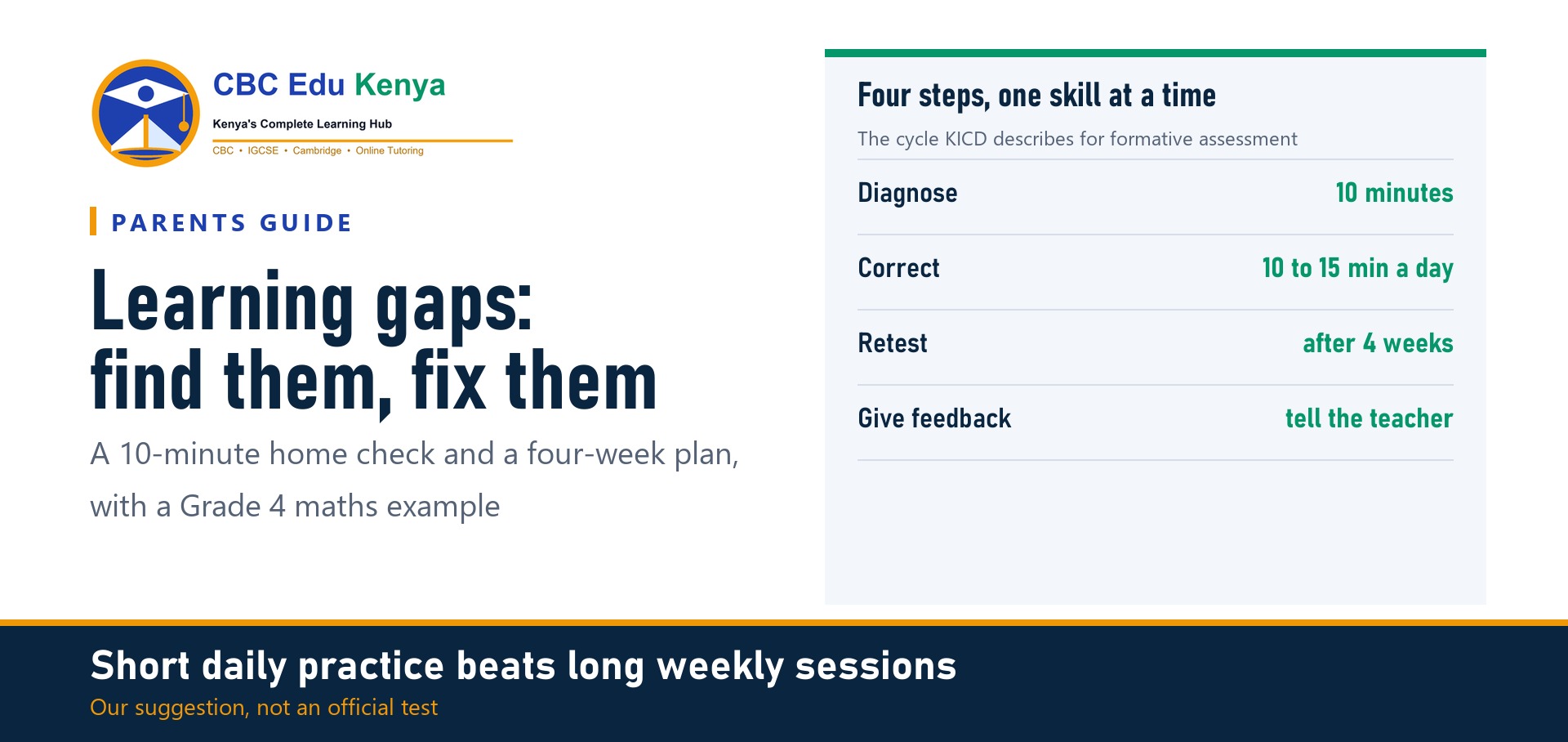
Direct answer: A learning gap is a skill or idea your child was meant to master earlier and did not, so later work keeps going wrong. Signs include the same mistake appearing in different lessons, avoiding one subject, or slow, finger-counting work. Find it with a short 10-minute check on one skill, fix it with 10 to 15 minutes of daily practice for about four weeks, then check again. KICD's framework says every learner comes to class with some gaps and the aim is fewer gaps over time.
Most parents first hear the phrase "learning gap" at a parents' meeting, usually when something is already going wrong. This guide helps you spot a gap early, test for it calmly at home, and fix it in the holiday with a plan you can follow without being a teacher. The worked example is Grade 4 mathematics, because that is where many families first notice gaps, but the method works for any grade and any subject.
What a learning gap is, and what it is not
A learning gap is a missing step. Mathematics, reading and writing are built in layers. If a Grade 4 learner never became comfortable with place value (what the 7 means in 4,732), then rounding, adding big numbers and later decimals will all feel hard, even though they look like different lessons. The weak point is the early layer, not the child.
It is not laziness, low intelligence or a verdict on the whole year. The Kenya Institute of Curriculum Development (KICD) says it plainly in the Basic Education Curriculum Framework: "All students come to class with some learning gaps, some have few while others have many. The teacher adds value to the students when they leave the class with fewer gaps than when they entered." The same framework says formative assessment is used for "the diagnosis of learning gaps, for corrective measures, retesting, feedback of evidence to teachers, and learners' self-evaluation." That four-part cycle (diagnose, correct, retest, give feedback) is exactly what you can copy at home.
Five signs that point to a gap
| Sign you may notice | What it often means | What to try first |
|---|---|---|
| The same kind of mistake in different lessons (for example, wrong answers whenever numbers are large) | One early skill is shaky and is breaking later work | Test that one skill with the 10-minute check below |
| Your child avoids one subject, "forgets" books, or says "it is boring" | Avoiding can hide the feeling "I do not get it" | Ask "which part is hardest?" and stay calm |
| Slow, finger-counting or guessing in mathematics | Number facts (addition, subtraction, multiplication) are not automatic yet | Short daily fact practice, 5 minutes |
| Reads aloud word by word and cannot say what the story was about | Reading fluency or understanding lags | Read together; ask 2 simple questions after each page |
| Marks fall in more than one subject after a long school break or a change of school | Learning slipped and nothing caught it | Ask the class teacher which lessons were missed |
One sign alone is a reason to look, not to worry. Two or three signs repeating over several weeks are worth acting on.
A 10-minute home check for Grade 4 mathematics
Sit down with your child when they are rested, not after a long day. Tell them it is a game to find what to practise, not a test. Ask the questions below, in order, on paper or aloud. Stop at the first row where your child hesitates or gets two wrong; that is likely where the gap starts. These are our own check questions, not an official test.
| Skill | Sample questions (do 3 each) | If your child struggles |
|---|---|---|
| Number facts (add and subtract within 20) | 8 + 7; 15 - 9; 6 + 6 | Practise with objects (bottle tops), then quick oral drills |
| Multiplication facts (2, 5, 10 tables first) | 5 x 6; 10 x 7; 2 x 9 | Skip-counting songs, a table on the wall, 5 minutes a day |
| Place value to 4 digits | What is the value of the 7 in 4,732? Write 3 thousands, 2 hundreds, 5 tens, 1 one | Draw a place-value chart; use money notes and coins as a model |
| Adding and subtracting with regrouping | 367 + 258; 502 - 237 | Use a column on squared paper; check by adding back |
| Fractions as parts of a whole | Shade 3/4 of a rectangle; which is bigger, 1/2 or 1/4? | Fold paper, cut a chapati or mandazi into equal parts |
| Word problems | A seller has 24 mangoes and packs 6 in each bag. How many bags? | Draw the story; underline the question; say which operation and why |
Write down what you find in one line, for example: "Place value: 2 of 3 wrong. Multiplication facts: all correct." That line is what you take to the class teacher and what drives your plan. It is also the "diagnosis" step in KICD's cycle.
Worked example: a Grade 4 learner who "cannot do" word problems
Wanjiru is in Grade 4. Her last two mathematics assessments had low marks, and her mother thought the word problems were the issue. She ran the 10-minute check.
- Check result: number facts correct, multiplication facts correct, place value correct, fractions fine, but 2 of 3 regrouping sums wrong (367 + 258 gave 515; 502 - 237 gave 375).
- What it meant: the word problems were not the real gap. Wanjiru was forgetting to carry in addition and to regroup across the zero in 502, so even a correct plan gave a wrong answer.
- Fix: 10 minutes a day for four weeks, weekdays only. Week 1: 5 addition sums with carrying in a column, marked together. Week 2: 5 subtraction sums with regrouping, including zeros (305 - 148). Week 3: the same, then 2 word problems that use those sums. Week 4: mixed practice and one new word problem she writes herself.
- Retest: at the end of week 4 her mother repeated the six sample sums from the check. Four of six right, so they added two more weeks of regrouping and moved on to fractions.
The numbers in this example are illustrative; no real child is described. The pattern is the point: find the real gap, practise it in small steps, retest, and only then widen the work. The BECF describes the same loop: assess, correct, retest.
A four-week plan you can copy for any gap
| Week | Daily 10 to 15 minutes | Your job |
|---|---|---|
| 1 | Re-learn the missing step with objects or drawings. Two or three examples worked together | Stay calm; say "this is a step we are fixing" |
| 2 | Practise 5 questions on that step alone. Mark together and fix wrong ones the next day | Keep a tick chart on the wall |
| 3 | 5 questions, then 1 question that uses the step in a real situation (shopping, cooking, sharing) | Ask "how did you know?" |
| 4 | Mixed questions; repeat the sample check from the start | Celebrate progress; decide whether to continue or move on |
For a holiday timetable that fits around this, see our week-by-week December revision plan and the guide on how to revise so it sticks. For how long to sit each day, our homework guide gives time ranges by age.
What KICD says about parents and teachers working together
KICD's Guidelines on Parental Empowerment and Engagement (first published 2019) open with the line "Parents are the first and continuing educators of their children." Among the strategies they list: monitor the child's learning progress while considering age, and have teachers and parents "jointly agree on an improvement plan"; and read and respond to school reports and teacher comments. In plain words: bring your one-line diagnosis to the teacher and agree a plan together. You do not need to replace the school.
Questions to ask the class teacher: Which skills from earlier grades is my child missing? Is there a short assessment I can see? What can we practise at home that matches what you teach? When will you check again? Our guides on how to read the CBC report card and the four performance levels will help you read what the school sends home.
Key facts and sources at a glance
| Fact | Source and date checked |
|---|---|
| "All students come to class with some learning gaps..." and "the diagnosis of learning gaps, for corrective measures, retesting..." | KICD Basic Education Curriculum Framework, 2019 edition, assessment chapter (pages 128 to 129). Opened 27 Nov 2026 |
| Parents are "the first and continuing educators of their children"; teachers and parents should jointly agree on an improvement plan | KICD Guidelines on Parental Empowerment and Engagement, first published 2019 (PDF on kicd.ac.ke). Opened 27 Nov 2026 |
| Teachers keep recorded evidence, for example anecdotal records, and write descriptive remarks | KICD framework, formative assessment section. Opened 27 Nov 2026 |
| KNEC publishes school-based assessment guidelines and a school report guide for schools | KNEC website (knec.ac.ke), downloads and notices. Opened 27 Nov 2026 |
| Home checks and the four-week plan | CBC Edu Kenya suggestion, not an official test |
Mistakes that make gaps worse
- Doing the work for the child. A neat page that your child did not understand hides the gap.
- Long sessions. Forty minutes once a week is weaker than ten minutes a day.
- Starting at the newest lesson. If place value is weak, more fractions will not help.
- Comparing with a sibling or neighbour. Compare your child with last month's work only.
- Buying many books at once. One focused skill, two or three pages a day, is enough. Our guide on how to check a pack before you buy explains what to look for.
The same habit of confidence and persistence is one of the seven competencies in our guide on core competencies in CBC, under self-efficacy.
Where CBC Edu Kenya fits, stated once
Everything above is free to use. If you also want ready-made practice for Grade 4, our Grade 4 page lists the packs, and the Grade 4 whole-grade bundle holds the subjects together. Normal prices are KSh 100 per subject and KSh 300 for the whole-grade bundle; check the product page for any offer that is running. Our free samples are at free sample. For live classes (Grades 4 to 10), the CBC Holiday Academy has already started and a learner can join in any week; the class group and timetable are confirmed on WhatsApp before you pay. If you would rather have a teacher check the gap, ask on WhatsApp about the Academy classes for your child's grade.
Official sources used
- KICD: Basic Education Curriculum Framework (2019 edition, PDF): formative assessment, learning gaps, recorded evidence
- KICD: Guidelines on Parental Empowerment and Engagement (PDF): parents as first educators; agreeing an improvement plan with the teacher
- KICD: Guidelines on Parental Empowerment and Engagement (page): the official page that hosts the guidelines
- KNEC: Kenya National Examinations Council: school-based assessment guidelines and the school report guide
Questions people ask
What is a learning gap?
A learning gap is a skill or idea a learner was meant to master earlier but did not, so later work in the same area keeps going wrong. KICD's framework says all learners come to class with some gaps and teachers aim to leave them with fewer.
How do I know my child has a learning gap?
Look for the same mistake in different lessons, avoiding one subject, slow counting on fingers, word-by-word reading, or falling marks after a long break. Then run a short 10-minute check on one skill at a time.
How long does it take to fix a learning gap?
Often about four weeks of 10 to 15 minutes a day on one skill, followed by a retest. Some gaps need six weeks or more. This is our suggestion, not an official rule.
Should I speak to the teacher?
Yes. KICD's parent guidelines encourage teachers and parents to agree an improvement plan together. Take your one-line check result to the class teacher.
Can I fix a gap in the school holiday?
Yes, weekdays only, with short sessions and rest at weekends. Start from the missing step, not from the newest lesson.
Do I need to buy materials to fix a gap?
No. Objects, paper, the exercise books and marked work are enough to start. A pack can add practice and answers for a subject where you need more, but it is optional.
The sample questions and the worked example are CBC Edu Kenya's own and are not an official test. CBC Edu Kenya is not part of the Ministry of Education, KICD, KNEC or TSC. Where this page says "our suggestion", it is our own advice and not an official rule.
Keep your child learning this holiday
Live online classes: 4 lessons a week, 2 hours each, KSh 2,500 a week. December holiday revision materials: Whole Grade Bundle KSh 250 (PP1 to Grade 9), or KSh 100 for one subject.
KSh 2,500 a week · Get it now → 📱 Pay by M-Pesa · printable packs are sent to your email after paymentHave a CBC question this article didn't answer?
Ask Somo, Kenya's first AI tutor. CBC-grounded, Kenyan examples, instant feedback. Five free questions a day with no signup, or start a 7-day free trial for 30 questions a day.
Try Somo Free →