
Last updated 28 November 2026. Official sources opened and checked on 27 November 2026.
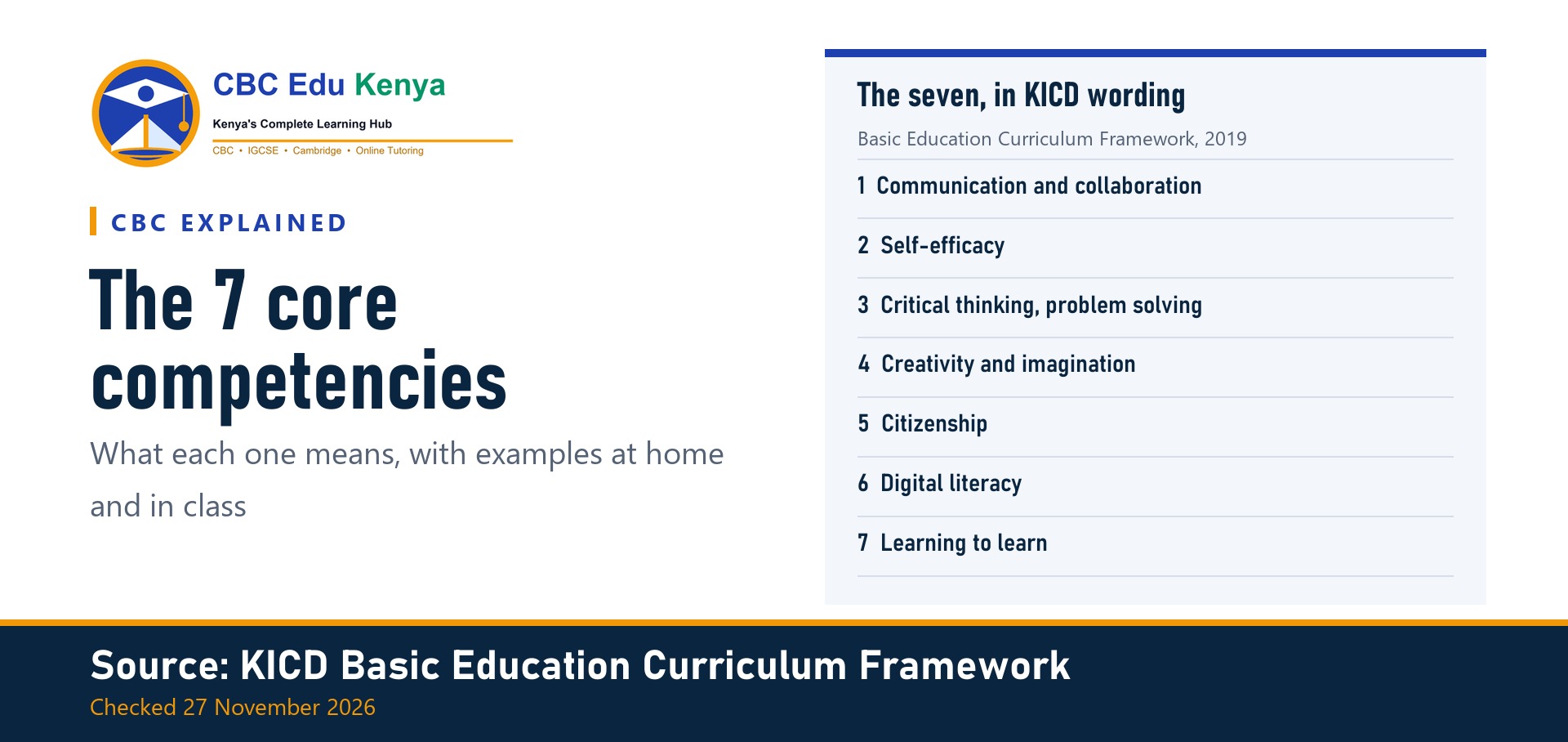
Direct answer: The Kenya Institute of Curriculum Development (KICD) names seven core competencies that every learner in basic education should build: communication and collaboration, self-efficacy, critical thinking and problem solving, creativity and imagination, citizenship, digital literacy, and learning to learn. They are not extra subjects. Teachers build them through the normal learning areas, and KICD defines a competency as the ability to apply knowledge, skills, attitudes and values to do something well.
Parents hear "competencies" at every school meeting and few are given a clear list. This guide gives you the official list from KICD's own framework, explains each one in everyday words, shows how a single school activity can build several at once, and ends with simple things to do at home in the school holiday. It is written for parents first, with a section for teachers.
What the seven competencies mean for your child, in one worked example
Take a Grade 5 class that is asked to find out why the school water tank runs dry every Friday and to suggest a fix. Nothing in that task is a single subject, yet it builds all seven competencies:
| What the learner does | Competency it builds |
|---|---|
| Interviews the cook and the caretaker, then presents findings to the class in a group | Communication and collaboration |
| Keeps going when the first measurement is wrong and tries again | Self-efficacy (belief that "I can work this out") |
| Compares water used per day with water stored and decides what the numbers show | Critical thinking and problem solving |
| Designs a simple rain-catching idea or a hand-washing rota nobody has tried at the school | Creativity and imagination |
| Presents a plan to the head teacher that serves the whole school, not only one class | Citizenship |
| Uses a phone or school device to look up average daily water need, and checks that the source is reliable | Digital literacy |
| Keeps a short log, plans the week, and asks the teacher for help where stuck | Learning to learn |
This is the point of the Competency Based Curriculum. KICD's framework says the learning areas "serve as vehicles through which the core competencies are developed over time". Mathematics, Science and Technology, English and the rest are the road; the competencies are what the learner carries away. The framework gives its own sample at the two ends of school: in pre-primary, learners can be asked to find the best ways of keeping their books and stationery safe, and at the other end of basic education, learners can be asked how to handle scarce resources such as water in the school and community.
The seven core competencies at a glance
| Competency (KICD wording) | What KICD says it is, in short | What it can look like in class | What it can look like at home |
|---|---|---|---|
| 1. Communication and collaboration | Using messages to create meaning in different settings and working with others toward shared goals | Group presentation, pair reading, role play | Telling you about the school day in full sentences; sharing a task with a sibling |
| 2. Self-efficacy | A learner's belief about their own capability to perform tasks; builds confidence, self-esteem, resilience | Trying a hard problem again after a wrong answer | Letting your child finish a difficult task before you step in |
| 3. Critical thinking and problem solving | Reasoning, making judgements and solving problems using logic and evidence | Explaining why an answer is right, comparing two methods | Asking "how do you know?" when your child gives an answer |
| 4. Creativity and imagination | Forming new ideas and turning them into real, visible creations | Designing a model, a poem, a poster or a new game | Building a toy from waste material; telling an invented story |
| 5. Citizenship | A sense of belonging, rights and duties; respect for others locally and globally | Class rules made together, community service tasks | Helping with a family or neighbourhood task; learning about elections and the flag |
| 6. Digital literacy | Knowledge, skills and behaviours to use digital content and devices effectively and safely | Searching and judging a source; typing a short report | Agreed screen rules; checking one claim together before sharing it |
| 7. Learning to learn | Pursuing and persisting in learning, and organising time and information | Keeping a notebook, planning a week, asking for guidance | A simple weekly timetable your child helps to write |
Each competency in plain words
1. Communication and collaboration
KICD describes communication as transferring information, whether vocally, visually or non-verbally, and says the aim is effective and ethical communication. Collaboration is two or more people working together toward a shared goal. In the classroom this is everyday: reading aloud, explaining a sum to a partner, planning a class presentation. Under the framework, language of instruction at the Early Years level is chosen with care so that young learners can express themselves.
Home idea (10 minutes): at supper ask your child to tell you one thing that happened at school, with a beginning, a middle and an end. Listen without correcting grammar. In Grades 1 to 3 let them answer in the language they are most comfortable with first.
2. Self-efficacy
KICD defines self-efficacy as a person's belief about their capability to perform tasks. The framework says learners with high assurance in their capabilities approach difficult tasks as challenges to be mastered, not as threats to be avoided, and that the competency supports self-awareness, self-esteem, confidence and personal integrity. It also names parental engagement as one of two crucial factors in building it (the other is teacher capacity building).
Home idea: when your child says "I cannot do this", reply with "What have you tried so far?" before giving a hint. Praise the effort and the method, not only the right answer. A child who has been rescued every time learns that someone else solves the problem.
3. Critical thinking and problem solving
The framework says critical thinking helps learners avoid being subjective and use logic and evidence to reach conclusions, and that for every issue there are multiple perspectives to explore, instead of "rigid recall and regurgitation". This matters for assessment too: a learner who only memorises a page will struggle with tasks that ask "why" and "what would happen if".
Home idea: pick one claim a week, for example an advert or a WhatsApp forward, and ask "What would we need to see to believe this?" For primary learners, a market-day sum works well: which stall gives more for the money, and how do you know?
4. Creativity and imagination
KICD describes creativity as the ability to perceive the world in new ways, find hidden patterns, connect seemingly unrelated things and generate solutions, and says the curriculum "creates room for innovative ways of teaching". For a parent, the useful reading is that a neat copy of the teacher's example is not the only good answer.
Home idea: give your child three waste items (a box, bottle tops, a sheet of paper) and ten minutes to make something useful. Ask them to explain their idea. Do not fix it for them.
5. Citizenship
The framework links citizenship to belonging and attachment to the nation and to dealing with conflict and controversy "knowledgeably and tolerantly". It also mentions global citizenship, which it describes as recognising that our choices may affect people locally, nationally and internationally. This is the competency that connects most closely to the values listed in the framework; our next guide covers the values and the pertinent and contemporary issues in CBC.
Home idea: give your child a real job that helps the household or the neighbourhood and ask what would happen if nobody did it.
6. Digital literacy
KICD describes digital literacy as the knowledge, skills and behaviours needed to use a wide range of digital content and devices effectively and safely, and says it "should not be confused with computer literacy". Judging information found online is part of the definition. Our guide on using AI safely for homework applies the same idea to chat tools.
Home idea: agree one family rule (for example, phones charge in the living room at night) and teach one habit: check who published a claim and when before you share it.
7. Learning to learn
KICD describes this as the ability to pursue and persist in learning and to organise your own learning by managing time and information, alone and in groups. It lists four pillars of learning: to know, to do, to be and to live together. A learner who can plan a week and ask for guidance needs less chasing each term.
Home idea: let your child help write a one-page weekly plan for the holiday. Our guide on how to revise so it sticks gives a method they can use.
How the competencies appear in the official curriculum designs
Each KICD curriculum design is laid out by strand and sub-strand, and for each sub-strand it lists the core competency to be developed, a link to pertinent and contemporary issues (PCIs), a link to values, and a suggested assessment. A real example from KICD's 2017 lower primary design for English, Grade 1, sub-strand 1.1 "Listen to instructions and questions" (two lessons), reads: "Communication and collaboration: Learners practice giving simple instructions and responding to instructions and questions in pairs and groups." The same entry links to the values of respect and responsibility. The newer rationalised designs keep the same idea. If you want to read the designs for your child's grade, start at our free KICD curriculum designs guide, and for the vocabulary see what strands and sub-strands mean.
How competencies are assessed
Competencies are not a separate exam paper. The framework says assessment focuses on the extent to which a competency has been acquired and is based on mastery against criteria, and it names the instruments teachers use for formative assessment: observation schedules, checklists, rating scales, rubrics, questionnaires, projects, portfolios and journals. It also says the teacher should keep recorded evidence, such as anecdotal records, and should write remarks about achievements "avoiding negative assessment even by implication". The framework's own sample remark reads: the learner "has acquired some competencies in creativity and problem solving", and needs to take more responsibility.
What you see at home is the result of that work: the performance level on the report and the teacher's comment. Our guides on how to read the CBC report card and the four performance levels explain them.
Key facts
| Fact | Detail | Where to check |
|---|---|---|
| Number of core competencies | Seven | KICD Basic Education Curriculum Framework (BECF), 2019 edition, page 23 |
| Definition of a competency | "The ability to apply appropriate knowledge, skills, attitudes and values to successfully perform a function" | BECF, page 22 |
| Are they separate subjects? | No. Learning areas are the vehicles through which they are developed over time | BECF, page 22 |
| Who selected them? | Based on a KICD needs assessment study and the vision and mission of the framework | BECF, page 23 |
| Levels of basic education | Early Years (2 years pre-primary and 3 years lower primary), Middle School (3 upper primary and 3 junior), Senior School (3 years) | BECF, pages 30 to 31, and the senior school section |
| Where they show in each design | As "core competency to be developed" under each sub-strand | KICD curriculum designs, kicd.ac.ke |
| How the teacher checks | Observation, checklists, rating scales, rubrics, projects, portfolios, journals | BECF, assessment chapter |
Common mistakes about core competencies
- "The competencies are a new subject." They are not. They run through every learning area.
- "My child has no competencies if the mark is low." A mark in one assessment is a single piece of evidence. The framework describes assessment as continuous, with recorded evidence.
- "Digital literacy means buying a laptop." KICD says it is about safe, effective use of digital content and devices, not owning one particular device.
- "Creativity means art only." The framework treats creativity as a way of solving problems in any learning area.
- "Parents cannot help." The framework names parental engagement as a crucial factor in self-efficacy.
What parents can do this week
- Write the seven names on a sheet and stick it where you plan the day.
- Choose one home idea above and try it for five days. One is enough.
- Ask the class teacher at the next meeting: "Which competency is my child building well, and which one needs support?" Teachers keep records, so they can answer with an example.
- Read the sub-strand page of the curriculum design for one subject so that you know what the teacher is working toward.
- Keep the holiday light. A competency grows with regular, short, positive practice.
For teachers: a short note on lesson plans
Write a competency in your lesson plan only if an activity in the lesson really builds it, and say which activity. A line such as "Digital literacy" with no activity behind it adds paperwork and no learning. In the Grade 1 example above, the activity (learners practise giving instructions in pairs) is what earns the competency its place.
Where CBC Edu Kenya fits, stated once
Everything above is free to use. If you also want ready-made practice for Grade 5, our Grade 5 page lists the packs, and the Grade 5 whole-grade bundle holds the subjects together. Normal prices are KSh 100 per subject and KSh 300 for the whole-grade bundle; check the product page for any offer that is running. Our free samples are at free sample. For live classes (Grades 4 to 10), the CBC Holiday Academy has already started and a learner can join in any week; the class group and timetable are confirmed on WhatsApp before you pay.
Official sources used
- KICD: Basic Education Curriculum Framework (2019 edition, PDF): core competencies, definition of competency, structure of basic education, formative and summative assessment, instruments
- KICD: Basic Education Curriculum Framework page: the official page that lists the framework
- KICD: lower primary curriculum designs, Volume 1 (September 2017, PDF): source of the English Grade 1 example and the layout of a design
- KICD: curriculum designs: current downloads by level
- KNEC: Kenya National Examinations Council: assessment and school-based assessment guidance for schools
Questions people ask
What are the seven core competencies in CBC?
They are communication and collaboration, self-efficacy, critical thinking and problem solving, creativity and imagination, citizenship, digital literacy, and learning to learn, as set out in the KICD Basic Education Curriculum Framework.
Are core competencies the same as learning areas?
No. Learning areas are subjects such as Mathematics, English and Science and Technology. KICD says the learning areas are vehicles through which the competencies are developed over time.
How are core competencies assessed?
Mainly through continuous classroom assessment with tools such as observation, checklists, rating scales, rubrics, projects and portfolios, recorded by the teacher. They are not a separate exam paper.
Does my child fail if a competency is weak?
No. A weak area is a signal for the teacher and the family to support that area. KICD asks teachers to write descriptive remarks and avoid negative assessment even by implication.
How can I help my child build these competencies at home?
Use short, regular activities: talk about the school day, let your child finish hard tasks, ask how they know an answer, make something from waste items, give real household jobs, set simple screen rules, and make a weekly plan together.
Where can I read the official list?
In the Basic Education Curriculum Framework on the KICD website, in the section called Core Competencies for Basic Education, which also appears in each KICD curriculum design under every sub-strand.
Page numbers are those printed in the KICD 2019 edition of the framework. CBC Edu Kenya is not part of the Ministry of Education, KICD, KNEC or TSC. Where this page says "our suggestion", it is our own advice and not an official rule.
Keep your child learning this holiday
Live online classes: 4 lessons a week, 2 hours each, KSh 2,500 a week. December holiday revision materials: Whole Grade Bundle KSh 250 (PP1 to Grade 9), or KSh 100 for one subject.
KSh 2,500 a week · Get it now → 📱 Pay by M-Pesa · printable packs are sent to your email after paymentHave a CBC question this article didn't answer?
Ask Somo, Kenya's first AI tutor. CBC-grounded, Kenyan examples, instant feedback. Five free questions a day with no signup, or start a 7-day free trial for 30 questions a day.
Try Somo Free →