
Last updated 28 November 2026. Official sources opened and checked on 27 November 2026.
Direct answer: To write a CBC scheme of work for Term 1 2027, count your teaching weeks, open the current KICD curriculum design for your grade and learning area, copy each strand, sub-strand and its suggested number of lessons into a week-by-week table, add the specific learning outcomes, learning experiences, key inquiry questions, resources and assessment, then leave a column for reflection. There is no single official template, so follow your school format and keep the design as your source.
The holiday is the best time to prepare a scheme of work, because Term 1 starts with teaching, not paperwork. This guide gives a method you can finish in an afternoon per learning area, with a real worked example taken from a KICD curriculum design, a blank layout you can copy into Word or Excel, and a checklist to run before you submit. It complements our Term 3 schemes of work checklist and our explanation of lesson plan, lesson notes and scheme of work.
What a scheme of work is, and what the official sources say
A scheme of work is the term-long map: which sub-strand you teach in which week, with what outcomes, activities, resources and assessment. A lesson plan is one lesson cut from that map. The scheme comes first, and everything else hangs on it.
Two points protect you from wasted effort:
- We found no single compulsory scheme-of-work template on the KICD or TSC pages we checked on 27 November 2026. What KICD publishes is the curriculum design for each learning area, and the Basic Education Curriculum Framework that sets the rules for it. Your head teacher or sub-county office may set a school format. Use that format, and build the content from the design.
- The design is the source of truth for content. Always check the current design for your grade on the KICD curriculum designs page. Many designs were rationalised in recent years, so a scheme copied from an old download may list sub-strands that have moved or merged. Our guide to the free KICD curriculum designs shows where to find them.
Step 1: Count your real teaching weeks
Open the school calendar for Term 1 2027 and count the weeks you can actually teach. Remove the opening-week admission days, the mid-term break and the assessment week. The Ministry of Education 2027 calendar did not appear on the education.go.ke circulars and guidelines page (first page) when we checked on 27 November 2026; Kenyan media report that schools reopen on 4 January 2027, but treat that as unconfirmed until the circular or your school gives the date. Write down the number of weeks, then the number of lessons per week that your timetable gives the learning area.
Example: if your timetable gives you 5 English lessons a week and you have 11 teachable weeks, you have 55 lessons to place.
Step 2: Open the design and read the layout
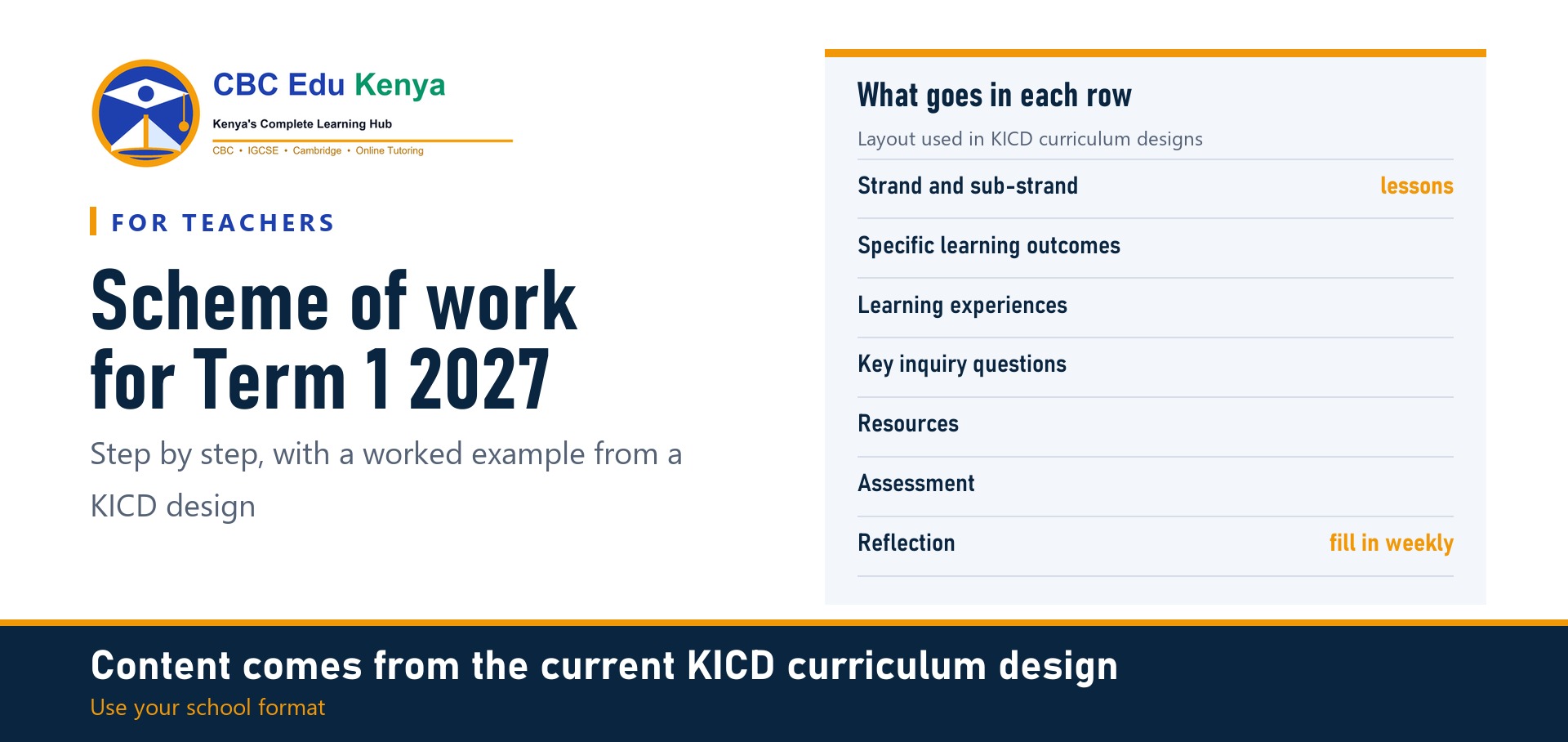
Every KICD design is organised by strand and sub-strand. For each sub-strand the design gives a table with these columns and notes:
| Part of the design | What it gives you | Where it goes in your scheme |
|---|---|---|
| Strand and sub-strand | The headings, with a suggested number of lessons for the sub-strand | Week-by-week plan; lesson allocation |
| Specific learning outcomes | What the learner should be able to do "by the end of the sub-strand" | Outcomes column |
| Suggested learning experiences | Activities such as role play, group work, observation | Learning experiences column |
| Key inquiry questions | Questions that drive the lessons | Key inquiry question column |
| Core competencies, links to PCIs and values | Which competency and values the activity develops | Competencies and values column (short) |
| Links to other learning areas, community service learning, non-formal activity | Ideas to connect and extend | Optional notes |
| Suggested resources | Charts, objects, recordings, resource persons | Resources column |
| Suggested assessment and rubric | Oral questions, observation, rubric descriptors for four levels | Assessment column |
Step 3: Copy the sub-strands in order and share the lessons
List the sub-strands for the term in the order of the design (or the order your school has agreed). Beside each, write the suggested number of lessons from the design. Add them up. If the total is more than your lessons, talk to your head of department before cutting, because the design allows depth to be adjusted but expects the strand to be covered. If it is less, use the spare lessons for revision, projects and the end-of-term assessment.
Step 4: Worked example from a real KICD design
The example below comes from KICD's lower primary design for English, Grade 1, the Listening strand (Volume 1, September 2017). It is shown only to demonstrate how the design becomes a scheme. Take your own content from the current design for your grade.
| Wk | Strand | Sub-strand (lessons) | Specific learning outcomes (short) | Learning experiences | Key inquiry questions | Resources | Assessment | Reflection |
|---|---|---|---|---|---|---|---|---|
| 1 | Listening | 1.1 Listen to instructions and questions (2 lessons) | Listen attentively to simple instructions and questions; respond appropriately; use courtesy words | Learners listen to simple instructions, give and respond to instructions in pairs and groups, role-play | Who gives us instructions? Who asks us questions? | Charts with instruction words, audio or video recordings | Oral questions; observe eye contact and responses | (fill in after teaching) |
| 1 to 2 | Listening | 1.2 Phonological awareness (3 lessons) | Pronounce and blend syllables; segment syllables; discriminate initial, middle and final sounds | Learners join rhymes, songs, tongue twisters and riddles; segment and blend sounds using objects and colours | What are some of the sounds we hear? What produces them? How do we say them? | Sound recordings, riddles and tongue twisters, resource persons | Oral questions; rubric on recognising, pronouncing, blending and segmenting | (fill in after teaching) |
In the same design, sub-strand 1.1 names communication and collaboration as the competency, links to the values of respect and responsibility, and suggests oral questions as assessment. Sub-strand 1.2 names communication and collaboration, learning to learn, and critical thinking and problem solving. The rubric has four levels: exceeding, meeting, approaching and below expectations. Copy those wording choices into the scheme instead of inventing new ones.
Notice what the scheme does not do: it does not rewrite the outcomes. Short forms are fine, but the meaning must match the design.
Step 5: Add the practical columns that make it usable
- Dates. Add them after the school confirms term dates.
- Resources you really have. Write what is in your classroom or can be made from waste material. A scheme listing a projector that your school does not own is a draft, not a plan.
- Assessment method. Write the tool, not only "assessment": oral questions, observation checklist, rubric, short written task, project. Our guide to setting a CBC exam that measures strands helps for written tasks.
- Reflection. Leave the column open and fill it each week: what worked, who needs more help, what moves to next week. This is also the best evidence for your own professional growth.
Step 6: Link the scheme to the records you already keep
Your scheme feeds your lesson plans, your record of work and your learner progress records. If you write the scheme properly, the other documents become copy and fill. Our guide on record keeping and assessor documents lists what a visitor may ask to see, and the guide on writing a lesson plan in the KICD format shows how to cut one lesson from a scheme. For the free Word template, see our free lesson plan template.
On appraisal: the Teachers Service Commission runs teacher appraisal on its TPAD platform at tpad2.tsc.go.ke, and keeps appraisal material in the performance management section of its downloads. We cannot see which documents your appraiser will ask for in 2027, so read the current TSC circulars and your school's instructions, and keep the scheme, lesson plans and record of work together. Our guide to TPAD 3 changes covers the platform.
Step 7: Run the checklist before you submit
| Check | Yes / no |
|---|---|
| Content taken from the current design for my grade and learning area | [ ] |
| Every sub-strand for the term is listed, in order | [ ] |
| Lessons add up to the weeks and timetable I really have | [ ] |
| Specific learning outcomes copied faithfully (short form, same meaning) | [ ] |
| Each row has a learning experience, a key inquiry question and a resource I can get | [ ] |
| Each row names an assessment tool | [ ] |
| Competencies and values are noted only where an activity builds them | [ ] |
| Reflection column left open | [ ] |
| No dates fixed before the school confirms them | [ ] |
| Saved as Word or Excel with a copy kept off the phone | [ ] |
Blank layout you can copy
| Week / dates | Strand | Sub-strand and lessons | Specific learning outcomes | Learning experiences | Key inquiry question(s) | Resources | Assessment | Reflection |
|---|---|---|---|---|---|---|---|---|
Common mistakes
- Copying last year's scheme without checking the design. Sub-strands and outcomes may have changed.
- Listing old textbook chapters instead of sub-strands. CBC uses strands and sub-strands; see what strands and sub-strands mean.
- Over-filling the term. Plan the lessons you have, with one revision week and one assessment week.
- Writing competencies as decoration. Name a competency only where an activity builds it; see the seven core competencies.
- Waiting for term to start. Draft one learning area in the holiday and the rest becomes easier.
If you also want ideas for how to rest and plan your holiday without burning out, read how teachers can plan Term 1 2027 over the holiday.
Where CBC Edu Kenya fits, stated once
Everything above is free to use. If you also want ready-made practice for Grade 7, our Grade 7 page lists the packs, and the Grade 7 whole-grade bundle holds the subjects together. Normal prices are KSh 100 per subject and KSh 300 for the whole-grade bundle; check the product page for any offer that is running. Our free samples are at free sample. For live classes (Grades 4 to 10), the CBC Holiday Academy has already started and a learner can join in any week; the class group and timetable are confirmed on WhatsApp before you pay. Teachers who want practice material for learners can use the free pages and samples; the packs are for learners and parents, not a substitute for your scheme.
Official sources used
- KICD: curriculum designs: where to download the current design for each level
- KICD: lower primary curriculum designs, Volume 1 (September 2017, PDF): the Grade 1 English example and the layout of a design
- KICD: Basic Education Curriculum Framework (2019 edition, PDF): rules for designing, implementing and assessing the curriculum
- TSC: Teachers Service Commission: TPAD appraisal link and downloads on performance management
- TSC: TPAD platform: teacher performance appraisal and development
- Ministry of Education: circulars and guidelines: where the 2027 school calendar circular will appear once posted
Questions people ask
Is there an official scheme of work template in Kenya?
We found no single compulsory scheme-of-work template on the KICD or TSC pages we checked; KICD publishes curriculum designs. Use the format your school or sub-county office gives you, and build the content from the current KICD design for your grade and learning area.
Where do I get the content for a CBC scheme of work?
From the KICD curriculum design for your grade and learning area on the KICD website, which lists strands, sub-strands, specific learning outcomes, suggested learning experiences, key inquiry questions, resources and assessment.
How many weeks should a Term 1 2027 scheme cover?
Count your real teaching weeks from the school calendar, after removing opening, mid-term and assessment weeks. The Ministry of Education 2027 calendar did not appear on its circulars and guidelines page when we checked on 27 November 2026, so confirm the dates with your school.
What is the difference between a scheme of work and a lesson plan?
A scheme of work maps the whole term, week by week. A lesson plan details one lesson taken from that map.
Do I need to list core competencies and values in the scheme?
Only where an activity really builds them. The KICD designs name a competency and link to values for each sub-strand, so you can copy those short phrases.
Can I use last year's scheme?
Only after checking it against the current design. Designs have been rationalised in recent years, so some sub-strands and outcomes may have moved or merged.
The worked example is taken from KICD's 2017 lower primary design and is shown only to demonstrate layout; always use the current design for your grade. CBC Edu Kenya is not part of the Ministry of Education, KICD, KNEC or TSC. Where this page says "our suggestion", it is our own advice and not an official rule.
Keep your child learning this holiday
Live online classes: 4 lessons a week, 2 hours each, KSh 2,500 a week. December holiday revision materials: Whole Grade Bundle KSh 250 (PP1 to Grade 9), or KSh 100 for one subject.
KSh 2,500 a week · Get it now → 📱 Pay by M-Pesa · printable packs are sent to your email after paymentHave a CBC question this article didn't answer?
Ask Somo, Kenya's first AI tutor. CBC-grounded, Kenyan examples, instant feedback. Five free questions a day with no signup, or start a 7-day free trial for 30 questions a day.
Try Somo Free →