Key takeaways
- Opero is a school management system built in Kenya for Kenyan schools, launched in September 2026 by the team behind CBC Edu Kenya. The price is KSh 20,000 once for setup, then KSh 1 per child per day for each module a school runs. Nothing else recurs.
- Four modules: Core (enrolment, attendance, assessments and report cards, admissions, three consoles) is always included. Transport, HR and Payroll and Finance are each optional at a further KSh 1 per child per day.
- On a 30-day month, a 180-child primary on Core only pays KSh 5,400; a 500-child school on all four modules pays KSh 60,000; a 1,200-learner school on Core plus Finance pays KSh 72,000. The arithmetic is shown below.
- Every module includes Kenya-hosted data, isolation between schools, and nightly backups with a tested restore, at no extra charge.
- Not yet: no M-PESA checkout, no SMS gateway, no self-service sign-up, and the school supplies its own tax rates. If any of those is a deal-breaker today, wait.
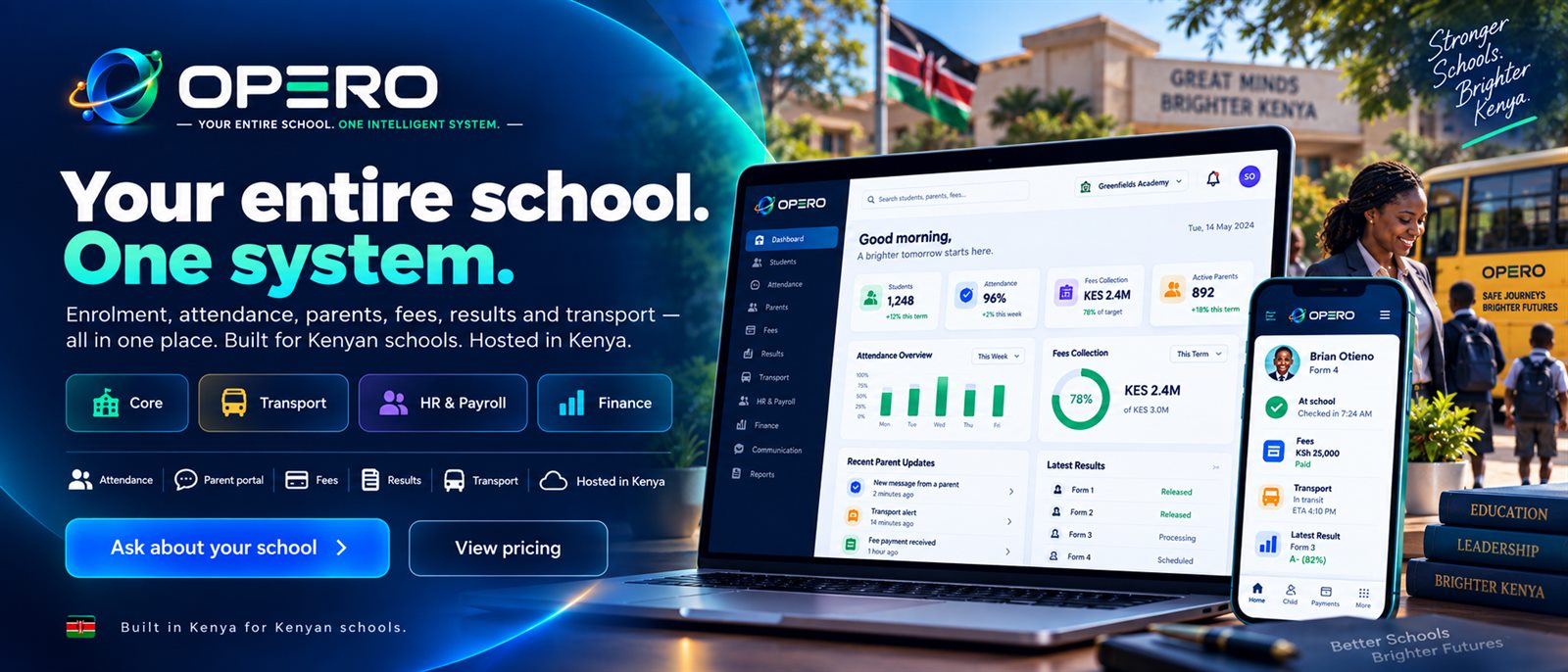
A school management system in Kenya has usually meant one of two things: an imported product priced in dollars and hosted on a server nobody at the school could point to on a map, or the bursar's spreadsheets. In September 2026 a third option launched. Opero, whose tagline is "Your entire school. One system.", puts enrolment, attendance, parents, fees, results and the bus in one place, for KSh 1 per child per day, with the children's records hosted inside Kenya. Information current as of September 2026.
One disclosure before anything else: Opero is built by the team behind CBC Edu Kenya, the people who run this site. That is why we can describe it in detail, and why you should read the "not yet" section as carefully as the pricing. This guide tells the launch straight: the four modules, the arithmetic for three sizes of school, what is included at no extra charge, what the system does not do yet, why Kenya hosting matters under the Data Protection Act, and what happens after you fill in the enquiry form. Whether or not you enquire, you should finish knowing what to ask of any system a vendor offers you.
What Opero is, and who built it
Opero describes itself, in its own footer, as "school management, built in Kenya for Kenyan schools". It is meant for Kenyan schools of any size that want to run the office, the classroom, the parents, the money and the bus from one system, with the children's records kept inside the country. There is no separate product for large schools and small ones. The same four modules are offered to every school, and the school takes the ones it wants.
The team behind it is the team behind CBC Edu Kenya: the same people who produce the lesson plans, schemes of work, revision packs and rubrics sold on this site, run Somo, the CBC AI tutor, and deliver the AI training programme for Kenyan schools announced on this site. We say this plainly so that you can weigh what follows accordingly. Where the product has a gap, this article names it, and where the website makes a claim, we quote it rather than improve on it.
The four modules of a school management system in Kenya, and what each costs
Opero is sold as four modules. Core is always included and is the price floor: KSh 1 per child per day. The other three are optional and each adds a further KSh 1 per child per day. The table below is drawn from the module descriptions on opero.co.ke.
| Module | What it covers | Price |
|---|---|---|
| Core (always included) | Enrolment "and everything that follows from it"; three consoles (office, teacher, parent), each showing one person only what belongs to them; attendance; assessments, marks and report cards; admissions with a public application page | KSh 1 per child per day |
| Transport (optional) | Routes, stops, vehicles and trips; boarding and drop-off recorded; a child who boarded and was never signed off is flagged; guardian notifications and confirmation | + KSh 1 per child per day |
| HR and Payroll (optional) | Worker records; leave types, requests, approvals and balances; salaries kept as a history; monthly payroll runs; the school supplies its own tax rates (PAYE, NSSF, SHIF and housing levy are configurable, not pre-loaded) | + KSh 1 per child per day |
| Finance (optional) | Fee structures, invoices, receipts, statements, payments, allocations and adjustments; projects; budgets; financial reporting | + KSh 1 per child per day |
Core: enrolment and everything that follows from it
Core starts with enrolment, and the site's phrase for the rest is "everything that follows from it". Once a child is enrolled, attendance, assessment, marks and report cards hang off that one record. There are three consoles, for the office, the teacher and the parent, "each showing one person only what belongs to them": a class teacher sees her class, a parent sees his own children, the office sees the school. Admissions come with a public application page, so a prospective parent can apply without first visiting the office.
If your school still assembles report cards from a mark book and a photocopier, our guide to reading a CBC report card shows what parents actually look for on the page, which is worth settling before you configure any system's report template. For Grades 7 to 9, the marks a system holds should be the same marks that go onto the KNEC CBA portal. Opero's site makes no claim of a link to that portal, so plan to upload scores as you do now, with the system as the one traceable place they came from.
Transport: "the bus, accounted for"
Transport covers routes, stops, vehicles and trips. Boarding and drop-off are recorded, and the site puts the safety case in one sentence: "A child who boarded and was never signed off is flagged, not forgotten." Guardians receive notifications and give confirmation. Note what the site does not say: there is no mention of GPS hardware or live vehicle tracking, and we are not claiming either here. What the module records is who got on, who got off, and whether a guardian confirmed. For a day school that runs buses, that record is the difference between a manifest on a clipboard and an audit trail; our honest guide to boarding versus day school covers the daily transport question that parents weigh when they choose.
HR and Payroll: workers, leave and salary history
HR and Payroll keeps worker records, handles leave types, requests, approvals and balances, keeps salaries as a history rather than a single overwritten figure, and runs monthly payroll. The important honesty here is on tax. PAYE, NSSF, SHIF and the housing levy are configurable, not pre-loaded: the school supplies its own rates and is responsible for keeping them current when the Kenya Revenue Authority or the other statutory bodies change them. That is a real limitation and a real responsibility; treat it as both.
Finance: fee structures through to financial reporting
Finance covers fee structures, invoices, receipts, statements, payments, allocations and adjustments, then projects, budgets and financial reporting. In practice that means a fee structure per level and term, an invoice per child, a receipt for every payment recorded, a statement any parent can read, and adjustments for bursaries and corrections that leave a trail. What it does not include yet is collection: there is no M-PESA checkout, so money still arrives through the bank account, paybill or till the school already uses, and is then recorded. To see how the parent side of fees looks this term, our Term 3 2026 school fees guide for parents is the companion piece.
What a school management system in Kenya costs on Opero: three worked examples
The pricing model has two parts. First, KSh 20,000 once, to set the school up, "the same whatever its size". Second, KSh 1 per child per day for each module the school runs. In the site's words, "Nothing else recurs." So the monthly figure for any school is:
children × modules × days in the month = monthly cost in KSh
Opero's own example is a school of 500 children on all four modules, which it prices at about KSh 60,000 a month (500 × 4 × 30) and describes as "about one term's fees for one child, for the whole school, for a month". Here is that example alongside two others, all on the same 30-day month the site uses. The first-year column adds the one-off setup fee to twelve such months.
| School | Modules | Monthly arithmetic | Per month | Per learner per month | First year (12 months + setup) |
|---|---|---|---|---|---|
| 180-child primary | Core only (1) | 180 × 1 × 30 | KSh 5,400 | KSh 30 | 5,400 × 12 + 20,000 = KSh 84,800 |
| 500-child school | All four (4) | 500 × 4 × 30 | KSh 60,000 | KSh 120 | 60,000 × 12 + 20,000 = KSh 740,000 |
| 1,200-learner school | Core + Finance (2) | 1,200 × 2 × 30 | KSh 72,000 | KSh 60 | 72,000 × 12 + 20,000 = KSh 884,000 |
Two things stand out. The per-learner figure depends only on how many modules you run, never on how big the school is: KSh 30 a month per child for Core alone, KSh 60 for two modules, KSh 120 for all four. And the setup fee flattens out fast. For the 180-child primary, KSh 20,000 is just under four months of subscription (20,000 ÷ 5,400 = 3.7); for the 1,200-learner school it is about eight days' worth (20,000 ÷ 72,000 = 0.28 of a month). Small schools feel the setup fee; large schools barely notice it.
Now the questions the site does not answer, which you should put in the notes field when you enquire. Any per-child model has to settle all four:
- Is a 31-day month billed as 31 days? The site's example uses 30; we have used 30 throughout. Over a year the difference is five days, or about 1.4 per cent.
- Are children billed during the school holidays? "Per day" could mean every calendar day or only school days. The answer changes the annual figure materially.
- What counts as a child? Every learner on the register, or only those attending? What happens when a learner leaves in week three of a month?
- What do you receive if you leave? The site describes tested restores of its own backups. Ask separately what export the school gets on exit.
To place these figures in the wider budget, our breakdown of what it costs to run a CBC school in Kenya walks through the recurring lines a school carries, and a management system is one of the smaller ones once it is compared with salaries, transport and utilities.
What is included in every module at no extra charge
Three things come with every module, whether a school takes Core alone or all four, and none of them appears on the bill.
- Data isolation between schools. In the site's words, "One school can never see another school's children." That sounds obvious until you have used a shared system where a mistyped admission number pulls up a learner from a school in another county.
- Kenya-hosted data. "Your children's records never leave the country." The next section explains why that is a legal point and not only a patriotic one.
- Nightly backups, "and the restore is tested". A backup that has never been restored is a hope, not a backup. The difference between the two is discovered on the worst possible day, which is why the phrase "restore is tested" is doing more work in that sentence than "backed up nightly".
What Opero does not do yet
The site is unusually direct about its gaps, and this article would be dishonest without repeating them. Four things are not there at launch. None of them is hidden, and each one has a workaround a school can live with, or cannot, depending on its situation.
| Not yet | What that means for a school today | In the meantime |
|---|---|---|
| No M-PESA checkout | Opero does not take payments. Finance records a payment, issues the receipt and updates the statement, but the money itself arrives elsewhere. | Keep collecting through your existing bank account, paybill or till, and record each payment against the child's invoice. |
| No SMS gateway | The system does not send text messages. Transport lists guardian notifications and confirmation, so expect those to reach parents through the system rather than by SMS; confirm the channel when you enquire. | Keep your WhatsApp broadcast list or bulk-SMS routine for parents who are not on the parent console. |
| No self-service sign-up | You cannot create an account and try it alone. Opero sets the school up after you enquire. | Fill in the "Ask about your school" form; use the notes field for your questions and your preferred go-live date. |
| School supplies its own tax rates | PAYE, NSSF, SHIF and the housing levy are configurable, not pre-loaded. Opero does not maintain the rates for you. | Take the current figures from the KRA and the other statutory bodies, enter them, and diarise a check whenever a Finance Act or a gazette notice changes them. |
Read that table against your own school before reading anything else. A school whose parents pay almost entirely by M-PESA and whose bursar wants the receipt to appear without human hands is not the right early customer, and it is better to know that in five minutes than after a setup fee. A school whose pain is the register, the report cards, the bus list and the reconciliation can work around all four gaps today.
Kenya hosting and the Data Protection Act, 2019
Every school holds personal data about children: names, dates of birth, guardians' phone numbers, health notes, marks, home areas, bus stops. Under the Data Protection Act, 2019, the school is the data controller for that information, which means the school, not the software vendor, is the party answerable for how it is handled. The Act sets conditions on transferring personal data outside Kenya, and it gives the personal data of children particular protection. The Office of the Data Protection Commissioner is the regulator; its website carries the Act, the regulations made under it, and the registration route for data controllers and processors.
This is where hosting location stops being a technical footnote. If the system your school uses stores its database on servers outside Kenya, then every enrolment you type in is a cross-border transfer of a child's personal data, and the Act's conditions on such transfers apply to you as the controller, whether or not anyone at the school has ever thought about them. If the data is hosted inside Kenya, the question does not arise. Opero's site puts it in one line: the records "never leave the country", which "removes the cross-border question under the Data Protection Act". That is included in every module at no charge, and it is, in our view, the most under-asked question when a school management system in Kenya is being chosen.
Two honest caveats. First, Kenya hosting does not by itself make a school compliant. The Act also expects a lawful purpose, consent from a parent or guardian for a child's data, access limited to those who need it, sensible retention, and notification to the Data Commissioner within 72 hours of a breach that carries a real risk of harm to the people concerned. A system with role-separated consoles helps with access; the rest is policy, and it is the school's. Second, ask the ODPC whether your school must be registered as a data controller. The registration regulations set out who must register, and we have deliberately not reproduced the thresholds here, because they should be read from the source on the day you check.
- Data controller: the organisation that decides why and how personal data is processed; for a school's learner records, that is the school.
- Data residency: the country in which data is physically stored; "Kenya-hosted" means the servers are in Kenya.
- Module: a set of related functions a school can switch on or leave off; Opero has four.
- Tested restore: a backup that has been loaded back and checked, rather than copied somewhere and assumed to work.
What onboarding looks like
There is no self-service sign-up. You cannot create an account tonight and explore alone; Opero sets the school up. The route in is the "Ask about your school" form on opero.co.ke, which asks for eight things: the school's name, your name, your email, your telephone, your town or county, the number of learners, the modules you are interested in, and notes. Existing schools sign in at opero.co.ke/signin. The site does not publish a setup timeline, so ask for one in the notes field, together with the four billing questions above.
What you can do before anyone replies is put your own house in order, because the quality of any system is capped by the quality of the register you load into it. Whichever system a school chooses, setup depends on the same inputs:
- A clean learner register. One row per child: admission number, full name as it should appear on a report card, class, date of birth, and at least one guardian with a working phone number and, ideally, an email address for the parent console.
- A staff list with roles. The office console, the teacher console and the parent console can only show each person what belongs to them if the school has said who is who.
- Your fee structure by level and by term, agreed and signed off, if you are taking Finance. Loading invoices from a structure that is still being argued over is the surest way to spend a term issuing corrections.
- Routes, stops and vehicles, if you are taking Transport, plus which children board where.
- Current statutory rates and your own allowances and deductions, if you are taking HR and Payroll, because the school supplies them.
- A date. The cleanest switch is at a term boundary. The 2026 school calendar gives the dates. With Term 3 already under way and the KJSEA and KPSEA windows falling in late October, a school with candidate classes may sensibly enquire now, clean its register through October, and go live for January 2027.
One thing a system does not replace: the teacher's own assessor documents. Schemes of work, lesson plans, records of work and the mark book remain the teacher's evidence, and our guide to Term 3 record keeping explains why those documents must agree with each other. A management system gives you one traceable source for marks and attendance. It does not write the reflection on a lesson plan.
Who should enquire now, and who should wait
Enquire now if:
- You want the children's records hosted in Kenya and have never had a straight answer from a vendor about where the data sits.
- Your school runs a bus and the current record of who got off where is a clipboard, a driver's memory, or nothing.
- Your bursar produces receipts and statements by hand, and finding out what a given family owes takes an afternoon.
- You want parents to see attendance and results themselves rather than phoning the office.
- You want a per-child price that scales down as well as up, and can absorb a KSh 20,000 setup fee.
Wait, or look elsewhere for now, if:
- You need fees collected inside the system today, with a parent paying by M-PESA and the receipt appearing by itself. Opero records payments; it does not yet take them.
- You need the system to send SMS to parents. There is no SMS gateway yet.
- You want to sign up alone, load a spreadsheet and test it tonight. Setup is done by Opero, not by you.
- You expect payroll software to know this year's PAYE bands, NSSF tiers, SHIF rate and housing levy without being told. On Opero, the school supplies its own rates.
- You are a teacher looking for classroom materials rather than a school system. That is a different shelf: our editable CBC lesson plan packs and schemes of work are what you want.
A worked example: Tumaini Ridge Academy (hypothetical)
Tumaini Ridge Academy is a hypothetical school invented for this section. It is not an Opero client and it does not exist. Picture a private day school in Machakos County with 420 learners from PP1 to Grade 9, two buses, a bursar, a deputy head who doubles as admissions officer, and 31 staff. The director's frustrations, in order: a driver's list that was two weeks out of date when a new guardian collected a child at a stop; a receipt book and a bank statement that disagreed by KSh 38,000 at the end of Term 2, with nobody able to say why; and report cards that took the last two days of every term to assemble.
The director takes Core, Transport and Finance and leaves HR and Payroll on the existing spreadsheet until January, because nobody wants to enter tax tables in the middle of Term 3. The arithmetic: 420 × 3 × 30 = KSh 37,800 a month, or KSh 90 per learner per month. Year one, on the same 30-day basis, is 37,800 × 12 + 20,000 = KSh 473,600. Whether that is worth it against the school's fee income is a decision for its board, not for us, and the honest comparison is not with zero but with the bursar's afternoons, the two reconciliation days each term, and the bus-stop incident that must not happen again.
Fees still arrive through the school's bank account and paybill, exactly as they do now. What changes is that each payment is recorded against an invoice, a receipt and a statement exist for every family, and the office no longer reconstructs balances by hand. The bus manifest becomes a boarding and drop-off record with guardian confirmation. And the two-day report card scramble becomes a print run, provided teachers enter marks as they go, which is a habit and not a feature.
Common mistakes when a school adopts any management system
These apply to any school management system in Kenya, not only to Opero, and most of them are about the school rather than the software.
- Loading a dirty register. Duplicate learners, three spellings of one surname, guardians' numbers that stopped working in 2024. Clean the spreadsheet first; a system faithfully preserves whatever mess it is given.
- Switching mid-term. Half a term's marks in the old mark book and half in the new system is the worst of both. Go live at a term boundary.
- Running two systems in parallel with no end date. A short overlap is prudent. An open-ended one means neither is trusted and both are half-filled.
- Nobody owns the data. Name one person who owns the register, one who owns fees, and one who can answer a parent's question about their own child's data. "The system" is not a person.
- Configuring report cards before agreeing the assessment policy. Decide first how strands, sub-strands, competency levels and any school marks are shown to parents, then configure. The template is the easy part.
- Loading invoices from an unsigned fee structure. Every later change becomes an adjustment, and adjustments are where disputes start.
- Not asking where the data lives and how you get it out. Ask about hosting location, backups, whether the restore has been tested, and what you receive if you leave. Opero answers the first three on its website; put the fourth in the form.
- Forgetting the parents. A parent console nobody has been shown how to use is a feature the school is paying for and not getting. Plan a parents' session in the first month.
- Treating statutory deductions as the software's problem. Whoever supplies the rates, the employer is liable for getting them right. Diarise the checks.
Frequently asked questions
How much does Opero cost for a school of 300 learners?
KSh 20,000 once for setup, then children × modules × days. On Core only, 300 × 1 × 30 = KSh 9,000 a month. On all four modules, 300 × 4 × 30 = KSh 36,000 a month. According to the site, nothing else recurs. Confirm with Opero how holidays and 31-day months are billed.
Is Opero's data stored in Kenya?
Yes. Kenya hosting is included in every module at no extra charge; the site says "your children's records never leave the country". Data is isolated between schools, and nightly backups are taken with the restore tested.
Can parents pay school fees through Opero by M-PESA?
Not yet. There is no M-PESA checkout. The Finance module records payments, issues receipts and produces statements, but the money itself arrives through whatever bank account, paybill or till the school already uses. If in-system collection is essential for you today, that is a reason to wait.
Does Opero send SMS to parents?
No. There is no SMS gateway. The Transport module lists guardian notifications and confirmation, and the parent console shows a family only what belongs to it, so expect communication to reach parents through the system rather than by text message. Confirm the exact channel when you enquire, and keep your WhatsApp broadcast routine for now.
Can I sign up and try Opero by myself?
No. There is no self-service sign-up. You fill in the "Ask about your school" form (school name, your name, email, telephone, town or county, number of learners, modules of interest, notes) and Opero sets the school up. Existing schools sign in at opero.co.ke/signin.
Does the payroll module calculate PAYE, NSSF, SHIF and the housing levy automatically?
It applies the rates the school enters. PAYE, NSSF, SHIF and the housing levy are configurable, not pre-loaded, so the school supplies its own rates from the KRA and the other statutory bodies and updates them when they change. Salaries are kept as a history and payroll runs monthly.
Further reading
- What it costs to run a CBC school in Kenya: the recurring lines a school budget carries, which is the context any software price belongs in.
- Term 3 2026 school fees: a parents' guide: the parent's view of invoices, statements and arrears.
- Term 3 record keeping: the assessor documents teachers need: what a system holds for you and what stays in the teacher's file.
- 2026 Kenya school calendar and term dates: for choosing a term boundary to go live.
Where to go next
Opero's launch offer is easy to state and, unusually, easy to check: KSh 20,000 once, KSh 1 per child per day per module, Kenya hosting and tested backups included, and a short honest list of things it does not do yet. For a 180-child primary that is KSh 5,400 a month on Core; for a 500-child school on everything, KSh 60,000; for a 1,200-learner school on Core and Finance, KSh 72,000. Whether it is the right school management system for your school depends on whether the "not yet" list touches something you need today, and on whether your register is ready to be loaded.
If it is, ask about your school on opero.co.ke: the form takes a few minutes, and the notes field is the place for the billing questions in this article. If you are still working out the budget, start with our breakdown of what it costs to run a CBC school in Kenya. And for the classroom side of the same school, from PP1 to Grade 9, Somo, the CBC AI tutor, answers in the curriculum's own terms at cbcedukenya.com.
KJSEA and KPSEA: 1 days to the first paper
The Grade 9 KJSEA course covers all 9 learning areas for KSH 400. The Grade 6 KPSEA course covers all 5 subjects for KSH 300. Notes, worked examples, topical questions and full marking schemes in both.
⏳ Only 1 days to the national assessments on 26 October. Start now.
KSH 300 or KSH 400 · Get it now → 📱 M-Pesa, sent to your email after payment · join parents preparing nowHave a CBC question this article didn't answer?
Ask Somo, Kenya's first AI tutor. CBC-grounded, Kenyan examples, instant feedback. Five free questions a day with no signup, or start a 7-day free trial for 30 questions a day.
Try Somo Free →