
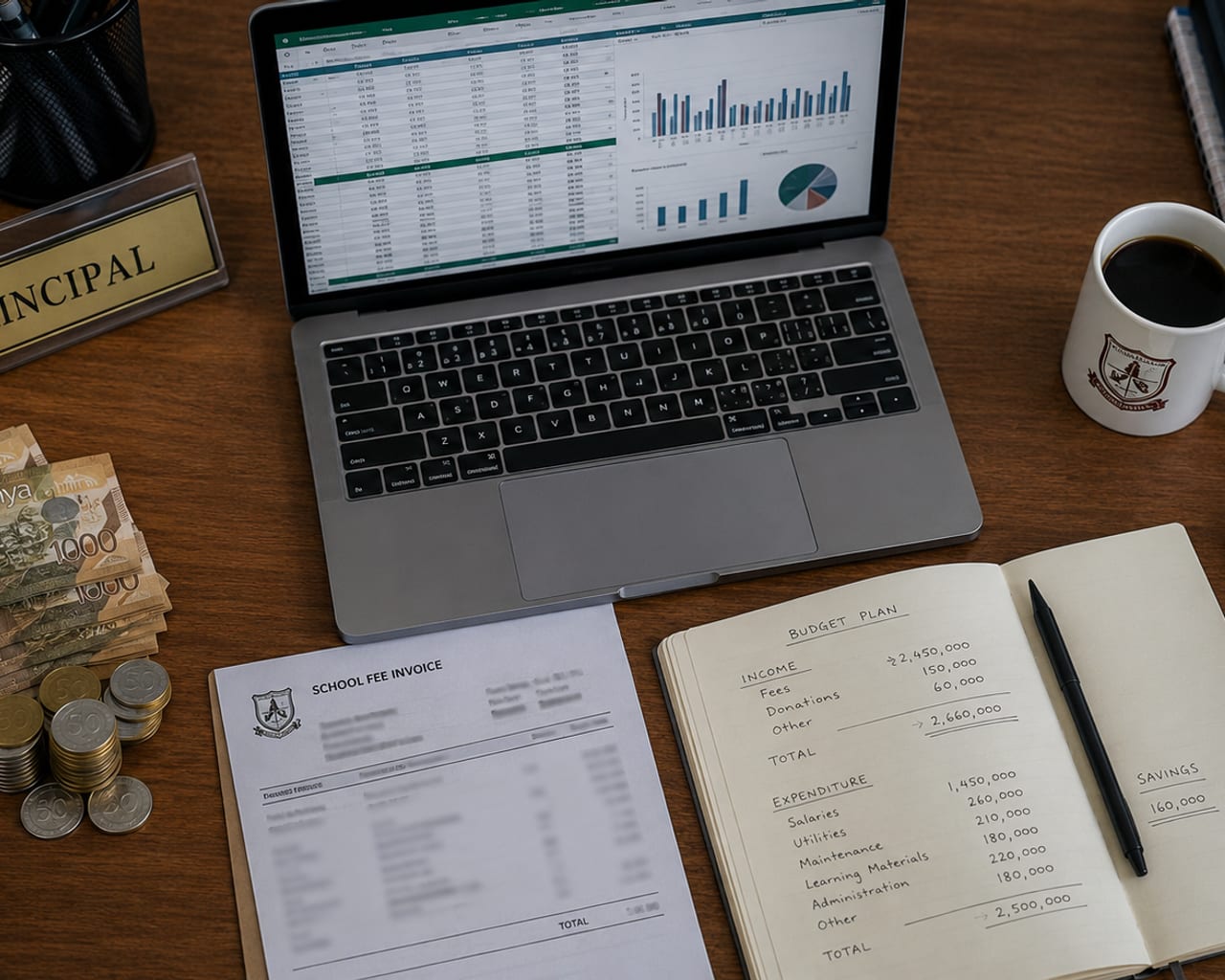
You are a head teacher, principal or board member of a Kenyan school. The annual budget conversation is coming. Most "cost to run a school" guides online are written by consultants who have never had to find the salary money in March. This guide is for people who have. Here is the honest, line-by-line breakdown of what it really costs to run a CBC school in Kenya in 2026, and where the biggest hidden costs hide.
The five cost layers
Any Kenyan school's annual budget breaks into five layers. The relative weight changes with size: a 100-learner school is mostly salaries; a 1,000-learner school spreads costs more evenly. But the layers are the same.
- Staff salaries: typically 55–70% of total budget
- Materials and consumables: 10–15%
- Facilities and utilities: 8–15%
- KICD compliance, KNEC exam fees, statutory obligations: 5–10%
- Technology, software and digital tools: 2–5% (rising)
Layer 1: Staff salaries
For a CBC school with about 250 learners, you typically need:
- 1 head teacher / principal: KSH 60,000–150,000/month depending on tier (private day school: lower end; established mid-tier: higher)
- 10–14 teachers: KSH 25,000–65,000/month each, average around KSH 35,000
- 2–3 administration staff (bursar, secretary, IT): KSH 20,000–40,000/month each
- 4–6 support staff (cooks, cleaners, watchmen, gardener): KSH 12,000–22,000/month each
For a 250-learner private school, annual salary bill is typically KSH 6 million to 10 million. NSSF, NHIF and PAYE add another 8–12% on top.
Layer 2: Materials and consumables
Per learner per year, expect:
- Textbooks and KICD-aligned learner materials: KSH 3,000–8,000 (CBC subjects, replaced every few years)
- Stationery (notebooks, pens, chalk/markers, printer toner): KSH 1,500–3,000
- Lab and practical materials (Sciences, Home Science, Pre-Tech): KSH 1,000–2,500
- Sports equipment depreciation and consumables: KSH 500–1,500
For a 250-learner school: KSH 1.5 million to 3.5 million per year on materials. Schools that print revision papers in-house save here vs schools that buy commercial revision packs: but the photocopier toner and paper bill is rarely counted accurately.
Layer 3: Facilities and utilities
- Electricity (KPLC): KSH 25,000–80,000/month depending on size and computer lab presence
- Water: KSH 15,000–40,000/month, higher if you have boarding
- Internet (Safaricom Business / Zuku / Liquid): KSH 10,000–35,000/month
- Cleaning supplies, security, vehicle fuel, maintenance: KSH 30,000–100,000/month
- Rent (if leasing) or mortgage / building depreciation: varies wildly
Typical mid-size school: KSH 1.5 million to 4 million per year in facilities and utilities.
Layer 4: KICD compliance, exam fees, statutory obligations
KICD requires schools to use approved curriculum designs (free download from kicd.ac.ke). KNEC charges examination registration and assessment fees:
- KPSEA registration: KSH 350 per Grade 6 learner
- KJSEA registration: KSH 750 per Grade 9 learner (2026 introductory rate; may rise)
- KCSE registration: KSH 7,200 per Form 4 candidate (2026)
- TSC compliance (if you employ TSC-registered teachers): document fees and registration costs
- County education office annual return and inspection fees: varies, KSH 30,000–120,000
- NEMA, NCK (National Construction Authority) and other compliance: KSH 50,000+ for medium schools annually
Layer 5: Technology and digital tools: the layer that's growing fastest
This is the layer that has changed most since 2020. Five years ago, schools spent a tiny percentage of budget on software. In 2026:
- School management system (fee tracking, report cards, parent communication): KSH 80,000–500,000/year depending on vendor
- Email and Google Workspace / Microsoft 365 for staff: KSH 1,200–2,500 per staff member per year
- Digital learning content licences: highly variable, often KSH 100,000–500,000/year for a per-learner subscription model
- Internet and devices for teachers (laptops, projectors): annual depreciation KSH 100,000–400,000
- AI tools (lesson planning, marking, tutoring): this is the new line item; from individual ChatGPT Plus subscriptions for teachers (KSH 3,000/month each) to school-wide AI subscriptions (KSH 30,000–300,000/year)
Where the biggest hidden costs hide
Three categories show up much larger than principals expect:
1. Printing and photocopying. Run a 250-learner school for a year and you probably spend KSH 250,000–600,000 on toner, paper and machine maintenance. Most schools never track this against the cost of buying ready-printed revision materials.
2. Teacher CPD and training. One CBC retraining workshop per teacher per year (KSH 8,000–20,000 each) adds up fast across a 14-person staff. Skipping it means TPAD scores drop and TSC compliance suffers.
3. Parent communication. SMS gateways (Africa's Talking), bulk WhatsApp tools, newsletter design: schools spend KSH 100,000–300,000/year here without realising it.
The whole budget: illustrative for a 250-learner private CBC school
Putting it together, a typical mid-tier 250-learner private CBC day school in Kenya in 2026 has an annual operating budget in the range of KSH 12 million to 22 million. That works out to KSH 48,000–88,000 per learner per year: which (interestingly) is close to what the school will charge in fees, minus surplus and contingency.
For schools in the same band, the digital tools layer (Layer 5) is the most predictable place to find savings. Bundling content + AI + report-card tools in one licence typically beats buying them piecemeal.
How CBCEduKenya for Schools fits
We built CBCEduKenya for Schools to consolidate the digital layer for Kenyan schools. One annual licence covers every CBC + IGCSE PDF for every learner, Somo AI tutor, Lesson Plan AI for teachers, CBA Rubric Builder, and Smart Flashcards. Pricing scales with enrolment: KSH 30,000/year (up to 200 learners), KSH 75,000/year (201–600), from KSH 150,000/year (600+).
The comparison most principals run: KSH 75,000/year for 500 learners works out to KSH 150 per learner per year. Buy three revision packs per learner per year individually and you have already paid more: without getting the AI tools, report card builder or unlimited downloads.
Book a 15-minute call about a school licence.
→ See CBCEduKenya for Schools: tiered KSH 30,000/yr to KSH 150,000+/yr.
14-day free pilot before any payment. WhatsApp +254 711 344 702 to schedule.
Sources: Kenya National Bureau of Statistics private school cost surveys 2024-2025; KNEC published exam registration fees 2026; KENPRO and KEPSHA private school operating reports; conversations with Kenyan school principals. Costs are illustrative ranges; exact figures vary by location, size and ownership model. Last updated: June 2026.
August Complete Bundle: Every Grade
All subjects plus the Holiday Revision Pack in one download, PP1 to Grade 12. Built for the August holiday, the longest revision window before October.
⏳ Only 84 days to the national assessments on 26 October. Start now.
from KSH 300 · Get it now → 📱 M-Pesa, instant download · join parents preparing nowHave a CBC question this article didn't answer?
Ask Somo, Kenya's first AI tutor. CBC-grounded, Kenyan examples, instant feedback. Five free questions a day with no signup, or start a 7-day free trial for 30 questions a day.
Try Somo Free →