
Pre-Primary CBC In Kenya: What PP1 And PP2 Learners Should Actually Be Doing
Information current as of Term 2, 2026.
Your 4-year-old is in PP1, or about to be. They come home singing songs in Kiswahili, telling you about colours and shapes, and showing you a wobbly drawing of a tree. There are no formal exams. There are no marks out of 100. You wonder: are they actually learning anything? Yes, they are: and Kenyan Pre-Primary under the Competency Based Curriculum (CBC, now formally referred to as Competency Based Education, CBE) is designed exactly this way, on purpose, for reasons backed by both KICD policy and international early-years research. This guide explains what is actually happening in your child's classroom, why it works, how PP1 differs from PP2, how progress is genuinely tracked without a single exam paper, and exactly what you can do at home to support it: without turning your living room into a second classroom.
- Pre-Primary covers two years: PP1 (around age 4) and PP2 (around age 5): and is entirely activity-based, with no formal exams or marks.
- KICD organises learning into five activity areas, building eight broad competencies rather than testing content recall.
- Progress is tracked through teacher observation checklists and a termly narrative report, not scores: this is age-appropriate assessment, not a lower standard.
- The single highest-leverage thing a parent can do at home is read aloud daily; formal worksheets and drilling are not recommended at this stage and can do more harm than good.
- PP2 deliberately raises the bar slightly on pre-literacy and pre-numeracy readiness so the transition into Grade 1's strand-based learning is gradual, not a sudden shock.
- Activity area: KICD's term for a Pre-Primary learning domain (e.g. Mathematical Activities), the equivalent of a "learning area" at higher grades.
- Competency: a demonstrable skill or disposition (e.g. confidence, basic numeracy) that the curriculum builds gradually, rather than a fact to be memorised.
- Observation checklist: the tool a Pre-Primary teacher uses to record what a child can do, replacing written exams entirely at this level.
- School readiness: the bundle of social, emotional, physical and pre-academic skills PP2 aims to build before Grade 1 begins.
- CBE: Competency Based Education, the current official name for what most parents still call "CBC"; the curriculum content and Pre-Primary structure described here are unchanged by the rename.
The Two Years of Pre-Primary in Kenya
Kenya's Pre-Primary phase covers two years, sitting immediately before Grade 1:
- PP1: typically 4-year-olds (turning 5 during the year). For most Kenyan children, this is their first formal school setting.
- PP2: typically 5-year-olds (turning 6). The bridge year before Grade 1, where pre-literacy and pre-numeracy readiness is gently raised.
Both years are activity-based, meaning learning happens through play, song, movement and exploration rather than worksheets and chalk-and-talk lessons. There is no formal end-of-term exam, no national assessment, no score out of 100 at this stage. KICD designed it this way because the developmental research is unambiguous: pushing 4 to 5-year-olds into formal academic instruction harms long-term outcomes more than it helps. Children who are drilled too early in formal literacy often show a short-term lead that disappears: or reverses: by Grade 3, once the cost of lost play-based learning and early burnout catches up with them.
PP1 vs PP2: What Actually Changes
Parents often ask what is genuinely different between the two years, since both look similar from the outside (songs, drawing, blocks). The honest answer is: the activities look alike, but the expected competency level rises gradually. The table below sets out the practical differences.
| Area | PP1 (around age 4) | PP2 (around age 5) |
|---|---|---|
| Number recognition | Counts 1–10 with support; recognises a few numerals | Counts to 20 independently; recognises and writes numerals 1–20 |
| Pencil control | Holds a crayon/pencil; scribbles with intention | Traces letters and numbers; copies simple shapes accurately |
| Language | Speaks in short phrases; large vocabulary growth | Speaks in full sentences; begins linking sounds to letters |
| Social skills | Plays alongside others; learning to share | Plays cooperatively in small groups; follows multi-step instructions |
| Attention span (sit-down task) | Around 10–15 minutes | Around 15–20 minutes |
| Typical class size guidance | 15–20 learners per teacher/assistant pair | 15–25 learners per teacher/assistant pair |
Notice that even the PP2 expectations stay well below what many parents assume "school readiness" should mean. A PP2 learner who cannot yet write full sentences independently is not behind: sentence writing is a Grade 1 expectation, not a PP2 one.
The Five Pre-Primary Activity Areas
KICD organises Pre-Primary learning into five activity areas:
- Language Activities: speaking, listening, basic reading readiness (letter shapes, sounds, simple words). Includes both English and Kiswahili, plus exposure to the learner's mother tongue where practical.
- Mathematical Activities: counting, recognising numbers 1–20, simple shapes, position words (above, below, next to), patterns. No formal arithmetic operations at PP1.
- Environmental Activities: exploring the natural world (plants, animals, weather), basic social awareness (family, neighbourhood, Kenya).
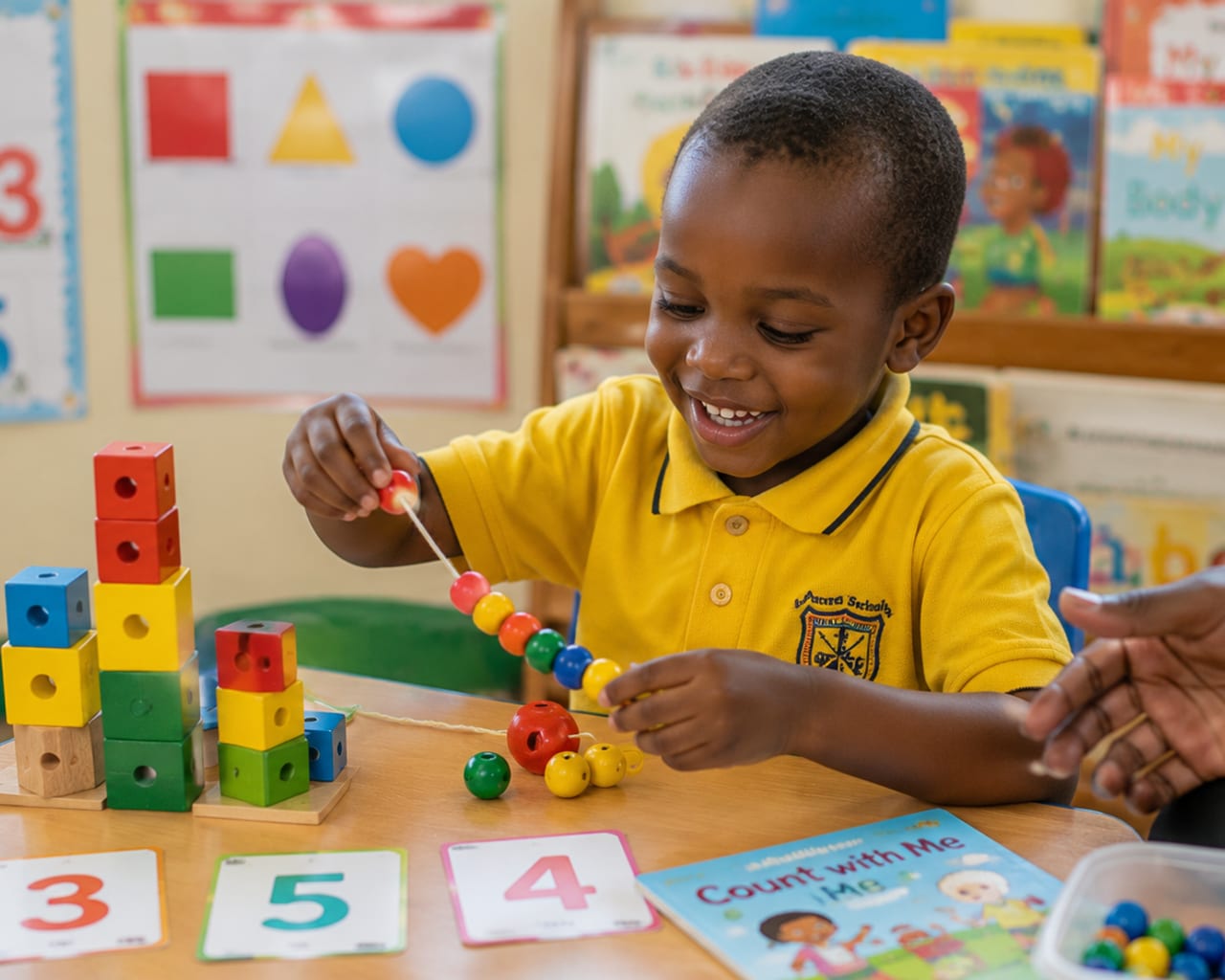
- Psychomotor and Creative Activities: gross motor (running, jumping, throwing) and fine motor (cutting, drawing, threading beads), plus creative expression (music, dance, art).
- Religious Education (CRE / IRE / HRE depending on family choice): basic stories, values, songs.
Across these five areas, the curriculum builds eight competencies appropriate to age: confidence, curiosity, communication, fine and gross motor skills, social emotional development, basic numeracy, basic literacy, and creativity. These are the same broad competency goals that, from Grade 1 onward, get organised into formal strands and sub-strands: Pre-Primary is the foundation those later strands are quietly built on.
What "No Formal Exams" Actually Means
Pre-Primary children are assessed continuously through observation. Teachers fill in observation checklists noting what each child can do (recognises numbers 1–10 ✓, can hold a pencil correctly ✓, can speak in short sentences ✓). At the end of each term, parents receive a progress report described in narrative form, not in marks.
This is not lower-quality assessment. It is age-appropriate assessment. A 4-year-old's "result" on a written exam tells you almost nothing about whether they are developing on track, because young children perform wildly inconsistently on test-like tasks depending on mood, sleep and familiarity with the format. A teacher's structured observation over an entire term, across dozens of small moments, tells you far more: and is the same underlying logic that, in later grades, becomes the BE/AE/ME/EE competency bands used throughout CBE.
A Day in the Life: Amani's PP1 Classroom in Eldoret
Take Amani, a 4-year-old in a PP1 classroom in Eldoret. Her mother initially worried that Amani "wasn't learning anything" because she came home talking only about a song and a story, never a worksheet. A closer look at Amani's actual school day showed otherwise. The morning circle, where Amani names the day, the weather and greets her classmates in both English and Kiswahili, is building language and confidence competencies simultaneously. The "counting game" with bottle caps before snack time is Mathematical Activities in disguise: Amani is sorting, counting and comparing quantities, the exact pre-numeracy skills that later support Grade 1 number work. The 30 minutes of outdoor play is not a break from learning; it is building the gross motor control that, in two years, will support steady pencil grip for handwriting. By the time her mother understood that every part of the day mapped to a specific competency, her anxiety eased: and she stopped pressuring the school for homework sheets that the curriculum deliberately does not require at this stage.
A Typical Pre-Primary School Day
A Kenyan Pre-Primary day typically includes:
- Morning circle (singing, greetings, weather discussion): 20 minutes
- Language activity (story time, letter recognition game): 25–30 minutes
- Mathematical activity (counting game with stones or beads): 25–30 minutes
- Snack break (and yes: eating IS learning at this age; it develops independence and fine motor skill)
- Outdoor activity (gross motor): 30 minutes
- Creative activity (drawing, painting, modelling clay): 25–30 minutes
- Quiet time / story / song: 15 minutes
- Closing circle and dismissal
Total formal learning time is short by design. The brain at 4–5 years old cannot sustain focus on sit-down academic work for more than 15–20 minutes at a stretch. Schools that drill PP1 children with two-hour writing exercises are not "ahead": they are wasting energy and risking early burnout in future learners.
Common Mistakes Parents Make at Pre-Primary Level
- Demanding worksheets and homework. Some parents request extra written work because it "feels like real school." This works against the curriculum design and the underlying developmental research, not with it.
- Comparing children against each other on academic milestones. A wide range of "normal" exists at 4–5 years old. A child reading simple words at PP1 is not automatically ahead of one who is not: both can be developing entirely typically.
- Treating play as time off from learning. Free and structured play are the primary delivery mechanism for Pre-Primary competencies, not a reward for finishing "real" work.
- Skipping the home-language exposure. Some families speak only English at home to "prepare" the child for school, inadvertently weakening the mother-tongue and Kiswahili exposure that KICD's multilingual approach is built on.
- Panicking over a narrative report instead of a percentage. A report that says "developing well in number recognition, needs more practice with scissors" is more useful than any single test score: read it carefully rather than searching for a missing grade.
The Five Things Parents Should Ask the School
- "How do you record my child's progress and when do I see it?" The right answer involves observation checklists and termly narrative reports: not exam marks.
- "What is the ratio of indoor sit-down work to outdoor / active learning?" A healthy ratio at PP1 is roughly 40/60 (40% sit-down, 60% active). Schools running 80/20 are pushing children too hard.
- "What language is most of the day in?" KICD recommends a mix of English, Kiswahili and the local mother tongue at Pre-Primary level. Children acquire languages best when they hear all three regularly.
- "How many children are in my child's class, and how many teachers / assistants?" Ratios above 25:1 are too high at PP1. 15–20:1 with an assistant is ideal: see the comparison table above for how this shifts slightly by PP2.
- "What homework do you set, and why?" The KICD answer is: very little. A short reading-with-parents activity at most. If your PP1 child is bringing home daily worksheets, the school is not following the curriculum design.
How to Support Pre-Primary Learning at Home
The single highest-leverage thing you can do as a PP1 / PP2 parent is to read aloud to your child for 15–20 minutes a day, every day. Picture books, simple storybooks in English or Kiswahili. Talk about the pictures. Ask "what do you think happens next?" The vocabulary your child hears at home in these years builds their academic future more reliably than any tutor or app: see our free African Storybook Library for read-aloud material that is both culturally relevant and free.
Five other simple home activities that reinforce: rather than duplicate: what happens at school:
- Count out loud. Count fruits at the table, steps on the stairs, cars passing. Numbers become familiar objects, not abstractions.
- Cook together. Measuring, counting, sorting (peas to one bowl, beans to another) is hidden Mathematics.
- Outdoor time. Running, climbing and balancing develop the gross motor skills that later support pencil control.
- Sing songs and rhymes. In English, Kiswahili and your home language. Music combines language, memory and joy in one activity.
- Let them be bored sometimes. Boredom is when imagination grows. Do not fill every spare minute with structured activity.
Preparing for the Transition into Grade 1
Towards the end of PP2, the curriculum gently raises expectations to prepare learners for Grade 1, where formal strand-based teaching and the first written assessments begin. This transition works best when it is gradual rather than sudden: a PP2 learner who has had consistent read-aloud time, plenty of fine motor practice, and exposure to numbers in daily life will find the shift into Grade 1's strand-based Mathematics and Language learning far less jarring than one who arrives at Grade 1 having only ever done unstructured play with no language-rich input. If you want a sense of where this leads, the parent playbook for supporting older CBC learners at home follows the same underlying philosophy: support, do not replace, the school's teaching.
Frequently Asked Questions
- Is Pre-Primary compulsory in Kenya?
- Pre-Primary is part of the official CBE structure and strongly encouraged as the foundation for Grade 1 readiness, though enforcement and access vary by county and by public versus private provision.
- Should my PP1 child already know the alphabet before starting?
- No. PP1 is where alphabet and letter-sound recognition begins for most children. Arriving already fluent is not an entry requirement.
- Why does my child's school not give homework at Pre-Primary level?
- This is correct practice under the curriculum design. Formal homework is not recommended at this stage; a short shared reading activity at home is sufficient and more effective.
- How is my child graded if there are no exams?
- Through ongoing teacher observation recorded in checklists, summarised into a narrative progress report each term: describing what the child can do, not a percentage score.
- What if my child seems behind compared to classmates?
- Developmental pace varies widely at 4–5 years old. Discuss specific concerns directly with the class teacher, who has the observation record to give you an accurate, non-anecdotal picture.
- Can I move my child between PP1 and PP2 mid-year?
- Placement is normally based on age and developmental readiness, decided in consultation with the school; this is handled case by case rather than on a fixed national rule.
- Does Pre-Primary include Kiswahili and English equally?
- KICD recommends a balanced mix of English, Kiswahili and the local mother tongue throughout Pre-Primary, since exposure to multiple languages at this age supports rather than confuses language development.
- What should I do if my child's school is pushing formal written work too early?
- Raise it directly with the school using the questions in this guide, referencing the activity-based design KICD has published for Pre-Primary: schools that over-formalise this stage are not following the official curriculum design.
Storybook Resources We Recommend
For families looking for affordable, culturally relevant story material:
- African folk tales (Sungura and Fisi, Anansi the Spider, Why Crocodile Has Rough Skin): free on our site, both readable and listenable, at the African Storybook Library.
- Local Kenyan publishers' early-reader series (Storymoja, East African Educational Publishers).
- Free Kiswahili nursery rhymes: good collections exist for car / matatu listening.
Free and affordable Pre-Primary resources:
→ African Storybook Library: free to read and listen, perfect for PP1 / PP2 read-aloud.
→ PP1 Activity Packs · → PP2 Activity Packs: gentle, KICD-aligned activities for home practice. From KSH 100 per subject.
→ PP1 + PP2 Lesson Plans: for teachers building activity-based weekly plans.
Your 4-year-old is doing exactly what they should be doing: singing, drawing, counting stones, telling you stories, scribbling shapes. That IS the curriculum. Trust it. Support it at home with reading, talking and play, and use the questions above if you ever feel a school is drifting away from the activity-based design. The marks will come at Grade 1, when learners are developmentally ready for them: not before.
Looking for KICD-aligned activity packs to support your PP1 or PP2 learner? Download from cbcedukenya.com: from KSH 100. Got a quick question about CBC at any grade? Try Somo, our AI tutor: KSH 300/month, 30 questions per day.
Sources: KICD Pre-Primary Curriculum Designs (PP1 and PP2); early childhood development research (NAEYC, OECD Starting Strong); KICD Pre-Primary Teacher's Guide. Last updated: Term 2, 2026.
PP1 August Complete Bundle
Every subject in one download: notes, practice, full answer keys, plus the 2026 Holiday Revision Pack, together.
⏳ Only 83 days to the national assessments on 26 October. Start now.
KSH 300 · Get it now → 📱 M-Pesa, instant download · join parents preparing nowHave a CBC question this article didn't answer?
Ask Somo, Kenya's first AI tutor. CBC-grounded, Kenyan examples, instant feedback. Five free questions a day with no signup, or start a 7-day free trial for 30 questions a day.
Try Somo Free →