
Grade 8 is the consolidation year. Your child is no longer the wide-eyed Grade 7 newcomer to Junior Secondary School, and not yet the KJSEA-pressured Grade 9 candidate. They are in the middle: the year when habits formed last year either harden into reliable study routines or quietly slip into avoidance, and the year when the foundations they need for KJSEA in twelve months either get laid properly or get postponed into panic. As a Kenyan parent, you sit at a crossroads. The school is doing what it can, with class sizes of 50 to 80 in many public JSS streams. The KICD curriculum design for Grade 8 is detailed but written for teachers, not parents. You want to help: but you do not want to be the parent who hovers, drills, or turns the dining table into a homework battlefield. This article is a practical, week-by-week playbook for Kenyan parents of Grade 8 learners. It tells you what to actually do at home, what to leave to the teacher, how to read the school report when it comes, and how to set up a sustainable study routine that does not destroy your relationship with your child.
What Grade 8 actually demands (the parent's-eye view)
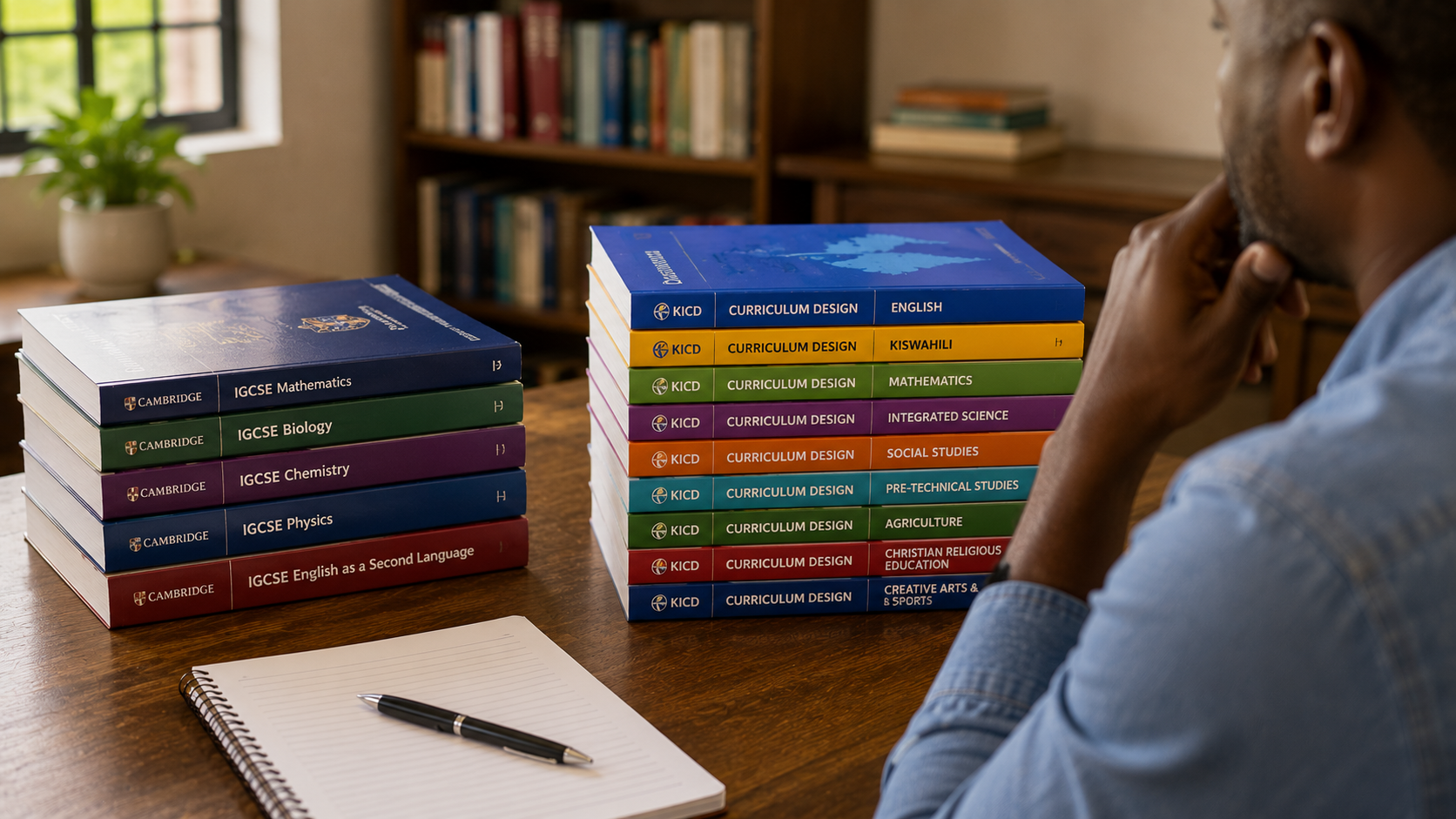
Grade 8 sits in the middle of Junior Secondary School and operates under the same nine compulsory learning areas as Grade 7 and Grade 9, drawn from the rationalised 2024 KICD curriculum framework. The compulsory nine are: English, Kiswahili (or Kenyan Sign Language for learners with hearing impairment), Mathematics, Integrated Science, Social Studies, Religious Education (one of CRE, IRE or HRE), Creative Arts and Sports, Pre-Technical Studies, and Agriculture and Nutrition. Each learning area is organised into strands and sub-strands as published in the KICD Grade 8 designs at kicd.ac.ke. The Grade 8 content depth is higher than Grade 7: for example, Mathematics introduces algebraic equations beyond simple substitution, Integrated Science deepens forces and energy, and Pre-Technical Studies begins meaningful applied work in design and computer use. The single largest cognitive shift from Grade 7 to Grade 8 is that learners are now expected to integrate ideas across sub-strands rather than treat each sub-strand as a separate compartment. A Grade 7 learner could survive by mastering one sub-strand at a time; a Grade 8 learner is increasingly asked to apply what they learned in an earlier sub-strand to a new one, and to start showing the cross-cutting Core Competencies that KICD names (critical thinking, communication, collaboration, citizenship, creativity and imagination, learning to learn, self-efficacy, digital literacy). The implication for parents is straightforward: spotting gaps in earlier-year foundations matters more in Grade 8 than it did in Grade 7. A learner who never solidly mastered Grade 7 fractions will start struggling visibly in Grade 8 algebra. A learner who never built strong Grade 7 comprehension habits will start to drop in Grade 8 English performance. Catch the gap early. For deeper subject-specific guidance, our CBC Grade 8 Mathematics revision notes and our JSS Maths and English study plan are good companions to this playbook.
The sustainable home study routine: 60 to 90 minutes that actually works
The single most common mistake Kenyan parents make is over-prescribing study time. Three-hour Saturday cram sessions do not move competency. Sixty to ninety minutes of focused, scheduled, daily study on school days does. Here is the routine we recommend and have seen work across hundreds of Kenyan Grade 8 families. Right after school (or after a 30-minute rest and snack): 25 minutes of homework completion. Use a timer. The learner works on the highest-priority assignment first, not the easiest. 5-minute break. 25 minutes of subject-of-the-day revision. Rotate through the five core learning areas (English, Kiswahili, Mathematics, Integrated Science, Social Studies) Monday through Friday: that way each one gets one focused revision day per week. The remaining four learning areas (Religious Education, Creative Arts and Sports, Pre-Technical Studies, Agriculture and Nutrition) get rotating coverage on Saturdays. 5-minute break. 10-15 minutes of reading aloud or being read to. This is the most underrated competency-builder in the entire routine: sustained reading at grade level (or one grade above) builds vocabulary, comprehension and concentration faster than any worksheet. Stop after 90 minutes. Do not push to two hours. The diminishing returns past 90 minutes are real, and the relationship cost of forcing extra time is large. On weekends: one focused 90-minute session covering whichever learning area felt weakest during the week, plus reading and one cross-cutting activity (a project, a Pre-Technical hands-on task, an Agriculture-and-Nutrition kitchen activity). That is it. Consistency beats intensity. Twelve months of this routine, well-kept, takes your Grade 8 learner into Grade 9 KJSEA preparation in genuinely strong shape.
Sample weekly home-study rotation for Grade 8
| Day | Focused revision subject | Suggested activity (25 minutes) | Reading focus (10-15 min) |
|---|---|---|---|
| Monday | English | Comprehension passage + 5 inferential questions | A short story or novel chapter |
| Tuesday | Mathematics | 15 problems from current sub-strand + 5 from prior | Maths-related newspaper article or KNEC sample |
| Wednesday | Integrated Science | Diagram-labelling + concept-explanation aloud | Science magazine article or experiment description |
| Thursday | Kiswahili | Insha drafting (1 paragraph) + 10-word vocabulary | Kiswahili story or KICD-suggested text |
| Friday | Social Studies | Map work + one Citizenship question with discussion | News article on Kenya/East Africa |
| Saturday | Weakest-area catch-up | 90-minute deeper session on the week's weakest subject | Choice reading |
| Sunday | Rest + family time | No formal study (rest matters as much as study) | Optional pleasure reading |
How to read your child's school report: what BE, AE, ME, EE mean for you
Under CBE, your Grade 8 child's report does not give you a percentage. It gives you a band: Below Expectation (BE), Approaching Expectation (AE), Meeting Expectation (ME), or Exceeding Expectation (EE): per learning area, and often per strand within the area. This is the part most parents read wrong. A "ME" band is not a B+ or a 70%. It means the learner has met the specific learning outcomes published in the KICD design for that sub-strand or strand. It is the target. EE means the learner has gone beyond: applying the competency in new contexts, demonstrating originality, or showing readiness to teach peers. AE means the learner is on the way but has not yet consolidated. BE means the learner needs further support and is not yet meeting the named outcome. When you read the report, do three things. First, find the band per learning area. Second, find any teacher comments on specific strands: these tell you where the gap is more precisely than the band alone. Third, ignore the urge to compare to other children's reports. CBE bands describe individual competency, not class rank. The right next-step questions for the teacher are: which sub-strand specifically is my child below expectation on, what should we work on at home, and what kind of support will the school give in the coming weeks. Our CBC assessment rubrics explained guide walks through each band with worked examples per learning area.
What you should NOT do (the most common parent traps)
The biggest harm Kenyan parents do to Grade 8 learners is not under-engagement: it is the wrong engagement. Five traps to avoid. 1. Doing the homework with them (which becomes doing the homework for them). Sit nearby, available for questions, but the learner does the work. If you do it, the teacher cannot see the real gap. 2. Treating every assessment as a referendum. Most Grade 8 assessments are formative: the teacher is checking what to teach next, not ranking your child. Asking "why did you not get ME?" after every test breeds anxiety and dishonesty. 3. Over-comparing siblings or cousins. CBE is built on individual competency development. Your nephew's EE in Mathematics has nothing to do with your child's pathway. 4. Adding tuition before fixing the home routine. If the 60-90-minute home routine is not in place, tuition does not fix it: it adds another hour on top of an unstructured study life and burns the learner out. 5. Going silent until results week. The opposite trap. Three months of no engagement followed by a Saturday-morning lecture when results disappoint is the fastest way to break trust. Steady, low-key, daily presence is the playbook. For families using the school holidays for additional structure, our April holiday revision guide and our holiday revision packs hub are good companions.
The Grade 8 to Grade 9 (KJSEA) bridge: what to start preparing now
KJSEA sits at the end of Grade 9. The single biggest predictor of how your child performs in KJSEA is how solidly they consolidated Grade 8. Three things to start putting in place in the second half of Grade 8. First, identify the two weakest learning areas honestly. Talk to the teacher. Look at the school's continuous-assessment patterns. Pick the two with the lowest bands or the most "AE/BE" entries, and plan a targeted catch-up over the long holiday between Grade 8 and Grade 9. Second, build the assessment-readiness habit. KJSEA is performance-based: projects, practicals, written items, oral assessments. Start asking your child to explain what they are learning aloud, in their own words, every day. This single habit transforms passive reading into active recall, which is the underlying competency KJSEA measures. Third, get the Grade 9 KICD curriculum design downloaded and skimmed before Term 1 of Grade 9 starts. The link is at kicd.ac.ke. You do not need to read all 130 pages of each learning area: read the strand summaries (a paragraph or two each) so you arrive in Grade 9 knowing what is coming. Our KJSEA Grade 9 assessment timeline and our complete Grade 9 parent's guide are the next things to read once Grade 8 is finishing. For ongoing strand-by-strand revision support, our subject-specific revision and assessment packs are built directly from KICD strands and pair cleanly with the home routine described here.
Frequently asked questions
How much should my Grade 8 child study at home each day?
Sixty to ninety minutes of focused, scheduled study on school days. Past ninety minutes, returns diminish sharply and the relationship cost rises. Consistency beats intensity.
Should I hire a tutor for my Grade 8 child?
Only after the home study routine is reliably in place. A tutor cannot fix an unstructured study life; they only add hours. If the routine is consistent and the learner is still struggling in a specific strand, then targeted tutoring helps.
What does ME mean on my child's report card?
ME stands for Meeting Expectation. It means the learner has met the specific learning outcomes published in the KICD design for that strand or sub-strand. It is the target band, not a B+ or 70%. EE (Exceeding Expectation) is above the target.
How important is reading at home for a Grade 8 learner?
Extremely. Ten to fifteen minutes of daily reading at or just above grade level builds the comprehension, vocabulary and concentration competencies that underlie performance across English, Kiswahili, Integrated Science and Social Studies. It is the most underrated lever in the home routine.
Where can I get the official KICD Grade 8 curriculum designs?
Free downloads at kicd.ac.ke/cbc-materials/curriculum-designs/. Each learning area is a separate PDF.
GRADE 8 August Complete Bundle
Every subject in one download: notes, practice, full answer keys, plus the 2026 Holiday Revision Pack, together.
⏳ Only 87 days to the national assessments on 26 October. Start now.
KSH 300 · Get it now → 📱 M-Pesa, instant download · join parents preparing nowHave a CBC question this article didn't answer?
Ask Somo, Kenya's first AI tutor. CBC-grounded, Kenyan examples, instant feedback. Five free questions a day with no signup, or start a 7-day free trial for 30 questions a day.
Try Somo Free →