
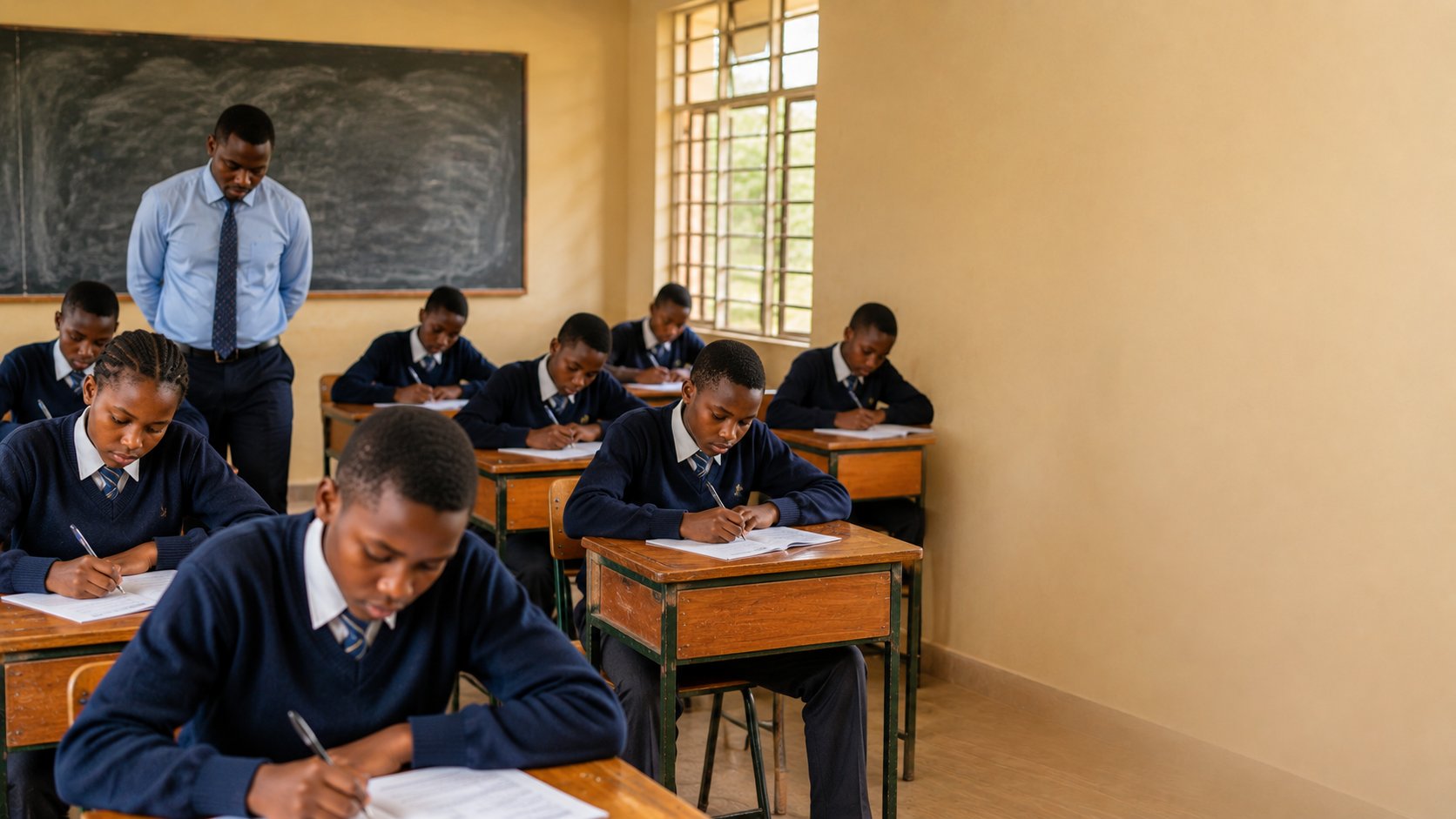
If your child is in Grade 9 this year, they are right now in the middle of the most important assessment of their basic-education journey under the new Competency-Based Education (CBE) framework. The Kenya Junior School Education Assessment: KJSEA: is the national assessment that, together with their School-Based Assessment (SBA) scores from Grades 7, 8 and 9, decides which senior school and which pathway your child enters in Grade 10. KJSEA is not a single exam day. It is a window that runs from May to October 2026, including the Creative Arts and Sports project that runs May to July. As of today, your child is somewhere inside that window. This guide explains the official KJSEA structure, the 60/40 weighting that determines Grade 10 placement, and the seven things every Grade 9 parent should track between now and October.
Last Updated: 16 May 2026
The Short Version
- KJSEA is the national assessment that, together with SBA, decides Grade 10 senior school placement under the new CBE framework.
- Placement weighting: School-Based Assessment 40%, KJSEA 60%.
- Assessment window runs May to October 2026. Creative Arts & Sports project: May to July 2026.
- Grade 9 is the first cohort ever to sit KJSEA: there is no "previous year" pattern to copy from.
- Parents must track 7 specific things this term to avoid the predictable last-minute scramble.
What KJSEA actually is
KJSEA replaces the old KCPE under the new CBE structure. Where KCPE was a single end-of-Standard-8 exam that determined Form 1 secondary placement, KJSEA is a structured assessment at the end of Junior Secondary (Grade 9) that decides senior school placement. It is administered by the Kenya National Examinations Council (KNEC) and combines written papers, practical components, and project work that runs across several months rather than a single sitting day. The official structure was announced through KNEC's circular on the 2026 examination calendar. Schools collected the Green Nominal rolls between 4 and 8 May 2026, and the assessment window opened immediately after.
The 60/40 weighting that decides Grade 10 placement
This is the single most important thing for Grade 9 parents to internalise. Senior school placement under CBE is not determined by KJSEA alone. The placement score is built from two sources:
| Component | Weighting | When it was accumulated | Who administered it |
|---|---|---|---|
| School-Based Assessment (SBA) | 40% | Grades 7, 8, 9: continuous | Your child's school teachers |
| KJSEA national assessment | 60% | May–October 2026 | KNEC (administered through the school) |
| Total placement score | 100% | Released after October 2026 | Used by the MoE selection system |
This means the school assessments your child has been doing since Grade 7 already count for nearly half of their senior school placement decision. If your child has been treating internal end-of-term papers as "just practice", that mindset needed to shift two years ago. The good news is that KJSEA is the larger weight, so a strong performance now still moves the placement substantially. The math is straightforward: a child with an average SBA score of 60% and an excellent KJSEA score of 85% lands at a composite 75%: comfortably in the upper tier for popular STEM placements.
The official KJSEA 2026 assessment window
KNEC published the assessment timetable in early 2026. The full timetable is on the KNEC official portal. The key dates Grade 9 parents must hold:
| Stage | 2026 window | What happens |
|---|---|---|
| Nominal rolls verification | 4 – 8 May 2026 | Schools verified candidate registration data with sub-county directors |
| Creative Arts & Sports project | May – July 2026 | Multi-month practical project assessed by the subject teacher |
| Main KJSEA assessment window | May – October 2026 | Written papers and practical components across learning areas |
| Marking and standardisation | October – November 2026 | KNEC processes scores; SBA is consolidated alongside |
| Results release | December 2026 (expected) | Composite placement scores released; pathway selection follows |
| Senior School placement | January 2027 | Grade 10 begins at the placed senior school |
7 things every Grade 9 parent must track this term
1. Confirm your child's KJSEA registration is on the verified nominal roll
The nominal-roll verification window closed on 8 May. Ask your child's class teacher in writing (a WhatsApp message to the teacher is fine: keep it for your records) for confirmation that your child appears on the verified Green Nominal Roll. If your child's name is missing or misspelled, this is the only window in which it can be corrected without bureaucratic escalation. Mistakes here in 2026 will mean missing or delayed placement letters in early 2027. Ask the teacher to share the assessment-number reference on which your child is registered. Save that number somewhere safe.
2. Track the Creative Arts and Sports project deliverables every two weeks
The Creative Arts and Sports project runs from May through July: three months of school work that contributes to the assessment. Unlike a written exam, the project unfolds in stages, with the teacher observing and scoring various deliverables along the way. If your child falls behind on a stage, recovery is hard. Every two weeks, ask your child to show you what stage of the project they are on and what is due next. This is not micromanaging: this is making sure a key portion of the assessment is not quietly being lost.
3. Confirm the SBA scores accumulated in Grades 7 and 8 are on file
The 40% SBA weighting is built from assessments your child has been doing since Grade 7. If your child changed schools at any point in Junior Secondary, the previous school's SBA records must have been transferred to the current school. Walk into the staff room and ask the deputy head teacher to confirm the SBA portfolio is complete back to Grade 7. If anything is missing, the time to recover it is now, while the previous school still has staff who remember your child. Trying to chase missing SBA records in November while results are being compiled is a nightmare you do not want.
4. Set up a Term 2 revision rhythm at home
KJSEA papers test all ten Grade 9 learning areas: English, Kiswahili, Mathematics, Integrated Science, Pre-Technical Studies, Social Studies, Religious Education, Business Studies, Agriculture, and Health Education. Your child cannot revise everything at once. Build a weekly schedule that covers 2–3 subjects per week on a rotation. Our Junior Secondary study plan walks through the rotation pattern that consistently produces the best results. The biggest single source of unforced KJSEA score loss is panicking in September and trying to cram ten subjects into four weeks. Start the rhythm in May.
5. Get the official KICD curriculum design for Grade 9: and read it
The Kenya Institute of Curriculum Development (KICD) publishes the full Grade 9 curriculum design for every learning area. The KJSEA assessment is structured around the specific learning outcomes in those designs: not around what an individual teacher chose to emphasise. If you want to understand what your child will actually be assessed on, read the KICD design for at least the three subjects where your child is weakest. The designs are dense but they tell you exactly what the strands and sub-strands are, which is exactly what KJSEA examines. This is one of the very few ways to genuinely level up your child's preparation independent of the school.
6. Budget for past-paper materials and a Term 3 revision push
Because the 2026 cohort is the first ever to sit KJSEA, there is no past-paper bank to rehearse on. What does exist are mock papers and revision materials built by KICD-aligned content producers (us included: our Term 2 Editable Lesson Plan Packs for Grades 7, 8 and 9 cover the full strand maps the assessment draws from). Budget a small monthly allocation between May and September for revision materials: even KSH 500–1,000 a month puts comprehensive subject coverage into your child's hands. Schools often do not have enough materials to go around, and the best-prepared candidates are typically those whose parents bought a supplementary stack of practice papers.
7. Plan the Grade 10 pathway conversation now: not in December
The day the KJSEA results come out, the Grade 10 pathway selection clock starts ticking. Your child will need to choose between Science, Technology, Engineering and Mathematics (STEM); Social Sciences; or Arts and Sports Science. That choice will shape the next three years of their schooling and substantially shape their career options. Do not leave this conversation until December. Start talking with your child now: what subjects do they love, what do they avoid, what careers have they wondered about? A child who has been thinking about pathway for six months makes a calmer, better-informed choice than one who is forced to decide on the spot when the placement system asks for their preferences. We cover the trade-offs in our Grade 10 pathway selection guide.
What you should NOT worry about
You will hear noisy commentary about "leaked" KJSEA papers, "guaranteed" results-boosting tutors, and "insider" pathway placement guarantees. Ignore all of it. KJSEA is administered through a national system with multiple checks; no individual tutor or agent has the ability to guarantee a placement or a score. Money paid to such people is money lost. If your child needs extra academic support, the legitimate route is a transparent tuition arrangement with a qualified teacher, a strong revision-materials base, and consistent home study. There are no shortcuts, and the people selling shortcuts are taking advantage of your anxiety.
Frequently Asked Questions
When exactly will KJSEA 2026 finish?
The KJSEA 2026 assessment window runs from May through October 2026, with the Creative Arts and Sports project specifically running May to July. The exact dates for written papers in your child's school depend on the KNEC-published timetable shared with each centre. Ask the deputy head teacher for the centre-specific schedule: most schools post it on the staff-room notice board.
How is KJSEA different from KCPE?
KCPE was a single-week exam at the end of Standard 8 under the old 8-4-4 system, with a single composite score deciding Form 1 placement. KJSEA replaces it under CBE: it is sat at the end of Grade 9, spans multiple months including a Creative Arts and Sports project, and is combined with three years of school-based assessment scores (SBA) on a 60/40 weighting before placement is decided. KJSEA is broader and more continuous than KCPE was.
Do all 10 Junior Secondary subjects count equally?
Subject weighting within KJSEA varies by learning area according to the KNEC-published structure. The core subjects (English, Kiswahili, Mathematics, Integrated Science) typically carry heavier weight than the more applied subjects, but the precise weighting per assessment paper is published in the centre-level timetable each school receives. The practical safe approach is to prepare for all 10 areas: KJSEA is broad enough that gaps in any one subject pull the composite down.
When will KJSEA 2026 results be released?
KNEC marking and standardisation is expected to run October–November 2026, with composite placement scores released in December 2026. Grade 10 senior school placement then runs in January 2027 ahead of the new school term. This timeline assumes no major delays: given that 2026 is the first KJSEA cohort, expect some calendar adjustments. Keep an eye on the official KNEC and Ministry of Education channels for confirmation closer to October.
My child changed school mid-Junior-Secondary. Do their old SBA scores still count?
Yes: SBA scores from Grades 7, 8 and 9 all contribute to the 40% SBA portion of the placement score. When a learner changes school, the previous school's SBA records must be transferred to the new school. If you have not confirmed this transfer happened, walk into the deputy head teacher's office this week and ask for written confirmation that the portfolio is complete. Recovering missing SBA records weeks before results are compiled is significantly harder than recovering them now.
Can my child sit KJSEA at a different school from the one they attended Grade 9?
KJSEA is sat at the school where the learner is registered as a candidate on the verified nominal roll. Changes to the centre of registration after the 8 May verification cut-off require formal application through the sub-county education office and are only granted in exceptional circumstances such as medical relocation. Plan around this constraint: switching schools mid-Grade 9 just before KJSEA is administratively very expensive.
Key Takeaways
- KJSEA + SBA, weighted 60/40: the school assessments your child has been doing since Grade 7 already count for nearly half the placement score.
- The window is now: May to October 2026 for written papers; May to July for the Creative Arts and Sports project.
- Confirm registration this month: the nominal roll verification window closed 8 May: ask the class teacher for written confirmation your child is on it.
- Set the revision rhythm in May, not September: 2–3 subjects per week on rotation beats a four-week cram.
- Start the pathway conversation now: waiting until December puts your child in a high-pressure decision moment with no preparation.
Strong KJSEA preparation depends on consistent term-by-term coverage. Our Term 2 Editable Lesson Plan Packs for Grade 9 across all 10 learning areas (KSH 100 per subject, KSH 500 for the whole grade) give teachers and engaged parents the structured weekly plan KJSEA is built around.
Need ongoing help with this topic?
Soma AI is Kenya's first AI tutor built exclusively for the CBC and CBE curriculum. Ask anything: homework, exam revision, KJSEA prep, lesson plan ideas: and get KICD-grounded answers in seconds.
30 messages/day during trial · KSH 500/month after · M-Pesa · no auto-renewal
Grade 9 KJSEA Complete Revision Course
All 9 learning areas in one download: notes, worked examples, topical questions and full marking schemes. Rebuilt for the 26 to 30 October assessment.
⏳ Only 41 days to the national assessments on 26 October. Start now.
KSH 400 · Get it now → 📱 M-Pesa, instant download · join parents preparing nowHave a CBC question this article didn't answer?
Ask Somo, Kenya's first AI tutor. CBC-grounded, Kenyan examples, instant feedback. Five free questions a day with no signup, or start a 7-day free trial for 30 questions a day.
Try Somo Free →