
Last updated 29 November 2026. Official sources opened and checked on 27 November 2026.
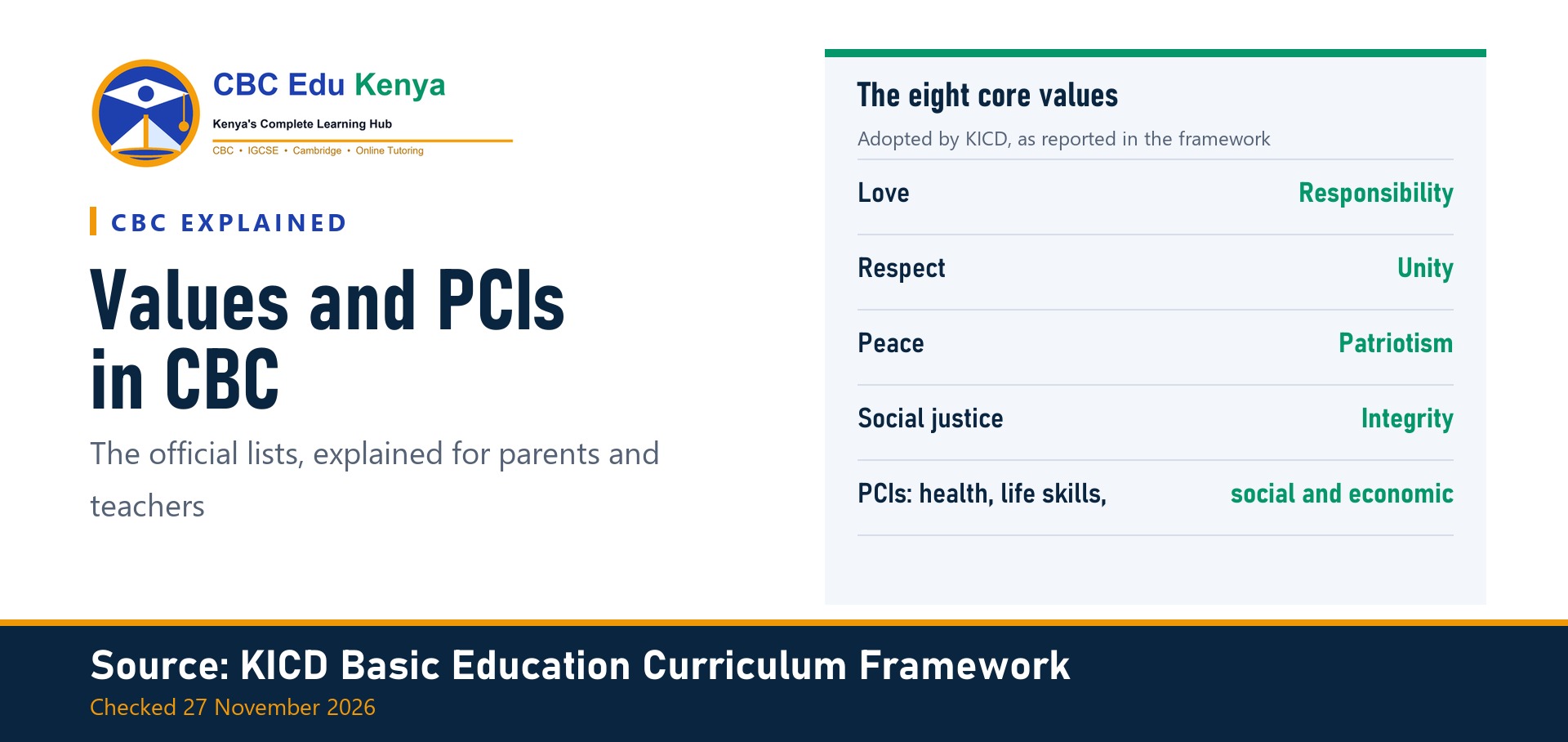
Direct answer: In CBC, values are the standards that guide how a learner behaves, and pertinent and contemporary issues (PCIs) are real-life matters such as health, life skills and the environment that every learning area must cover. KICD's framework lists eight core values (love, responsibility, respect, unity, peace, patriotism, social justice and integrity) and groups PCIs into three areas: health issues, life skills and values issues, and social and economic issues. They are woven into lessons, not taught as a separate subject.
Open any KICD curriculum design and, under every sub-strand, you will find two short lines: "Link to PCIs" and "Link to values". Parents often skip them, and teachers sometimes copy them without thinking. They matter because they describe the part of CBC that is about character and real life, not only marks. This guide gives the official lists, explains the difference between a value and a PCI, and shows how both appear in an ordinary school week.
Values and PCIs in one worked example
A Grade 6 class in Social Studies is studying how a community looks after a shared water point. In one week the teacher does three things: the learners map where water is used, they discuss what to do when a neighbour wastes water, and they agree a rota to keep the school tap clean. Here is how the official ideas show up:
| What happens in the lesson | Value at work | PCI at work |
|---|---|---|
| The class agrees a fair rota so no group is left out | Social justice, responsibility | Life skills and values (cooperation, decision making) |
| Learners return the tap to a clean state after use | Responsibility, respect | Environmental issues (water, hygiene) |
| A learner reports a leaking pipe to the caretaker, even though it is a friend's job | Integrity | Safety and security |
| The class writes to the board of management about a broken tap | Patriotism, unity | Citizenship (core competency) and community service learning |
The lesson is still Social Studies. The values and the PCIs are the lens, not a separate lesson. KICD's framework says exactly this: pertinent and contemporary issues "are not taught in isolation but are mainstreamed in the three dimensions of the curriculum: the formal, non-formal and informal."
What is a value, and which are the official ones?
KICD's Basic Education Curriculum Framework defines values as "standards that guide an individual on how to respond or behave in a given circumstance", and says they influence how we feel, act and make choices. It adds that the primary responsibility for nurturing values rests with parents and the community, with education playing an important supporting role.
The framework records how the list was set:
| Source or year | Values listed | What it tells us |
|---|---|---|
| Constitution of Kenya, Article 10 (2010), as cited by KICD | 17 national values and principles of governance, including patriotism, national unity, the rule of law, human dignity, equity, social justice, integrity and sustainable development | The legal root of values in the curriculum |
| Framework of 2017, as cited by KICD | 13 core living values: love, cooperation, unity, peace, simplicity, humility, honesty, responsibility, respect, tolerance, integrity, happiness and freedom | The first list used for the curriculum |
| KICD review with stakeholders, also 2017, as reported in the framework | 8 core values: love, responsibility, respect, unity, peace, patriotism, social justice and integrity | The short list KICD adopted; the value lines in the designs use words such as respect and responsibility, which are on it |
When a design says "Link to values: respect, responsibility", those two words are on the short list. Parents can use the same eight words at home. A learner who hears "responsibility" at school and at home is more likely to remember it.
What are pertinent and contemporary issues?
PCIs are issues in society that the curriculum wants every learner to understand and manage safely. KICD's framework classifies them into three broad areas:
| Broad area | PCIs listed by KICD | What it can look like for a learner |
|---|---|---|
| 1. Health related issues | HIV and AIDS, alcohol and drug abuse prevention, lifestyle diseases | Learning how to say no to peer pressure; understanding healthy eating |
| 2. Life skills and values issues | Life skills, values and human sexuality | Making decisions, managing feelings, respectful relationships; age-appropriate guidance |
| 3. Social and economic issues | Environment, disaster risk reduction, safety and security, countering terrorism, violent extremism and radicalisation, poverty eradication, gender and animal welfare | Caring for the environment, fire and road safety, equal respect for boys and girls, kind treatment of animals |
The framework says matrices on PCIs guide teachers on "the logical sequencing and the scope of concepts and competencies to be mainstreamed in each learning area", and that learning should be experiential and inquiry based. In plain words: learners should do and discuss, not only copy notes.
How values and PCIs sit with the other parts of CBC
CBC has several layers that work together. The core competencies (communication, critical thinking and the rest) describe what the learner can do; values describe how the learner chooses to act; PCIs describe which real issues the learning touches; and community service learning links the lesson to a need in the community. Our guides on the seven core competencies and strands and sub-strands cover the first and the structure; for community service in senior school see community service learning.
What parents can do at home
KICD's Guidelines on Parental Empowerment and Engagement (first published 2019) say parents should "model the values and character they desire in their children since values are caught rather than taught". They also list involving the child in age-appropriate chores and family and community activities that enhance learning. That gives you a short, practical list:
- Pick one value a week from the eight (for example, responsibility) and name it when you see it: "That was responsible of you."
- Give one real job that someone depends on, such as feeding a hen or washing dishes on a set day.
- Talk about one PCI at a time in an age-appropriate way. For Grades 1 to 3: keeping the compound clean and staying safe on the road. For Grades 7 to 9: peer pressure, online safety and respect.
- Model what you ask. Children copy the adults they see.
- Ask the teacher which value or PCI the class is working on this week, then talk about it at supper.
Our guides on using AI safely for homework and special needs learners in CBE apply the same ideas to two areas that parents ask about.
What teachers can do in lessons
- Copy the design's lines, then make them real. If the design says "Link to values: respect", plan the moment in the lesson where respect is practised (a turn-taking rule, a group role), not just a line in the scheme.
- Do not teach PCIs as separate lectures. Use a local example: a school drainage problem for the environment; a road crossing for safety.
- Mind age-appropriateness for sensitive areas such as human sexuality. Follow the design's guidance and your school's approach, and involve parents through the school.
- Record observations. Observation schedules and checklists work well for values, because values are shown in behaviour over time, not in one test.
- Use real service. Community service learning gives learners a chance to practise the value they discuss.
Key facts
| Fact | Detail | Source (opened 27 Nov 2026) |
|---|---|---|
| Definition of values | "Standards that guide an individual on how to respond or behave in a given circumstance" | KICD Basic Education Curriculum Framework (BECF), 2019 edition, values section |
| Number of core values adopted | Eight: love, responsibility, respect, unity, peace, patriotism, social justice, integrity | BECF, learner support programmes, values based education |
| Earlier list | Thirteen core living values adopted in 2017, reduced to eight after a stakeholder review | BECF, same section |
| National values in the Constitution | 17 national values and principles of governance (Article 10) | BECF, citing the Constitution of Kenya 2010 |
| PCI groups | Health; life skills and values; social and economic issues | BECF, PCIs in the curriculum |
| Where PCIs are taught | Mainstreamed in the formal, non-formal and informal curriculum, not as a separate subject | BECF, PCIs in the curriculum |
| Parents' role | Model values; involve the child in age-appropriate chores and community activities | KICD Guidelines on Parental Empowerment and Engagement (2019) |
Common mistakes
- "Values are a subject with a mark." They are shown in behaviour and noted by teachers, not examined as a paper.
- "PCIs are only about HIV or drugs." The framework lists three broad areas, including the environment, safety and gender.
- "Only the school teaches values." KICD says the primary responsibility rests with parents and the community.
- "A list on the wall is enough." Values grow when adults practise them and children get chances to practise too.
For more on how teachers record what they observe, our guide to setting a CBC exam that measures strands shows how written and practical tasks fit together, and the report card guide how to read the CBC report card explains how teacher comments appear at home.
Where CBC Edu Kenya fits, stated once
Everything above is free to use. If you also want ready-made practice for Grade 6, our Grade 6 page lists the packs, and the Grade 6 whole-grade bundle holds the subjects together. Normal prices are KSh 100 per subject and KSh 300 for the whole-grade bundle; check the product page for any offer that is running. Our free samples are at free sample. For live classes (Grades 4 to 10), the CBC Holiday Academy has already started and a learner can join in any week; the class group and timetable are confirmed on WhatsApp before you pay.
Official sources used
- KICD: Basic Education Curriculum Framework (2019 edition, PDF): values, core values, PCIs and how they are mainstreamed
- KICD: Guidelines on Parental Empowerment and Engagement (PDF, first published 2019): parents modelling values and age-appropriate chores
- KICD: Values-based education materials: the KICD page that lists its values-based education materials
- KICD: curriculum designs: where the "link to PCIs" and "link to values" lines appear in each design
- Ministry of Education: policy and circulars for basic education
Questions people ask
What are the core values in CBC?
KICD's framework lists eight core values: love, responsibility, respect, unity, peace, patriotism, social justice and integrity. An earlier list of 13 was reduced to eight after a KICD review with stakeholders in 2017.
What does PCI mean in CBC?
PCI means pertinent and contemporary issues: real-life matters such as health, life skills and values, the environment and safety that every learning area is expected to cover.
How many groups of PCIs are there?
KICD groups PCIs into three broad areas: health related issues; life skills and values issues; and social and economic issues.
Are values and PCIs separate subjects?
No. KICD says PCIs are mainstreamed in the formal, non-formal and informal dimensions of the curriculum, and values are developed through learning in every area.
Are values examined with marks?
Not as a separate paper. Teachers observe and record behaviour over time and may comment on it, using tools such as checklists and observation schedules.
How can I teach values at home?
Name one value a week when you see it, give your child a real job, talk about one issue at a time at an age-appropriate level, and model the behaviour you ask for. KICD's parent guidelines say values are caught rather than taught.
The worked example is a classroom illustration, not an official lesson. CBC Edu Kenya is not part of the Ministry of Education, KICD, KNEC or TSC. Where this page says "our suggestion", it is our own advice and not an official rule.
Keep your child learning this holiday
Live online classes: 4 lessons a week, 2 hours each, KSh 2,500 a week. December holiday revision materials: Whole Grade Bundle KSh 250 (PP1 to Grade 9), or KSh 100 for one subject.
KSh 2,500 a week · Get it now → 📱 Pay by M-Pesa · printable packs are sent to your email after paymentHave a CBC question this article didn't answer?
Ask Somo, Kenya's first AI tutor. CBC-grounded, Kenyan examples, instant feedback. Five free questions a day with no signup, or start a 7-day free trial for 30 questions a day.
Try Somo Free →