
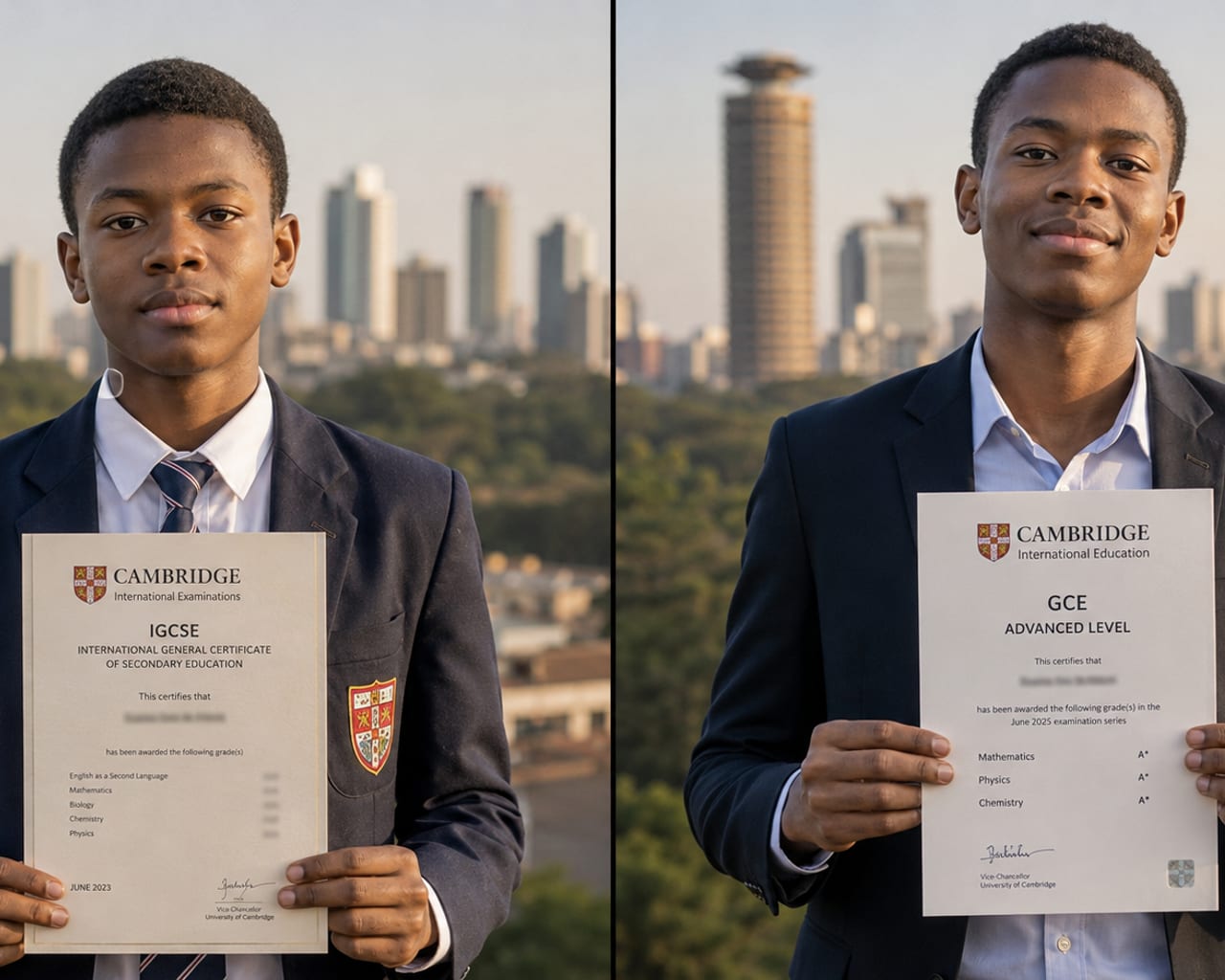
"My child has IGCSE: they're set, right?" It is one of the most common things we hear from Kenyan parents. The honest answer: IGCSE is a strong foundation, but for most competitive university courses, in Kenya and abroad, A-Level (or its IB equivalent) is what actually unlocks the door. This article walks through what each qualification gives a Kenyan student in 2026, where the gaps are, and how to plan the next step.
What IGCSE actually is: and isn't
Cambridge IGCSE (International General Certificate of Secondary Education) is a Year 10–11 qualification, equivalent broadly to the British GCSE or to KCSE in the Kenyan system. It signals foundational secondary education: your child has covered the core subjects to a standard accepted internationally.
What IGCSE does NOT do, by itself, is qualify a Kenyan student for direct entry to most competitive university courses. UK universities, Canadian universities, and the more selective US universities require post-16 qualifications (A-Level, IB, AP, or equivalent) on top of GCSE / IGCSE. KUCCPS in Kenya uses KCSE: IGCSE students applying through KUCCPS need to undertake an equivalency assessment.
What A-Level (and AS Level) adds
Cambridge AS Level is a one-year post-IGCSE qualification (typically Year 12). A-Level is the full two-year version (Year 12 + Year 13). A-Level is the qualification UK universities use to set their entry offers: e.g., "AAA in A-Level Maths, Physics, Chemistry" is a standard medicine offer at a UK medical school.
A-Level shows depth. Where IGCSE shows you covered the subject, A-Level shows you can do it at the level required for a university degree. A Cambridge A-Level Physics student, for example, has covered classical mechanics, electromagnetism, modern physics and substantial mathematical methods: close to the first year of a UK physics degree.
The four pathways open to a Kenyan student post-IGCSE
Pathway 1: Stay in Kenya, transition to KCSE
Some Cambridge schools allow IGCSE graduates to switch to KCSE for Form 5/6 (the old 8-4-4 form) or to the equivalent CBC pathway. This is a viable route into Kenyan universities via KUCCPS, but requires a curriculum re-alignment year. It works best for students whose IGCSE subjects map cleanly to KCSE counterparts (Maths, Sciences, English).
Pathway 2: Continue at Cambridge: AS / A-Level in Kenya
The most direct continuation. Cambridge AS / A-Level is offered at most Tier 1 and Tier 2 Nairobi schools (Brookhouse, Hillcrest, Peponi, Braeburn, Aga Khan and others). Strongest route into UK universities. Also accepted by University of Nairobi, Strathmore, USIU and most Kenyan private universities under their international qualifications pathway.
Pathway 3: Switch to IB Diploma
Schools like ISK, Aga Khan Academy, Brookhouse and a few others offer the International Baccalaureate Diploma Programme as a Year 12–13 alternative to A-Level. IB is broader (six subjects, theory of knowledge, extended essay), more demanding in some ways and easier to pitch to US universities. UK universities accept it equally with A-Level.
Pathway 4: Go abroad for sixth form / boarding
Some Kenyan families send IGCSE graduates to UK boarding schools for two years of A-Level (Sevenoaks, Eton, Westminster, hundreds of others), or to international schools in Dubai, Hong Kong, Switzerland. Expensive (£35,000–55,000 per year for UK boarding) but the network and university preparation are significant.
What university entry actually requires in 2026
By destination:
- UK universities (Oxbridge, Russell Group, others): A-Level or IB, full stop. IGCSE alone does not qualify for direct entry to any of these. Foundation years exist but they cost a year and substantial money.
- US universities (Ivy League, top public, liberal arts): SAT or ACT + a strong post-16 qualification (A-Level / IB / AP). IGCSE alone is insufficient.
- Canadian universities (UofT, McGill, UBC): A-Level / IB at high grades.
- Kenyan universities via KUCCPS: KCSE certificate. IGCSE students need an equivalency or apply through the international students' pathway (Strathmore, USIU and others).
- Kenyan universities via direct admissions (private universities): Most accept A-Level / IB at competitive grades. Strathmore Business School, USIU and others routinely admit Cambridge students.
- Australian and South African universities: A-Level / IB accepted readily.
The mistake parents make at the IGCSE-to-A-Level transition
The most common pattern we see: a strong IGCSE student finishes Year 11 with a clutch of A* and A grades, the family is delighted, and momentum stalls. The student "takes a break" before the A-Level decision, then drifts into a less-than-ideal sixth-form choice or starts AS Level a year late, having lost a year of academic continuity.
A-Level decisions should be made in Year 11, not after IGCSE results. Pick the sixth-form school by April of Year 11 at the latest, finalise A-Level subject choices alongside IGCSE results, start Year 12 the September after IGCSE. Any other rhythm costs time and grade momentum.
For families choosing the subject combination
A-Level offers in Kenyan sixth-forms typically follow these patterns:
- Medicine / Pharmacy / Dentistry: Biology + Chemistry + Maths or Physics. AAA target.
- Engineering: Maths + Physics + Chemistry or Further Maths. A*AA target for top UK engineering.
- Economics / Finance / Business: Maths + Economics + a humanity or second science. AAB minimum for top UK economics.
- Law: English Lit + a humanity + any rigorous third. AAB usually sufficient.
- Computer Science: Maths + Further Maths + Physics or Computer Science. A*AA standard.
How we currently support AS / A-Level (honestly)
Our AS / A-Level catalogue is thinner than our IGCSE catalogue. As of 2026 we publish 2 dedicated AS / A-Level products: both English Literature set text guides. We are actively building out Maths, Physics, Chemistry and Biology A-Level over the coming term. In the meantime, our Cambridge AI tutor Somo handles A-Level Maths and Sciences questions, and our IGCSE materials cover the foundational content that bleeds into the first months of any A-Level course.
Plan the next step deliberately.
→ Browse the IGCSE / Cambridge Hub (notes, schemes, revision, mark schemes)
→ Try Somo for AS / A-Level questions in Maths, Physics, Chemistry and Biology
Pathway or curriculum-switch queries: WhatsApp +254 711 344 702.
Sources: Cambridge International qualifications framework; UCAS published entry requirements (2026 cycle); KUCCPS international student pathway documentation; published university entry requirements (University of Nairobi, Strathmore, USIU). Last updated: May 2026.
Online IGCSE tutoring for adults and private candidates: expert lessons, marked practice and a two-year plan, around your schedule.
See IGCSE Tutoring packages →
IGCSE Revision Materials
Notes and topical questions for the core IGCSE subjects, timed to the Oct/Nov series.
⏳ Only 84 days to the national assessments on 26 October. Start now.
from KSH 350 · Get it now → 📱 M-Pesa, instant download · join parents preparing nowHave a CBC question this article didn't answer?
Ask Somo, Kenya's first AI tutor. CBC-grounded, Kenyan examples, instant feedback. Five free questions a day with no signup, or start a 7-day free trial for 30 questions a day.
Try Somo Free →