
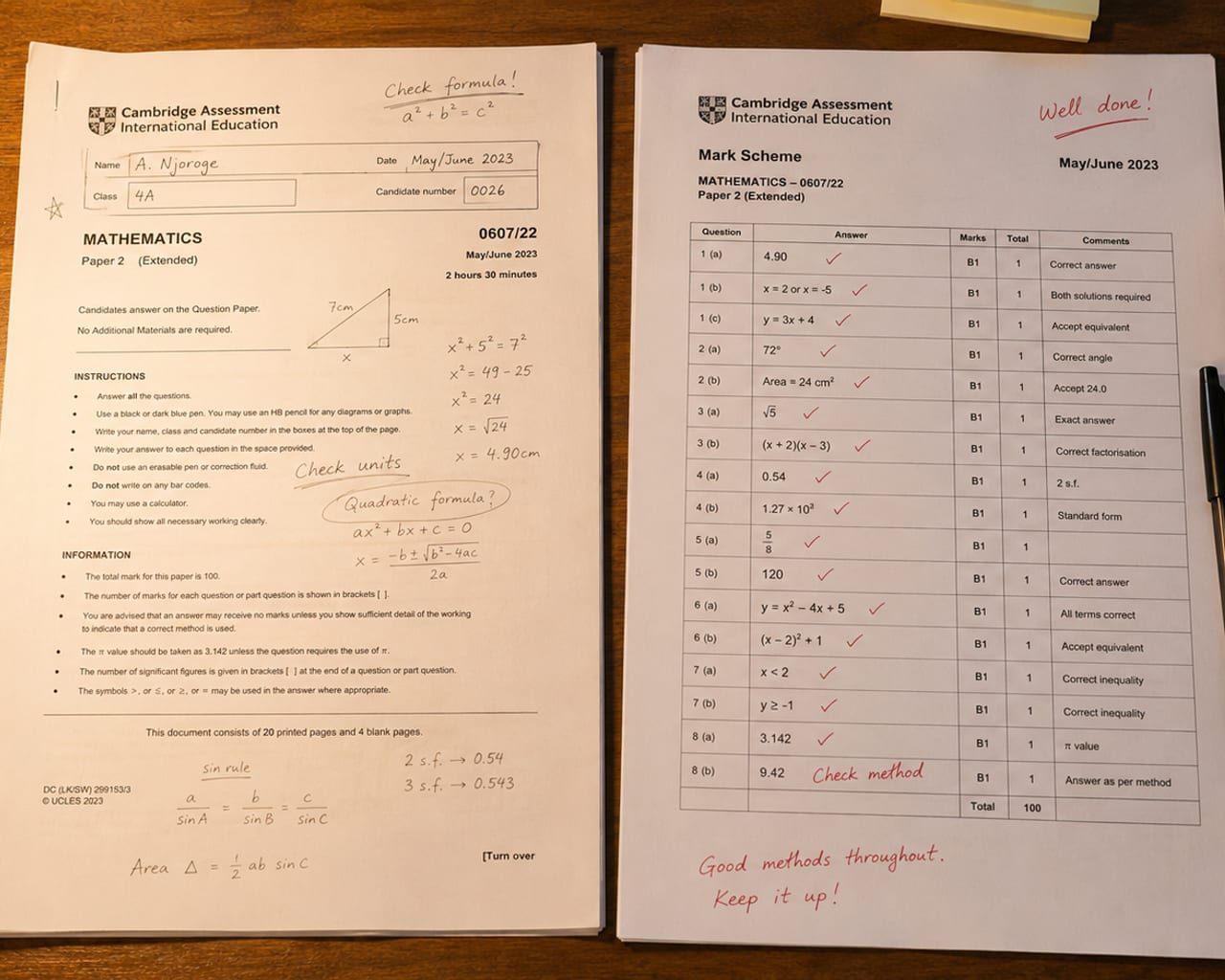
Walk into any IGCSE study group in Kenya and you will find the same scene: stacks of Cambridge past papers, students grinding through questions, glancing at the mark scheme, ticking the right ones, crossing the wrong ones, moving on. This is the most common revision pattern. It is also one of the least effective. Cambridge mark schemes were designed by examiners to teach you how the marks are awarded. Used properly, one past paper is worth a week of textbook reading. Here is the method.
What a Cambridge mark scheme actually contains
If you have only ever skimmed a mark scheme for the right answer, you have been missing the most valuable parts. A Cambridge IGCSE mark scheme is structured to give examiners precise instructions on every mark. The notation looks dry but is rich:
- M1: a method mark. Awarded for the correct approach, even if the calculation goes wrong.
- A1: an accuracy mark. Awarded for the correct numerical answer.
- B1: a standalone mark for stating a fact, definition or correct unit. Usually independent of working.
- (M1 dep): a method mark that depends on a previous correct step.
- OR: Cambridge will accept multiple valid forms. The mark scheme shows them all.
- ecf: "error carried forward". If you got an earlier answer wrong but used it correctly in a later step, you still earn the later mark.
Read a 30-question paper this way and you stop seeing "right" and "wrong": you start seeing how Cambridge actually distributes marks. That changes how you answer the next paper.
The wrong way most students use past papers
The default pattern looks like this:
- Open the past paper.
- Work through the questions, often skipping the hard ones.
- Open the mark scheme.
- For each question, glance at the answer, mark it right or wrong, move on.
- Total the score, feel either good or bad, put the paper away.
This pattern produces familiarity with the syllabus but does not improve technique. The student who scored 60% last week scores 62% this week and calls it progress. Six weeks of this and the score plateaus.
The right way: past papers as diagnosis
The method that produces real grade jumps treats past papers as diagnostic instruments, not score-cards. The pattern:
Step 1: Time it properly
Sit the paper under exam conditions. Phone off. Notes away. Timer set. Cambridge papers are timed to the minute for a reason: pacing is a skill you have to practise.
Step 2: Mark with the scheme open beside you
Now the work starts. For every question, do NOT just mark right or wrong. Read the mark scheme entry in full. Where did the M1 sit? Where did the A1 sit? Did you earn the method mark even though the final answer was wrong (and you crossed yourself off thinking you got nothing)? Cambridge frequently rewards partial credit that students mark themselves down for missing.
Step 3: Write a one-line "why" for every lost mark
Keep a notebook. For every lost mark, write one line: WHY did you lose it? Examples from real Kenyan student notebooks:
- "Forgot units: lost B1 in mensuration"
- "Wrote 'because it gets hotter' instead of 'kinetic energy of particles increases': lost explanation mark"
- "Used calculator in radians instead of degrees: wrong angle answer"
- "Skipped the question because I didn't recognise it: would have earned 2/4 just by attempting"
After 3–4 papers, patterns emerge. The same 2–3 mistakes account for 60% of your lost marks. Now you know what to fix.
Step 4: Re-attempt only the lost-mark questions
One week later, sit ONLY the questions you lost marks on. No timer this time: just slow, careful re-attempt with the mark scheme afterwards. This is where the real learning sets in. You will see the pattern Cambridge wants and the next time a similar question comes up in a paper, you will write the answer in the shape Cambridge rewards.
Step 5: Sit a fresh paper at the end of the cycle
Every 4 papers, sit a fresh one under exam conditions. The score should be higher than the first one in the cycle. If it is not, your method is wrong somewhere: go back to step 2 and read the mark schemes more carefully.
What separates A* candidates from B candidates
It is not how many past papers they do. It is how they mark them. A* candidates spend more time on marking than on answering. B candidates skim the mark scheme in 5 minutes after spending 90 minutes on the paper. Flip that ratio and you will see the grade move.
Where to get Cambridge mark schemes
Cambridge publishes mark schemes for past papers on their official site (cambridgeinternational.org), and several aggregator sites (Save My Exams, Physics & Maths Tutor) republish them with annotations. For Kenyan students, the gap is rarely the availability of papers: it is having mark schemes presented alongside model answers in a way that explains WHY each mark is awarded, not just WHAT the right answer is.
That is what we have built. Our IGCSE Cambridge-aligned revision papers and mark scheme packs at KSH 200 per subject include worked answers that walk through every mark allocation, not just the final answer. Used with the past papers (which are free from Cambridge), they turn weekend revision into the kind of grade-moving practice described above.
Stop guessing where the marks went.
→ All IGCSE Mark Schemes: KSH 100 each
→ Browse the IGCSE Hub for matching revision papers, notes and schemes
→ Try Somo for personalised feedback on a stuck question
Bulk orders or family packs: WhatsApp +254 711 344 702.
Sources: Cambridge International published mark schemes (Maths 0580, Physics 0625, Chemistry 0620, Biology 0610, multiple sessions); examiner reports; teaching observation across Nairobi IGCSE classrooms. Last updated: May 2026.
Online IGCSE tutoring for adults and private candidates: expert lessons, marked practice and a two-year plan, around your schedule.
See IGCSE Tutoring packages →
IGCSE Revision Materials
Notes and topical questions for the core IGCSE subjects, timed to the Oct/Nov series.
⏳ Only 85 days to the national assessments on 26 October. Start now.
from KSH 350 · Get it now → 📱 M-Pesa, instant download · join parents preparing nowHave a CBC question this article didn't answer?
Ask Somo, Kenya's first AI tutor. CBC-grounded, Kenyan examples, instant feedback. Five free questions a day with no signup, or start a 7-day free trial for 30 questions a day.
Try Somo Free →