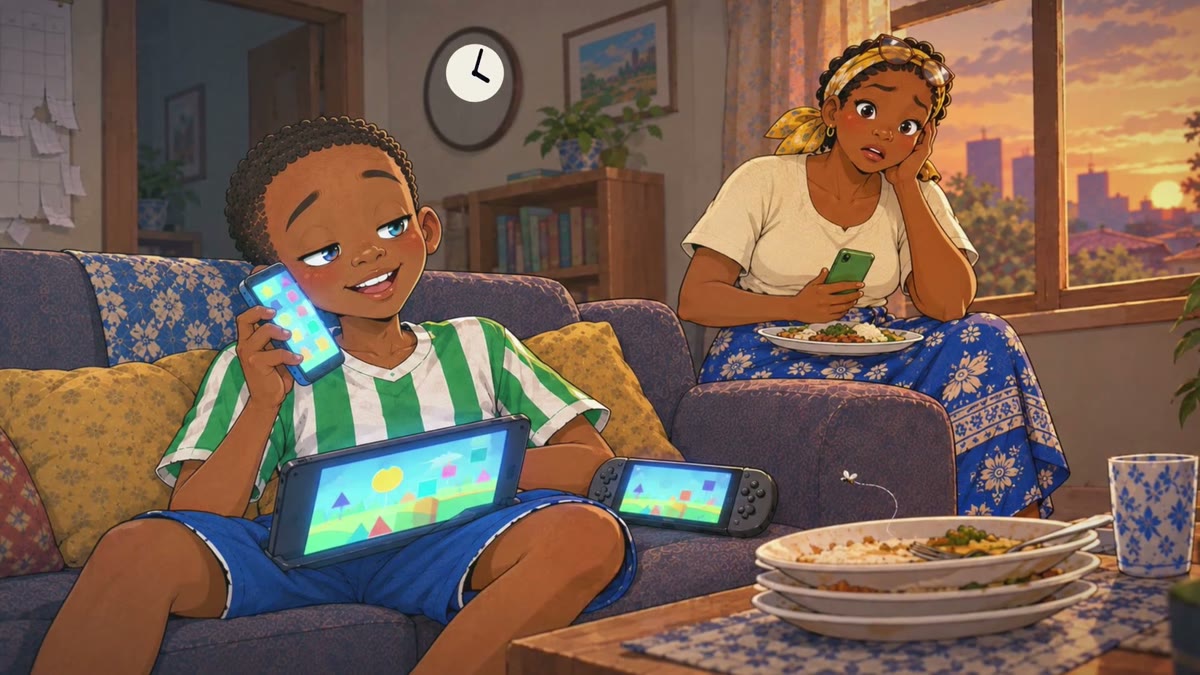
Your child grew up with a screen in the room. To them it is not a gadget, it is a place: where friends are, where jokes happen, where music lives. When you say "put it down", they can hear "leave your friends". That is why the usual shouting does not work, and why the conversation matters more than the rule.
Here is a calm approach for parents of Gen Z teenagers and Gen Alpha children in Kenya: how to start, what to say, what rules to set and how to keep the relationship while you do it.
Watch the 89-second story: "Holiday, Day 12"
A story with cartoon characters, made by CBC Edu Kenya. Prefer YouTube? Open it here: youtu.be/pyxh7socsfc. For more information, click the link in the description on YouTube or use the button at the end of this page.
Understand their screen before you limit it
Sit with your child for ten minutes and ask them to show you what they play, watch and follow. Do not criticise. Ask questions: "What is this game about?" "Who are you playing with?" "What do you like about this channel?" Children who feel heard are far more willing to listen later.
You will learn what is harmless, what is a worry, and what is simply different from your own childhood. Keep your face calm, even if the content surprises you.
A short script that works better than shouting
- Start with something true and kind. "I notice you are really good at this game."
- Say the worry, once. "I am worried that the whole day is going into it."
- Ask for their idea. "What do you think is fair for the holiday?"
- Agree on one change. Write it down together.
- Review in a week. Keep what worked, change what did not.
Family rules, by age group
| Child | What often works | What to avoid |
|---|---|---|
| Younger children, Grades 4 to 6 | Fixed screen times, devices in shared rooms, clear timers, plenty of outside play | Letting the screen be the babysitter all day |
| Young teens, Grades 7 to 9 | Rules agreed together, no phones at meals or in bedrooms at night, a fixed learning hour | Spying and surprise confiscation |
| Older teens, Grades 10 and above | Shared responsibility, talk about sleep, focus and online safety, trust with checks | Treating them like small children |
Notice that sleep appears on every row. Screens in bedrooms at night are one of the easiest things to change, and one of the most valuable. For exam-year learners, we cover this in our guide to sleep, food and screens before the exams.
Keep the connection
- Do something together offline. A walk, a cooking session, a football game, a drive.
- Keep your own phone in check. Children copy what you do.
- Praise the effort to stop. "Thank you for stopping when the timer rang."
- Do not make shame the tool. "You are addicted" hurts and rarely helps.
- Know when to ask for help. If screens are affecting sleep, mood, school or friendships for weeks, speak to your school counsellor or a health professional.
Give them something worth putting the phone down for
A rule that only removes something leaves a hole. Fill it with something real: a sport, a club, a task at home, a class. In the holiday, a live class is one option. It is still a screen, but it has a teacher, a time and a group, and your child takes part. CBCEDUKENYA ACADEMY runs 4 live classes a week for CBC Grades 4 to 10 and IGCSE. For more ideas on a whole holiday, see how to keep your child learning this holiday and the 2026 school calendar.
| Academy fact | What it is |
|---|---|
| Name | CBCEDUKENYA ACADEMY: live online classes by CBC Edu Kenya |
| Who it is for | CBC (CBE) learners in Grades 4 to 10, and IGCSE learners |
| Format | 4 live classes a week, about 60 minutes each, with a real teacher who answers questions live |
| After class | Notes after every class |
| CBC subjects | Mathematics, English, Kiswahili, Integrated Science, Social Studies, Business Studies |
| CBC price | KSh 3,000 a week, KSh 6,000 for 2 weeks, KSh 12,000 a month |
| IGCSE price | Exactly double: KSh 6,000 a week, KSh 12,000 for 2 weeks, KSh 24,000 a month |
| How to pay | M-Pesa |
| How to join | WhatsApp 0711 344 702 with the grade and subjects, we confirm the class group and timetable, pay, join live from a phone or laptop |
The goal is a child who can stop, not a child who is forced to
Rules are the scaffolding. The real aim is a young person who can put the phone down because they have something better to do and someone who listens. You do not need to be perfect. You need to keep talking.
Frequently asked questions
How do I talk to my teenager about phone use without an argument?
Pick a calm moment, start with something kind and true, say your worry once, ask for their ideas and agree one change together. Review it in a week.
What is the difference between Gen Z and Gen Alpha?
Gen Z are usually described as people born from the late 1990s to around 2012, and Gen Alpha as those born after that. In a Kenyan home, that often means older teenagers and younger children growing up with screens as part of daily life.
My child gets angry when I take the phone. What should I do?
Avoid taking it in anger. Agree the rule in advance, use a timer, and offer a calm warning before the stop. If anger is intense or lasts for weeks, talk to a school counsellor or a health professional.
Should phones be allowed in bedrooms?
Many families keep phones and tablets out of bedrooms at night to protect sleep. Charge them in a shared room and agree this together.
How can online classes fit in without adding to the screen problem?
Choose a live class with a fixed time and a real teacher, so the screen time is purposeful and ends when the class ends. CBCEDUKENYA ACADEMY classes are about 60 minutes, 4 a week.
KJSEA and KPSEA revision courses
The Grade 9 KJSEA course covers all 9 learning areas for KSH 400. The Grade 6 KPSEA course covers all 5 subjects for KSH 300. Notes, worked examples, topical questions and full marking schemes in both.
KSH 300 or KSH 400 · Get it now → 📱 M-Pesa, sent to your email after payment · join parents preparing nowHave a CBC question this article didn't answer?
Ask Somo, Kenya's first AI tutor. CBC-grounded, Kenyan examples, instant feedback. Five free questions a day with no signup, or start a 7-day free trial for 30 questions a day.
Try Somo Free →