
Who this is for
- Parents of a child in Grade 4 to Grade 10 who want the long break to end with a sharper child, not a rusty one.
- Working parents who cannot sit beside a child every afternoon but still want real learning to happen at home.
- Families outside the big towns, or with one shared phone, who assume live classes are only for households with laptops and fibre.
- Anyone weighing up holiday learning options and wanting a clear, honest picture before paying a shilling.
The long school holiday is here. On the Ministry of Education's 2026 calendar the December break runs from 26 October 2026 to 1 January 2027, roughly ten weeks without school. Ten weeks is a gift for rest, family and play. It is also long enough for a child to forget a good share of what they learnt in Term 3, especially in Mathematics and languages, where skills fade fastest when they are not used.
Most parents know this. The hard part is doing something about it in a busy Kenyan household: you are at work, the child is at home, the phone is in their hand, and the revision book you bought in August is still in its plastic. This guide sets out a simple plan that works, explains why live teaching beats almost everything else for keeping a child on track, and shows you exactly how our Holiday Learning Academy live online classes fit into the holiday without taking it over.
Key takeaways
- Little and often wins. Four focused hours a week keeps skills alive; a crammed fortnight in December does not.
- A live teacher changes behaviour. A child who knows a teacher is waiting at a set time shows up. A child with a video or a book "to do later" usually does not.
- Our live CBC classes: Grades 4-10, 4 live sessions a week of about 60 minutes, East Africa Time, taught live by qualified Kenyan teachers and aligned to KICD.
- Cost: KSh 3,000 a week (4 sessions), KSh 6,000 for two weeks (8 sessions, most popular) or KSh 12,000 a month (16 sessions), paid by M-Pesa.
- Getting started: WhatsApp ACADEMY to 0711 344 702. We confirm the class group and timetable within 24 hours.
Why the long holiday is a risk and an opportunity
Teachers see it every January. The first two or three weeks of a new term go into re-teaching what children already knew in October. Fractions that were solid are wobbly again. Composition writing has lost its structure. Kiswahili vocabulary that was flowing now needs coaxing. The child is not less able; the skill simply was not used for ten weeks.
The opportunity is the mirror image. A child who keeps a light, steady rhythm through the break walks into January ahead of the class instead of behind it. In CBC (now CBE), where learners are assessed on what they can actually do, that confidence shows up quickly in class activities, projects and school-based assessments. For a Grade 10 learner in Kenya's first senior school cohort, it means starting Grade 11 with the foundations firm.
The good news is that keeping skills alive does not need long hours. It needs regular contact with real learning, a reason to show up, and someone to ask when something does not make sense. That is the whole case for live teaching, and it is why the plan below is built around it.
A simple holiday learning plan that families actually follow
Plans fail when they ask too much. If you have read our 70-day holiday revision plan you will know we favour short daily doses with real rest weeks built in. Here is the same idea in its simplest form, for any grade from 4 to 10:
- Rest first. Give the first week after closing (or after KPSEA and KJSEA for Grade 6 and Grade 9) as a genuine break. A tired child learns nothing.
- Fix the anchor. Choose four learning slots a week at the same times. This is the heartbeat of the holiday. With our live classes, the teacher sets these and your child simply turns up.
- Add a light daily habit. Twenty minutes of reading, or a page of the notes from the last class, on the days without a live session.
- Check once a week. A five-minute Friday conversation: what did you learn, what was hard, what will you ask the teacher next week?
- Protect Christmas. Pause for the festive week if the family travels. A plan with breaks survives; a plan without breaks collapses.
Grade-specific ideas for the days in between are in our Grade 4 and 5 holiday plan and our Grade 7 and 8 holiday plan.
Why live teaching works better than "do it yourself" revision
There is no shortage of learning material in Kenya. Revision books, PDFs, YouTube channels and apps are everywhere. The problem is not access to content. It is three very human things that content alone cannot fix.
1. Children need a reason to show up
A book on the shelf has no start time. A video can always be watched "later". A live class at a set time, with a teacher who will notice if your child is missing, creates the gentle accountability that most children (and most adults) need. For many children that set time is the single biggest difference between learning and meaning to learn.
2. Children need to ask questions
The question a child was too shy to ask in a class of fifty is often the exact thing holding them back. In our live sessions the child speaks, asks and practises. The teacher hears the mistake as it happens and fixes it on the spot, which is something no printed answer key can do.
3. Children need to practise, not just watch
Watching someone solve an equation feels like learning. Solving one yourself, getting it wrong, and being shown why, is learning. Our classes are interactive by design; this is a class, not a video library.
What our Holiday Learning Academy live classes include
Everything below is what you get with every plan. There are no hidden extras.
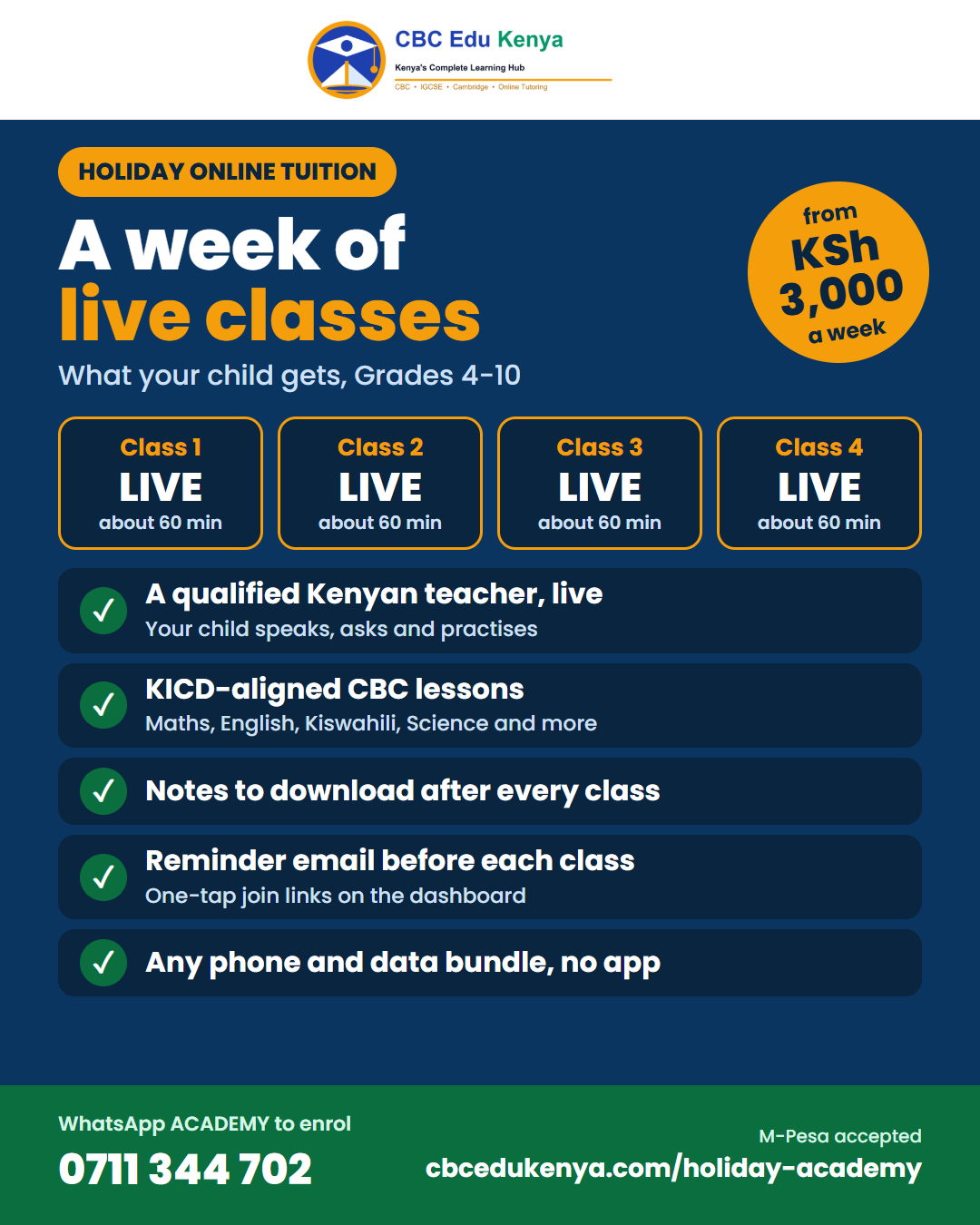
| What you get | What it means at home |
|---|---|
| 4 live sessions a week | A steady rhythm through the holiday. Each session is about 60 minutes, East Africa Time. |
| Qualified Kenyan teachers, live | A real teacher on the screen who knows the Kenyan curriculum and the way CBC is assessed. |
| KICD-aligned lessons | Lessons follow the strands and sub-strands your child is assessed on, not a foreign syllabus. |
| Small live groups | Every child gets to speak and ask. Private 1-on-1 coaching can be arranged on WhatsApp. |
| Notes after every session | Further reading notes to download, perfect for the 20-minute habit on non-class days. |
| Reminder emails and a dashboard | A reminder before each class and a dashboard with one-tap join links, so nobody hunts for a link at 4.59pm. |
| Phone and data bundle, no app | The class opens in the browser on a normal smartphone. Earphones help in a busy house. |
| M-Pesa payment | Pay weekly, every two weeks or monthly. Your plan starts from your first attended class. |
Subjects
Our CBC live classes cover Mathematics, English, Kiswahili, Integrated Science, Social Studies and Business Studies. Tell us on WhatsApp which subjects your child needs most and we will place them in the right class group. If your child is following the Cambridge route instead, see our IGCSE live classes.
Book your child's holiday class group today
4 live classes a week with a qualified Kenyan teacher, from KSh 3,000 a week. Pay by M-Pesa, join from any phone.
See the Holiday Learning Academy WhatsApp ACADEMY to 0711 344 702
Plans and prices
Every plan includes the same thing: 4 live sessions a week with notes after every session. You only choose how you pay.
| Plan | Price | Live sessions | Good for |
|---|---|---|---|
| Weekly | KSh 3,000 | 4 | Trying it out, or topping up a busy week |
| Bi-weekly (most popular) | KSh 6,000 | 8 | A steady rhythm without a big one-off payment |
| Monthly | KSh 12,000 | 16 | Families who want the whole month settled at once |
Work it out per class and the weekly plan comes to KSh 750 for about an hour with a live teacher, notes included. Compare that honestly with any other option you are considering; our seven questions to ask before you pay for holiday learning will help you do it.
How to enrol in four steps
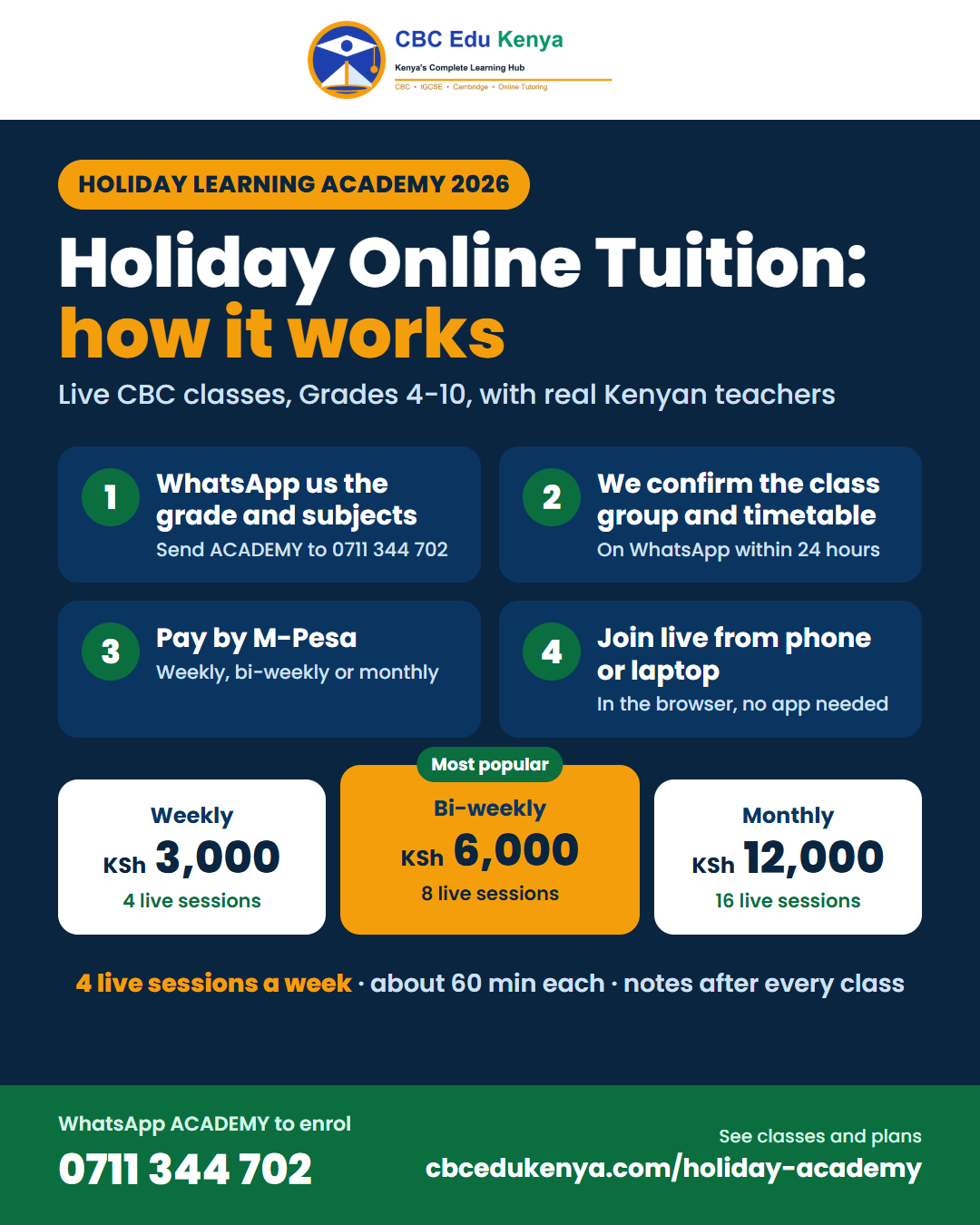
- WhatsApp us the grade and subjects. Send ACADEMY to 0711 344 702 with your child's grade and the subjects they need.
- We confirm the class group and timetable. You get your child's timetable on WhatsApp within 24 hours.
- Pay by M-Pesa. Choose weekly, bi-weekly or monthly.
- Join live from phone or laptop. A reminder email arrives before each class, and the dashboard has one-tap join links.
Making live classes work in a real Kenyan home
Live online learning is easy, but a little preparation makes it much better. These are the habits we see in families whose children get the most out of the holiday.
- One quiet corner. A chair, a table and a wall behind the child. It does not need to be a study room; the end of the dining table works.
- Earphones. The single best accessory. They cut out the television, the siblings and the matatu outside.
- Charge and bundle the day before. Make topping up data and charging the phone part of the evening routine so class time is never lost to a flat battery.
- Exercise book open. Children remember what they write. Ask your child to keep one book just for the holiday classes.
- Sit in now and then. You are welcome to sit beside your child; many parents do, especially in the first class.
- Use the notes. On days without a class, twenty minutes with the last session's notes keeps the thread unbroken.
If your child also uses other free resources over the break, our guide to using an AI tutor safely this holiday explains how to keep that useful rather than a shortcut.
What a good holiday week looks like
Here is an example week for a child with four live classes. Your actual class times are confirmed on WhatsApp; the point is the shape of the week.
| Day | Learning | Everything else |
|---|---|---|
| Monday | Live class (about 60 min) | Chores, play outside, family time |
| Tuesday | Live class | Reading for pleasure |
| Wednesday | 20 minutes with the class notes | A visit, a game, a project |
| Thursday | Live class | Help with cooking or the shamba |
| Friday | Live class, then the 5-minute parent check | Film night |
| Weekend | Nothing formal | Church or mosque, family, rest |
That is about four hours of real teaching a week. It leaves the holiday a holiday, and it keeps your child's mind switched on. For more on getting the balance right, see our piece on how much homework is right in CBE.
Grade by grade: what to focus on
- Grades 4 and 5: reading fluency, number work and written English. Strong foundations here make everything after easier. Upper Primary groups open as they fill, so WhatsApp us early to secure a place.
- Grade 6: after KPSEA, a rest, then a calm bridge into Junior School with Mathematics, English and Integrated Science.
- Grades 7 and 8: close the gaps from this year in Mathematics, Integrated Science and languages before the next year builds on them.
- Grade 9: after KJSEA, keep the momentum into senior school, especially in Mathematics and English.
- Grade 10: Kenya's first senior school cohort moves to Grade 11. Firm up the core so the new year starts strongly.
Do not let ten weeks undo a year of learning
Send your child's grade and subjects on WhatsApp now. We confirm the class group and timetable within 24 hours.
Frequently asked questions
Which grades do the live CBC classes cover?
Grades 4 to 10. Junior School (Grades 7 to 9) and Grade 10 classes run now; Upper Primary (Grades 4 to 6) groups open as they fill. Tell us your child's grade on WhatsApp and we will confirm the right group.
How long is each class, and when is it?
Each live session is about 60 minutes, East Africa Time, four times a week. We confirm your child's exact timetable on WhatsApp within 24 hours of your message.
Do we need a laptop?
No. A normal smartphone with a data bundle is enough. The class opens in the browser, so there is no app to install. A laptop or tablet works too.
Is it a group or one-on-one?
Small live groups, so every child gets to speak and ask. Private 1-on-1 coaching can be arranged on WhatsApp if your child needs it.
What if my child misses a class?
The timetable repeats weekly and the teacher recaps. Your plan starts from your first attended class, so you lose nothing by enrolling mid-week.
How do I pay?
By M-Pesa. Weekly KSh 3,000, bi-weekly KSh 6,000 or monthly KSh 12,000. All plans include 4 live sessions a week and notes after every session.
Is holiday learning allowed?
Section 37 of the Basic Education Act bans holiday tuition, and the Ministry's enforcement is aimed at schools that organise classes and pressure parents to pay. Our classes are not run by any school: they are optional, chosen by parents, and paid week by week if you prefer, so you stay in full control. Rest and play should still take up most of the holiday, which is exactly why our plan is only four sessions a week.
Information current as of 22 October 2026. Holiday dates are from the Ministry of Education 2026 school calendar. Class details and prices are as shown on our CBC live classes page; if anything changes, that page wins.
Further reading
GRADE 4: Term 3 Complete Bundle
Every subject for Term 3 in one download: notes, practice and full answer keys, with exam revision included.
KSH 300 · Get it now → 📱 M-Pesa, sent to your email after payment · join parents preparing nowHave a CBC question this article didn't answer?
Ask Somo, Kenya's first AI tutor. CBC-grounded, Kenyan examples, instant feedback. Five free questions a day with no signup, or start a 7-day free trial for 30 questions a day.
Try Somo Free →