
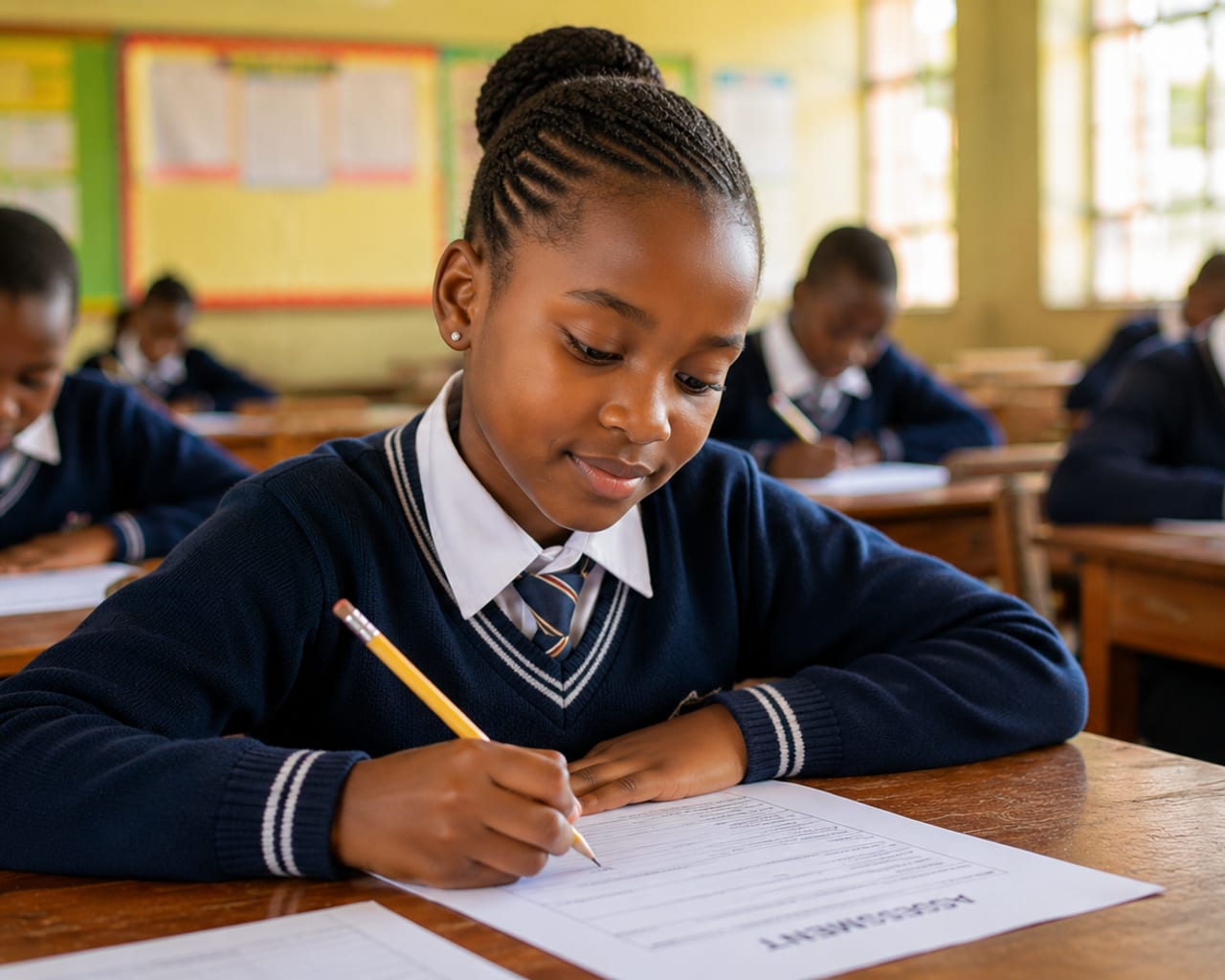
If your child is in Grade 6 this year, they sit KPSEA: the Kenya Primary School Education Assessment: in October 2026. KPSEA isn't a high-stakes single exam like the old KCPE; it is a summative assessment that, together with school-based assessments, decides which Junior Secondary School your child joins next year. Here is the full guide for parents.
What KPSEA is (and what it isn't)
KPSEA is the national summative assessment at the end of upper primary (Grade 6). It is administered by KNEC, sat in your child's own school under normal classroom conditions, and contributes 60% of the placement score for Junior Secondary School (JSS). The remaining 40% comes from school-based assessments accumulated across Grades 4, 5 and 6.
What KPSEA is NOT: it is not KCPE. It is not a pass/fail gatekeeping exam. Every Grade 6 learner progresses to Junior Secondary regardless of their KPSEA score. What KPSEA decides is WHICH JSS: national, extra-county, county, or sub-county: your child is placed in.
The 5 subjects assessed
- English (Language and Composition): comprehension, grammar, composition writing.
- Kiswahili (Lugha na Insha): ufahamu, sarufi, insha.
- Mathematics: numbers, measurements, geometry, algebra basics, statistics.
- Integrated Science: living things, energy, environment, health and nutrition.
- Social Studies and Religious Education (combined): Kenyan history, geography, citizenship, plus the religious education option (CRE / IRE / HRE) your child takes.
Each paper runs 60–90 minutes. The format is multiple-choice plus short structured responses. There is no oral or practical component at KPSEA level (unlike KJSEA).
The 2026 timetable
Per the KNEC 2026 calendar:
- Registration window: closed (was March 2026)
- KPSEA assessment dates: 27 October: 30 October 2026 (4 days, one or two subjects per day)
- Marking: November 2026, at designated KNEC centres
- Results: December 2026 / early January 2027, released to schools first then parents
- JSS placement announced: January 2027
Confirm exact subject-by-subject timings via your child's school in October: KNEC publishes the day-by-day schedule about 4 weeks before the assessment.
What is in each paper (so you can help your child prepare)
English: 2 sections. Section A: comprehension passage (10-15 multiple-choice questions on the passage). Section B: short composition (about 80-100 words) on a familiar topic. Tip: practise reading short non-fiction passages and answering the "what is the main idea" question: that is the most common type.
Kiswahili: Mirroring English. Ufahamu (comprehension) then insha (composition). Insha topics tend to be everyday: describe a place you have visited, write a story that ends with a proverb, etc. Practise writing short paragraphs with correct grammar and tense.
Mathematics: Number operations (including fractions and decimals), measurements (length, area, volume, time, money in KSH), geometry (basic shapes, angles), simple data interpretation (bar graphs, tables). Past KPSEA-style papers are widely available online and from publishers. Focus on accuracy over speed.
Integrated Science: Living things and their environment, energy (electricity basics, light, sound), health and nutrition, weather. Lots of diagram-reading. Practise labelling diagrams from memory.
Social Studies / Religious Education: Map reading (Kenya), Kenyan history (the journey to independence is heavily tested), citizenship and government basics, plus the religious education syllabus your child follows.
The realistic 90-day prep plan
Starting around end of July (90 days before KPSEA), here is what works for most Grade 6 learners:
Days 1–30 (August): Daily 30-minute review of ONE subject. Rotate across the 5 subjects, hitting each subject roughly twice a week. The goal is to refresh what was taught in Grades 4 and 5, not learn new content.
Days 31–60 (September): Move to past KPSEA-style papers. Three past papers per week, one subject at a time. Mark them honestly. For every wrong answer, write a one-line note on WHY it was wrong (didn't understand the question / forgot the formula / careless mistake).
Days 61–90 (October until exam): Full mock papers under timed conditions. Two full mocks per week minimum. The last week before KPSEA: light review only, no new material, focus on rest and confidence.
Five things every Grade 6 parent should do in the last month
- Confirm registration. Ask the class teacher in writing that your child is registered. Mistakes happen; catch them early.
- Buy stationery early. 2B pencils, sharpener, eraser, blue/black pens, a clear plastic ruler. Schools often dictate the colour and brand: confirm.
- Establish the morning routine. Two weeks before, start having your child wake up at the time they would for the assessment. Test their breakfast: don't try a new food on assessment day.
- Sleep, not cramming, the night before. Most lost marks at KPSEA come from tiredness, not lack of knowledge.
- On assessment days, drop them off calm. No "make sure you do well" pep talks at the school gate. A simple "I'll see you after, have fun, do your best" works.
What happens after KPSEA: JSS placement
Once results are out (December/early January), the Ministry runs the placement process. Parents indicate JSS choices via the national JSS placement portal. Placement is based on:
- KPSEA performance (60% weight)
- School-based assessment scores from Grades 4-6 (40% weight)
- Parental choices (you list preferred schools in order)
- School capacity and category
National JSS schools are the most competitive; extra-county and county follow; sub-county JSS schools absorb the bulk of placements. Most children are placed within their county.
Grade 6 KPSEA revision packs are ready.
KICD-aligned Term 3 packs across all 5 KPSEA subjects, exam-style questions, complete mark schemes.
→ Browse Grade 6 KPSEA revision packs: KSH 100 per subject or KSH 250 for the whole-grade bundle.
Stuck on a question? Somo AI tutor on WhatsApp: explains in English or Kiswahili, free 30 questions/day for 7 days.
Sources: KNEC 2026 assessment calendar; Ministry of Education JSS placement guidelines; KICD upper primary curriculum designs (Grades 4-6). Dates as of May 2026: confirm with your school. Last updated: June 2026.
All 5 Grade 6 learning areas in one 70-page download: full-cycle notes, topical questions with marking schemes, and mock papers. KSH 300 instead of KSH 750 bought separately. See exactly what is inside or get the bundle here.
Grade 6 KPSEA Complete Revision Course
All 5 subjects with notes, worked examples, questions and marking schemes. Rebuilt for the 26 to 28 October assessment.
⏳ Only 41 days to the national assessments on 26 October. Start now.
KSH 300 · Get it now → 📱 M-Pesa, instant download · join parents preparing nowHave a CBC question this article didn't answer?
Ask Somo, Kenya's first AI tutor. CBC-grounded, Kenyan examples, instant feedback. Five free questions a day with no signup, or start a 7-day free trial for 30 questions a day.
Try Somo Free →