
Start here: KJSEA 2026 hub: dates, scoring, the 10-week plan and the free all-9-areas mini-mock, updated weekly.
The Kenya Junior School Education Assessment (KJSEA) runs 26 to 30 October 2026 (written papers; rehearsal Friday 23 October), with the main exam window opening for most learners on Monday 26 October. From the mid-term break in late June, Grade 9 learners have roughly 18 weeks of school plus two short holidays to consolidate three years of Junior Secondary content into something they can perform under timed exam conditions. That sounds like a lot of time. It is not. Most families squander the first four of those weeks, panic in August, then exhaust the child in October. This plan gives you the opposite: a realistic six-week calendar starting from the mid-term break (24-28 June 2026), built around what KNEC has actually published in its 2026 KJSEA timetable and project schedule. The goal is not to make your child miserable. The goal is steady, accumulating competence with enough rest to walk into the exam centre on 26 October with energy intact. Read this once with your Grade 9 learner. Print the calendar. Stick it on the fridge. Then mostly leave them alone to work it.
The non-negotiable dates parents must know
Before any revision strategy you need the calendar locked in. Per the KNEC 2026 KJSEA timetable published in February 2026, the formal exam administration runs as follows. Pin these dates somewhere visible at home; most Grade 9 family stress in October is downstream of one or more dates getting forgotten. Friday 23 October 2026 is rehearsal day at every assessment centre: your child must attend even though no real paper is sat; this is when they learn the seating, timing, and reporting rules. Monday 26 October to Friday 30 October 2026 is the main written exam week for most learning areas. The Creative Arts & Sports project was accessed by schools on 11 May 2026, runs for three months, and must be uploaded by 30 August 2026. Pre-Technical Studies and Agriculture & Nutrition projects are accessed on 1 July 2026 with a one-month duration, also uploaded by 30 August 2026. The final results window typically runs into late November/early December. Two practical implications: first, the August school break is not a holiday for Grade 9 learners: it is when projects must be completed and uploaded. Second, the entire month of October is exam-discipline time, not new-content time. Plan accordingly.
How the 9 learning areas are weighted in practice
KJSEA assesses nine learning areas, each scored out of 8 points: English, Kiswahili (or Kenyan Sign Language), Mathematics, Integrated Science, Social Studies, Creative Arts & Sports, Pre-Technical Studies, Agriculture & Nutrition, and Religious Education (CRE, IRE, or HRE). All nine count equally toward the 72-point total. That makes the temptation to over-revise Mathematics and Integrated Science at the expense of the so-called "minor" subjects a costly mistake: losing 4 points in Agriculture & Nutrition costs exactly as much as losing 4 points in Mathematics. The KNEC 2026 assessment design also explicitly examines competencies across strands rather than discrete topics, which means a child who has memorised facts but cannot apply them across sub-strands will land in AE rather than ME. Your revision strategy needs to weight all nine subjects proportionally and prioritise application practice (worked examples, past-paper questions, mini-projects) over passive re-reading of notes. The single highest-leverage habit you can install in your Grade 9 learner this term is to start every revision session by attempting a question from the previous lesson before opening any notes: retrieval before re-reading is the single most evidence-backed study technique in cognitive science, and almost no Kenyan learner does it spontaneously.
The 6-week mid-term-to-school-break revision calendar
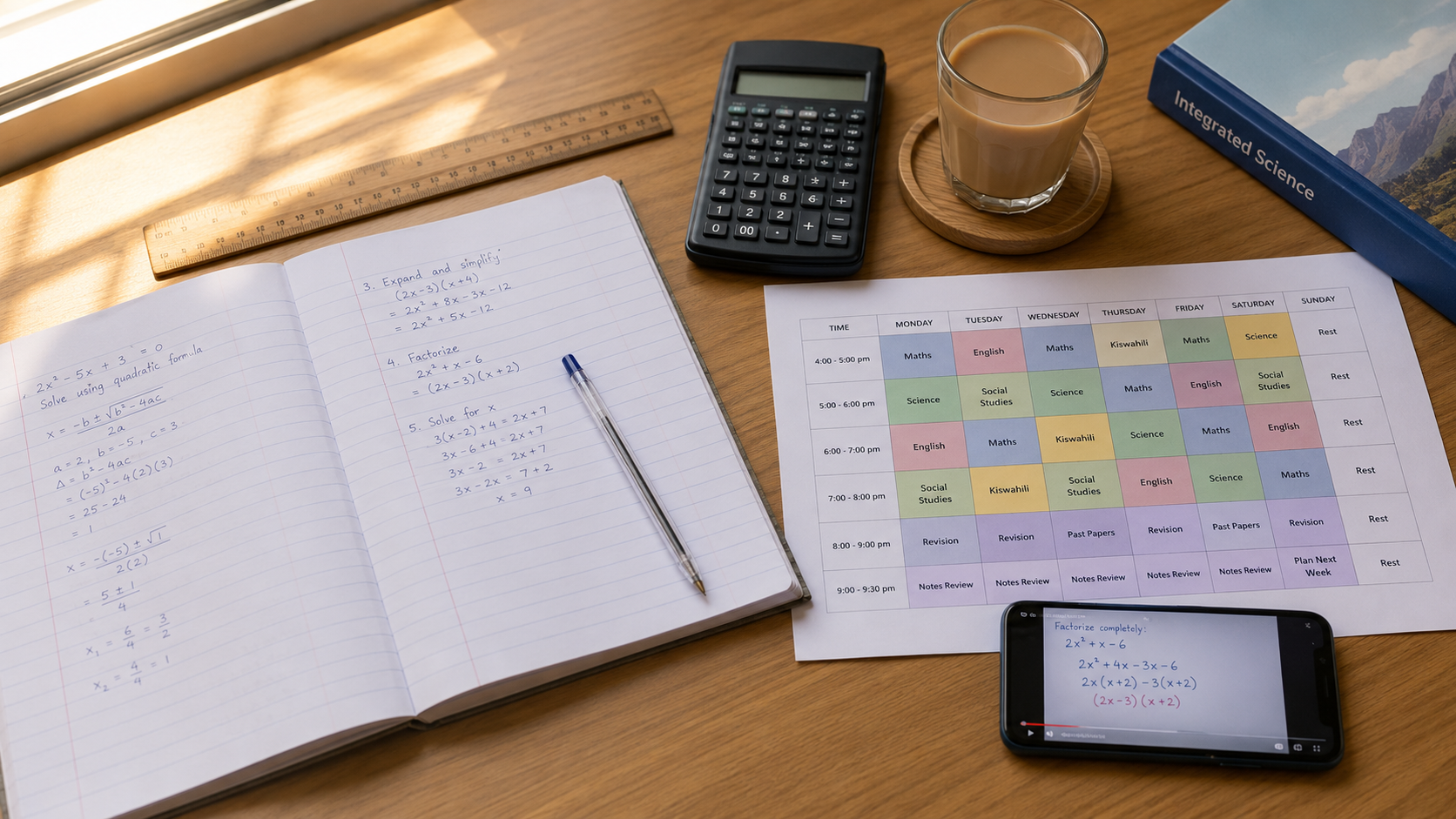
Below is the week-by-week plan starting from Mid-Term Break Monday 24 June 2026. It assumes about 90 minutes of focused revision per day on school days and 3 hours per day during the mid-term and August breaks, with one full rest day per week. If your child cannot sustain 90 minutes initially, start at 45 minutes and add 15 minutes each week: the discipline matters more than the duration. Each week names two priority subjects (where most of the time goes) and three rotation subjects (one short session each). Adjust the priority pairing if your child's recent SBA scores reveal different weaknesses; the principle is "spend most time on the subjects where the gap is biggest", not "always Maths and Science".
| Week | Dates 2026 | Focus subjects | Rotation subjects | Project work | Output target |
|---|---|---|---|---|---|
| Week 1 | Mon 22 June - Sun 28 June (Mid-Term Break) | Mathematics, English | Integrated Science, Kiswahili, Religious Education | Creative Arts & Sports project well under way | 5 past-paper questions per focus subject; 1 written essay (English); 1 Kiswahili insha |
| Week 2 | Mon 29 June - Sun 5 July | Integrated Science, Kiswahili | Mathematics (maintenance), Social Studies, Agriculture & Nutrition | Pre-Technical & Agriculture projects start (accessed 1 July) | 1 full mock-paper per focus subject under timed conditions; ufahamu practice |
| Week 3 | Mon 6 July - Sun 12 July | Social Studies, Pre-Technical Studies | Mathematics, English, Religious Education | Pre-Tech project rough draft completed | Map-work practice (Social Studies); Pre-Tech project draft submitted to teacher for feedback |
| Week 4 | Mon 13 July - Sun 19 July | Agriculture & Nutrition, Religious Education | Integrated Science, Kiswahili, Creative Arts & Sports | Agriculture project rough draft completed | 5 past-paper questions per focus subject; recipe/nutrition practical write-up |
| Week 5 | Mon 20 July - Fri 31 July (Term 2 ends Fri 31 July) | Full-paper Mathematics + Integrated Science | English (timed essay), Kiswahili (timed insha) | All three projects in final revision with teacher | 2 full-length mocks (Maths, Sci); essays graded against KNEC marking guides |
| Week 6 | Mon 3 Aug - Sun 9 Aug (start of August break) | Weakest 2 subjects identified from Week 5 mocks | Mixed-question review | Projects finalised & uploaded by school well before 30 Aug deadline | One 5-day rest period inside the break: no revision, no books, full sleep |
From the end of Week 6 (early August) until Term 3 reopens on 24 August 2026 you have roughly two weeks. Use the first week as deliberate rest: your child has been working since late June and the brain consolidates only when it sleeps. Use the second week for project upload and one final mock per subject. Term 3 then runs August through November and follows the same pattern but with mock exams provided by the school every two weeks; sit them seriously, every time, and analyse every wrong answer with your child within 48 hours of the result.
High-yield strands per learning area
The KNEC 2026 KJSEA specifications and the publicly available sample papers from the 2025 inaugural cohort give us a strong signal on which strands carry the most assessment weight. We have analysed the patterns and pulled the "high-yield" strands per subject below. Do not interpret this as "ignore the others": KNEC assesses across all sub-strands and the question patterns shift each year. Interpret it as "if you only have time for partial coverage, start here". Each list is in priority order, highest first.
Mathematics: high-yield strands
- Algebra: equations, inequalities, formula manipulation. Heavy carrier of marks across both papers; weakness here cascades into Science.
- Geometry & measurement: area, volume, similar shapes, basic loci.
- Numbers: fractions, decimals, ratios, percentages applied to real-world Kenyan context (M-Pesa transactions, fee structures, household budgeting often appear as question contexts).
- Data & probability: interpreting tables and charts; simple probability calculations.
English: high-yield strands
- Composition / writing: narrative and discursive essays; the single largest mark block.
- Comprehension (cloze and passage): practise active reading with paper, not screen.
- Grammar in context: tense, prepositions, articles applied across sentences, not isolated.
- Listening & oral skills: assessed but lower weight in the written components.
Kiswahili: high-yield strands
- Insha: both narrative (hadithi) and discursive (mjadala); structure marks heavily.
- Ufahamu & ufupisho: comprehension and summary.
- Sarufi: particularly ngeli, vitenzi, and matumizi ya alama za uakifishaji.
- Fasihi simulizi: methali, vitendawili, nyimbo.
Integrated Science: high-yield strands
- Mixtures and separation; chemical reactions: practical-based questions almost guaranteed.
- Force, work, energy and electricity basics: formula application.
- Living things: classification, reproduction, ecosystem interactions.
- Human body systems: circulation, respiration, nutrition.
Social Studies: high-yield strands
- Map work: high-mark single skill; practise weekly until automatic.
- People and population in Africa: migration, settlement, urbanisation patterns including Kenyan counties.
- Government and citizenship: Kenyan constitution at Grade 9 level, devolution, county functions.
- Economic activities: agriculture, industry, trade in East African context.
Creative Arts & Sports, Pre-Technical Studies, Agriculture & Nutrition, Religious Education
Each of these has a substantial project component with the published 30 August deadline. The single highest-leverage decision your child can make is to treat the project as 60% of their mark for that subject and start early. A well-planned, on-time, properly documented project lifts subject scores from AE to ME more reliably than any amount of end-of-term cramming.
The honest "when to stop pushing your child" section
Most parents we work with do not need help making their child study more: they need help recognising when more study has gone past the point of usefulness. Three warning signs that you have crossed the line. First, sleep degradation. A Grade 9 learner needs 8-9 hours of sleep. If your child is up past 11 p.m. revising on weeknights, you are losing more in retention than you are gaining in coverage. The hippocampus consolidates the day's learning during deep sleep; sleep loss is direct revision loss. Second, declining mock scores despite increasing study time. This is the unmistakable signature of cognitive exhaustion. If mock paper scores are trending down while hours studied are trending up, your child has hit the wall. Schedule a full week off books: no negotiation. The scores will recover. Third, somatic symptoms. Persistent headaches, appetite loss, stomach complaints with no infectious cause, withdrawal from family meals: these are the body raising a flag the child cannot articulate verbally. Take them seriously. KJSEA matters. Your child's mental health matters more. A learner who arrives at the assessment centre on 26 October in physical and emotional good shape outperforms a learner who arrives exhausted and anxious, every single time, across hundreds of studies of exam performance. The kindest revision plan is also the highest-scoring revision plan.
What we sell to support this plan
If you want ready-made materials aligned with the KJSEA 2026 specifications, our Grade 9 holiday-tripwire pack (KSH 40) covers all nine learning areas with revision notes and one practice paper per subject in a single PDF: designed exactly for the mid-term-break Week 1 of the plan above. It is the cheapest possible entry into structured Grade 9 revision and works on any phone. The full Grade 9 bundle (KSH 500) adds three more papers per subject, full marking schemes, and the recommended KNEC sample papers. Both are downloadable instantly after M-Pesa payment to Till 5310731. For free background reading, see our existing complete Grade 9 KJSEA parent guide, the KJSEA 2026 assessment timeline, and our Grade 9 hub which collects all Grade 9 materials in one place. Parents specifically looking for KICD-aligned schemes should also see CBC Grade 7 schemes of work as a methodology reference even though it covers Grade 7: the structure carries through.
Bottom line
Eighteen weeks looks like a lot of time on 24 June. By 26 October it will feel like very little. The families who do best with KJSEA 2026 will be the ones who started a steady, repeatable revision rhythm during this mid-term break, who weighted all nine learning areas roughly equally rather than over-rotating onto Maths and Science, who treated the August projects as the high-leverage marks they actually are, and who let their child rest properly in early August so they could push hard in Term 3. The families who panic in September and lay on three new tutors and two extra weekend classes will, in our experience, see worse outcomes than the families who stuck with a calmer plan. KJSEA is real and it matters. It is not, however, a measure of your child's worth, and it is not the gateway that 8-4-4 KCSE used to be: every learner is guaranteed a Senior School placement regardless of band. Build the calendar. Trust the process. Send them to bed by 10:30 p.m. on school nights. The rest takes care of itself.
Frequently asked questions
When does KJSEA 2026 actually take place?
According to the KNEC 2026 KJSEA timetable, the rehearsal is on Friday 23 October 2026, with the main written assessment running from Monday 26 to Friday 30 October 2026. Most learning areas are examined within the first week. Morning papers start at 8:30 a.m. and candidates must report at least 15 minutes before each paper.
How is the final Grade 9 score calculated?
The CBC assessment framework calculates the final summative grade as 20% from KPSEA (the Grade 6 assessment), 20% from Grade 7 and Grade 8 School-Based Assessments (SBA), and 60% from KJSEA itself. KJSEA assesses nine learning areas with a maximum of 8 points each, total 72 points, banded into BE / AE / ME / EE per subject.
When are the KJSEA project deadlines in 2026?
Per the KNEC 2026 project guidelines, the Creative Arts & Sports project was accessed by schools on 11 May 2026 with upload deadline 30 August 2026. Pre-Technical Studies and Agriculture & Nutrition projects are accessed on 1 July 2026 with the same 30 August 2026 upload deadline. Plan the projects ahead of the written-paper revision: they are graded into the final subject score.
How many hours per day should a Grade 9 learner revise for KJSEA?
On school days, aim for 90 minutes of focused revision split across two priority subjects plus a 15-minute rotation subject. On weekends and during breaks, 3 hours total with at least one full rest day per week. Sleep must remain at 8-9 hours per night: sleep loss is direct revision loss because memory consolidation happens during deep sleep.
Which Grade 9 subjects should we prioritise in revision?
All nine learning areas count equally toward the 72-point KJSEA total, so over-rotating onto Mathematics and Integrated Science at the expense of Agriculture & Nutrition or Religious Education is a costly habit. Use the most recent SBA scores to identify the subjects where the gap between current and ME (Meeting Expectations) is largest, and weight time toward those.
Where can I get past papers for KJSEA 2026 preparation?
KNEC publishes sample papers for KJSEA on its official site. Our Grade 9 Holiday Revision Pack (KSH 40) and Grade 9 bundle (KSH 500) include KNEC-aligned practice papers across all nine learning areas with marking schemes, downloadable instantly after M-Pesa payment.
Sources: KNEC 2026 Revised KJSEA Timetable & Instructions (knec.ac.ke); KNEC Guidelines and Schedule for Grade 9 KJSEA Projects 2026 (knec.ac.ke); Kenya Institute of Curriculum Development (KICD) Junior Secondary curriculum designs (kicd.ac.ke); Ministry of Education Kenya 2026 school calendar (education.go.ke). CBC Edu Kenya analysis of KJSEA 2025 sample-paper question patterns.
Grade 9 KJSEA Complete Revision Course
All 9 learning areas in one download: notes, topical questions and full marking schemes. Built for the 26 October assessment.
⏳ Only 42 days to the national assessments on 26 October. Start now.
KSH 400 · Get it now → 📱 M-Pesa, instant download · join parents preparing nowHave a CBC question this article didn't answer?
Ask Somo, Kenya's first AI tutor. CBC-grounded, Kenyan examples, instant feedback. Five free questions a day with no signup, or start a 7-day free trial for 30 questions a day.
Try Somo Free →