
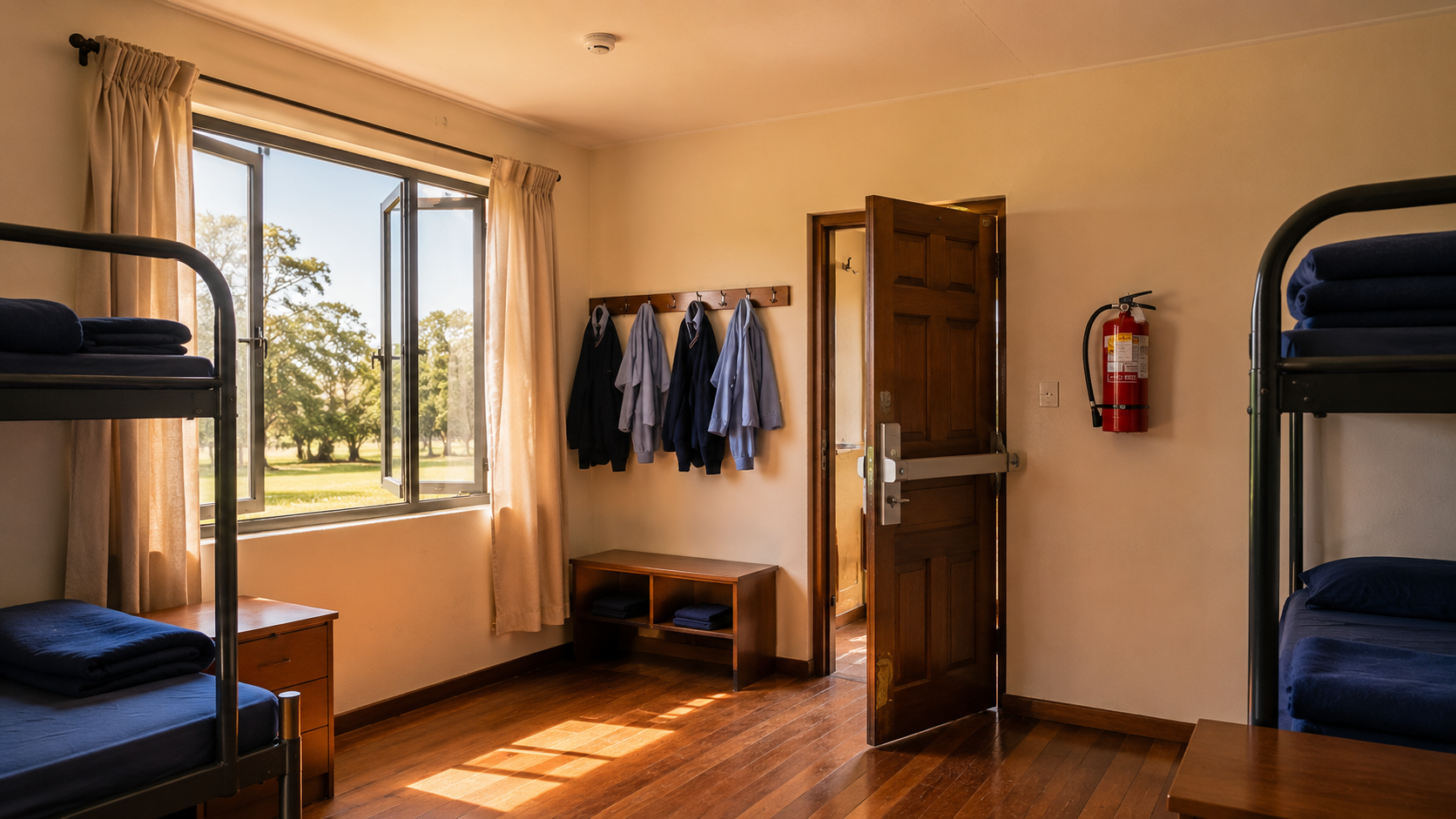
To the parents, teachers, classmates, neighbours and wider Gilgil community grieving after the fire at Utumishi Girls Academy on the night of Wednesday, 27 May 2026 — we are so sorry. There are no words that close a wound of this size, and we will not pretend there are. The names of the girls lost will be carried by their families forever, and the rest of the country owes them the only tribute that actually matters: making sure no other Kenyan family has to endure the same phone call. This article is not written to chase a headline. It is written for every head teacher, every boarding matron, every BoM member, and every parent who is reading the news this morning and wondering whether their own child is safe tonight. We will look honestly at what we know about Utumishi so far, place it within Kenya’s painful history of school fires, and walk through what the Ministry of Education’s own Safety Standards Manual already requires — plus a practical checklist any school can implement this term. Honour the dead by educating the living.
What we know about the Utumishi fire so far
According to early reports from Daily Nation, The Star, Capital FM and other Kenyan outlets, the fire broke out in a dormitory at Utumishi Girls Academy in the small hours of Thursday, 27–28 May 2026. The school sits in Gilgil sub-county, Nakuru, and serves a community that includes many children of National Police Service officers. By daybreak, Interior CS Kipchumba Murkomen and Education CS Julius Ogamba were on site with the Directorate of Criminal Investigations. Official communications confirmed at least 16 learners had lost their lives, with dozens more injured; one parent told reporters injuries were worsened because an exit door was reportedly closed at the time. We deliberately do not repeat the more graphic accounts circulating on social media. Investigations are ongoing, and the government has set up an emergency hotline (119). At the time of writing, no official cause had been confirmed, and out of respect for the families we will not speculate.
A pattern we cannot ignore
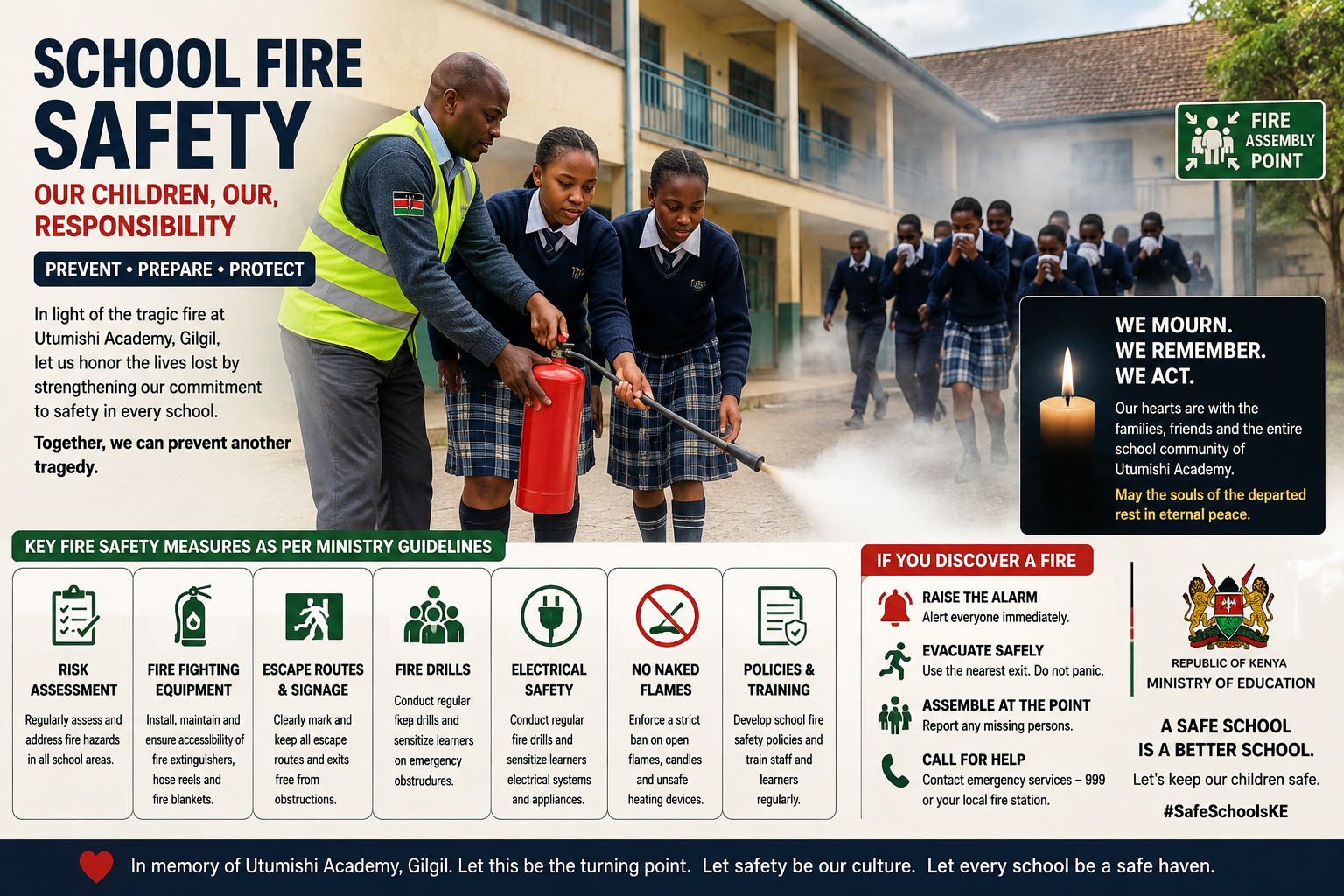
The hardest truth Kenya has to face is that this is not the first time. In September 2024, a dormitory fire at Hillside Endarasha Academy in Nyeri County killed 21 boys aged 10–14; families backed by the Kenya Human Rights Commission have since sued the state and the school. Further back, the Kyanguli Mixed Secondary arson of March 2001 in Machakos killed 67 boys; the Bombolulu Girls Secondary fire of 1998 killed 26 girls during a stampede in which one dormitory door had been locked from outside and the windows were fitted with grills; Asumbi Girls Boarding Primary in 2009 lost children whose exits were similarly compromised. Across nearly three decades of judicial inquiries and ministerial reports, the same words recur: locked doors, no extinguishers, no drills, overcrowding, untrained night supervision, blocked exits, grilled windows. The lessons have not been hidden. They have simply not been enforced everywhere they need to be. After Utumishi, we owe the children we have lost the courage to insist that this time the lessons stick.
What the Ministry of Education Safety Standards Manual already requires
The Safety Standards Manual for Schools in Kenya, issued by the Ministry of Education in 2008, is public and not advisory. It sets out the minimum standards every primary, junior and senior school is expected to implement, reinforced by later MoE circulars, the 2020 Auditor-General’s special audit, and the MoE’s Assessment on Compliance to Safety Standards for Boarding Primary and Junior Schools conducted after Endarasha in Sept–Oct 2024. The Manual’s key dormitory provisions in plain language:
- Doors: at least 5 feet wide, opening outwards, and never locked from outside when students are inside. Doors at both ends, plus a labelled Emergency Exit in the middle.
- Windows: without grills, openable outwards, usable as a secondary escape.
- Equipment: working fire extinguishers at each exit, and fire alarms at accessible points.
- Spacing: beds at least 1.2 m apart, 2 m corridors, admissions matched to bed capacity; no bed-sharing or overcrowding.
- Supervision: regular security patrols and supervised night presence; no visitors in dormitories.
- Drills: evacuation drills on a documented, recurring basis — not a one-off opening-of-school ritual.
Almost every recurring failure named above maps onto a Manual clause already in force. The Manual’s authority is not in doubt; the gap has always been in implementation, inspection, and consequence.
A practical checklist for every Kenyan school — this term
The table below is not a wish list. It translates the Manual’s requirements into what they look like in a typical Kenyan school, with honest cost indications. Most items are inexpensive or free; all are cheaper than the lawsuits and unforgivable losses that follow when they are skipped. Treat it as a self-assessment to tick off before next term, with dated photos and a signed register kept on file for the next sub-county inspection.
| Safety Requirement | What it looks like in practice | Indicative cost |
|---|---|---|
| Doors openable from inside | Open outwards, internal release only, no external padlocks. Doors at both ends + a labelled middle emergency exit. | Free to KSH 20,000 per dorm |
| Working fire extinguishers | At least two serviced cylinders per dormitory, mounted near each exit, next inspection date visible. | KSH 3,500–6,000 + KSH 800–1,500/yr service |
| Termly evacuation drills (documented) | One unannounced drill per term; typed report with date, evacuation time, absentees, lessons. | Free |
| Night supervision | Matron/patron resident in or beside each block; scheduled patrols with a signed logbook. | KSH 8,000–25,000/month |
| Clear, illuminated evacuation routes | Corridors clear of storage; visible exit signs; solar/battery emergency lights where mains is unreliable. | KSH 2,000–6,000 per solar light |
| Smoke detectors (recommended) | Battery alarms in each dormitory ceiling, tested monthly, batteries replaced annually. | KSH 1,500–3,500 per unit |
| Parent emergency contact tree | Up-to-date SMS list per class, tested twice yearly. In a real incident, parents notified within minutes. | Free / negligible |
| Bed spacing and capacity | Beds 1.2 m apart, 2 m corridors, no bed-sharing, admissions capped at bed capacity. | Free |
| Ungrilled, openable windows | Grills removed; windows open outwards so learners can escape if exits are blocked. | Free to KSH 5,000 per window |
If a school cannot fund everything at once, the life-saving priority order is: (1) unlock and re-fit the doors, (2) clear and illuminate the routes, (3) run a documented drill, (4) install and service extinguishers, (5) add smoke alarms and supervisor coverage. Steps 1–3 are essentially free.
What parents can ask their child’s school THIS WEEK
If your child boards — or attends a day school with boarding facilities — you have every right to ask the head teacher the following questions. None are confrontational; all are reasonable. A good school will welcome them; a school that bristles is telling you something important.
- “Can you show me, in writing, when the last fire-evacuation drill was conducted and how long it took to evacuate the dormitories?”
- “How many serviced fire extinguishers are in my child’s dormitory, where are they mounted, and what date is on the next inspection sticker?”
- “Are the dormitory doors ever locked from outside at night? If yes, by whom, and how is the key accessed in an emergency?”
- “Who supervises the dormitory between 10pm and 6am? How many adults per dormitory block, and where do they sleep?”
- “Do the windows in my child’s dormitory have grills? If yes, what is the escape plan if the doors are blocked?”
- “Is my number on the school’s parent SMS emergency tree, and when was it last tested?”
- “May I see the school’s most recent sub-county safety inspection report?”
Ask in writing where possible — a letter or email creates a record. If the school refuses to engage, escalate to the Board of Management and then to the sub-county Director of Education. You are not being difficult; you are being the parent every child needs. See also our Term 2 back-to-school checklist and the Kenyan parent playbook.
Resources and support for families affected
The government’s emergency information hotline is 119. The Kenya Red Cross Society typically deploys psychosocial first-responders after incidents of this scale; their national helpline is 1199. For wider support, contact your county education office or sub-county Director of Education — they can connect grieving families to counselling and verify official communications. If you are a teacher returning to a classroom of children who lost a friend or relative, please prioritise listening over teaching this week. And please do not forward graphic images or unverified casualty lists — the families deserve their grief without that intrusion.
How CBC Edu Kenya can help your school stay compliant
Our Ministry Guidelines hub is one easy reference point for the documents MoE already expects every school to implement — the Safety Standards Manual among them. For drill log templates, extinguisher service logs and parent communication trees, explore our shop of teacher resources. If there are specific safety templates you want us to publish for free, write through the contact page and we will prioritise them.
Frequently Asked Questions
How often must a Kenyan school conduct fire evacuation drills?
The Safety Standards Manual expects schools to conduct drills on a regular, documented basis. Best practice — and what sub-county inspectors look for — is at least one full drill per term, conducted at an unannounced time, with a typed report in the school’s safety file.
Are dormitory door locks required by law in Kenya?
Doors may have internal release mechanisms, but the Manual is explicit that they must never be locked from outside when students are inside. External padlocks at night have been named as a contributing factor in inquiries since the 1998 Bombolulu tragedy.
What should a parent do if their school refuses to do fire drills?
Raise it in writing with the head teacher, then the Board of Management. If there is no progress, escalate to your sub-county Director of Education and copy the Ministry of Education. Keep records of every communication.
Are window grills on dormitories allowed?
The Manual specifies that dormitory windows should be without grills and openable outwards, so learners can escape if doors are blocked. Address security through perimeter fencing and supervision — not by trapping children inside.
What is the official emergency number for the Utumishi response?
The national emergency hotline is 119. The Kenya Red Cross national helpline is 1199. Please use these official channels rather than forwarding unverified WhatsApp messages.
Sources
- Ministry of Education, Republic of Kenya — Safety Standards Manual for Schools in Kenya (2008): education.go.ke
- Ministry of Education — Assessment on Compliance to Safety Standards for Boarding Primary and Junior Schools in Kenya (Sept–Oct 2024)
- Daily Nation, The Star, Capital FM — Utumishi Girls Academy fire reporting and ministerial statements, 28 May 2026
- Daily Nation — “Endarasha 21: Who failed them?” (Sept 2024 Hillside Endarasha Academy follow-up)
- The Standard — “Kyanguli School fire tragedy that claimed 67 lives” (March 2001)
- Kenya National Assembly — Bombolulu Girls High School Fire Tragedy Judicial Commission Report (1998)
- Office of the Auditor-General, Kenya — Special audit on school safety compliance (2020)
August Complete Bundle: Every Grade
All subjects plus the Holiday Revision Pack in one download, PP1 to Grade 12. Built for the August holiday, the longest revision window before October.
⏳ Only 43 days to the national assessments on 26 October. Start now.
from KSH 300 · Get it now → 📱 M-Pesa, instant download · join parents preparing nowHave a CBC question this article didn't answer?
Ask Somo, Kenya's first AI tutor. CBC-grounded, Kenyan examples, instant feedback. Five free questions a day with no signup, or start a 7-day free trial for 30 questions a day.
Try Somo Free →