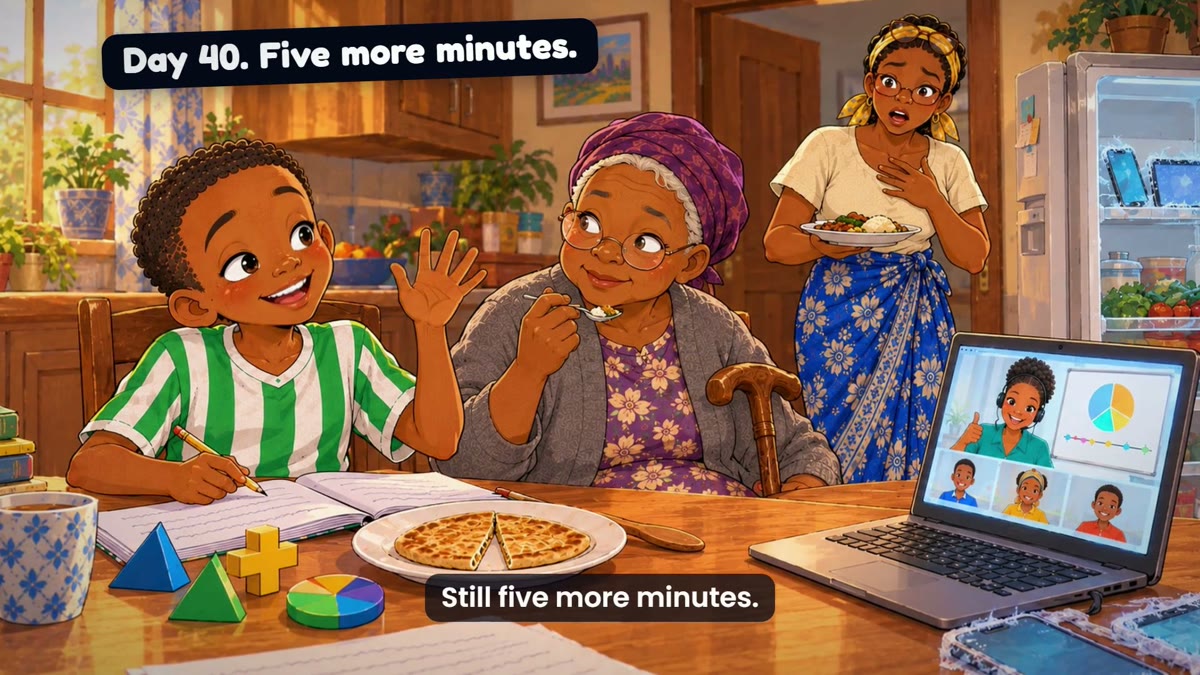
The long school holiday is a gift and a risk. Children need rest, play and time with family. They also forget things they do not use, and by the second month a Grade 6 learner can look at a fraction question as if it came from another planet. The answer is not to run a second school at home. It is one short, fixed hour a day that your child can follow without a fight.
This page gives you a one-hour routine, a weekly plan you can copy, and a way to choose what to practise. It works whether you teach it yourself, use books, or add a live class.
Watch the 89-second story: "Holiday, Day 12"
A story with cartoon characters, made by CBC Edu Kenya. Prefer YouTube? Open it here: youtu.be/pyxh7socsfc. For more information, click the link in the description on YouTube or use the button at the end of this page.
Why one hour is enough
A long learning day in the holiday usually fails by day three. Children feel it is school again, parents run out of energy, and the whole plan is dropped. A single hour is small enough to defend and big enough to keep skills alive. It also leaves room for the things a holiday is for.
The aim is not to finish the syllabus. It is to keep reading, writing and number skills warm so that the first week of Term 1 is not a shock. Grade 4 to Grade 10 learners all benefit from the same shape, with different content.
The one-hour routine
- Minutes 0 to 5, settle. Water, pencil, notebook, phone away.
- Minutes 5 to 15, warm up. Ten quick questions on something your child already knows, such as times tables or spelling.
- Minutes 15 to 45, one focus. One topic from the day's subject, with a teacher, a book or a worked example.
- Minutes 45 to 55, try it alone. Two or three questions without help.
- Minutes 55 to 60, say it back. Your child explains one thing they learned, to you or a sibling.
The last step matters most. Explaining something out loud shows quickly whether it was understood, and it makes learning feel like a conversation, not a test.
A weekly plan you can copy
| Day | Focus | Example for Grades 4 to 7 | Example for Grades 8 to 10 |
|---|---|---|---|
| Monday | Mathematics | Fractions and multiplication practice | Algebra or number work from last term |
| Tuesday | English | Reading a short passage and writing five sentences | Comprehension and a short composition |
| Wednesday | Integrated Science | A simple question about plants, water or energy | One concept explained with a diagram |
| Thursday | Kiswahili | Insha fupi or sarufi practice | Ufahamu and sarufi review |
| Friday | Social Studies or Business Studies | A map, a community or a money question | A short case question and a summary |
| Saturday | Review and a project | Draw or build something that uses the week | Revise the weakest topic of the week |
| Sunday | Rest | No study | No study |
Parents of Grades 6, 9 and 10 can add more weight. Our 70-day holiday revision plan lays out the weeks, and there are grade pages for Grades 4 and 5, Grades 7 and 8, Grade 6 and Grade 9.
Make the routine stick
- Same time every day. A routine you do at 10:00 is easier than one you negotiate each morning.
- Let your child choose the order of the week. A little control improves cooperation.
- Tick it off. A paper chart on the wall gives a small win each day.
- Keep screens after the hour. Learning first, free time second.
- Do not grade it. Praise effort and ask what was hard.
When you need a teacher in the hour
Some topics are simply hard to teach at home, and some parents are working during the day. That is where a live class helps: a real teacher, a fixed time and notes afterwards. CBCEDUKENYA ACADEMY runs 4 live classes a week for CBC Grades 4 to 10, and IGCSE. You can read more about the idea in our guide to keeping your child learning this holiday or see the tutoring page.
| Academy fact | What it is |
|---|---|
| Name | CBCEDUKENYA ACADEMY: live online classes by CBC Edu Kenya |
| Who it is for | CBC (CBE) learners in Grades 4 to 10, and IGCSE learners |
| Format | 4 live classes a week, about 60 minutes each, with a real teacher who answers questions live |
| After class | Notes after every class |
| CBC subjects | Mathematics, English, Kiswahili, Integrated Science, Social Studies, Business Studies |
| CBC price | KSh 3,000 a week, KSh 6,000 for 2 weeks, KSh 12,000 a month |
| IGCSE price | Exactly double: KSh 6,000 a week, KSh 12,000 for 2 weeks, KSh 24,000 a month |
| How to pay | M-Pesa |
| How to join | WhatsApp 0711 344 702 with the grade and subjects, we confirm the class group and timetable, pay, join live from a phone or laptop |
One hour, every day, same time
You do not need a perfect plan. You need a small one that survives the first week. Start tomorrow with one hour, one subject, and a clock. If you want a teacher to carry some of the weight, we are one WhatsApp away.
Frequently asked questions
How much should a child study in the school holidays?
About one focused hour a day, five or six days a week, is enough for most children in Grades 4 to 10 to keep their skills warm. Rest, play and family time need the rest of the day.
Will my child forget what they learned if they do nothing for the holiday?
Skills that are not used tend to fade, especially maths and reading fluency. A short daily routine is a simple way to prevent that, without turning the holiday into school.
What should a Grade 4 to 7 learner revise in the holiday?
Focus on the foundations: number work and times tables, reading and writing in English and Kiswahili, and one science or social studies topic a week.
Can a live online class be the daily learning hour?
Yes. A live class of about 60 minutes can be the fixed hour, as long as your child takes part and uses the notes afterwards.
How do I join CBCEDUKENYA ACADEMY?
WhatsApp 0711 344 702 with the grade and subjects. We confirm the class group and the timetable, you pay by M-Pesa, and your child joins live from a phone or laptop.
KJSEA and KPSEA revision courses
The Grade 9 KJSEA course covers all 9 learning areas for KSH 400. The Grade 6 KPSEA course covers all 5 subjects for KSH 300. Notes, worked examples, topical questions and full marking schemes in both.
KSH 300 or KSH 400 · Get it now → 📱 M-Pesa, sent to your email after payment · join parents preparing nowHave a CBC question this article didn't answer?
Ask Somo, Kenya's first AI tutor. CBC-grounded, Kenyan examples, instant feedback. Five free questions a day with no signup, or start a 7-day free trial for 30 questions a day.
Try Somo Free →