
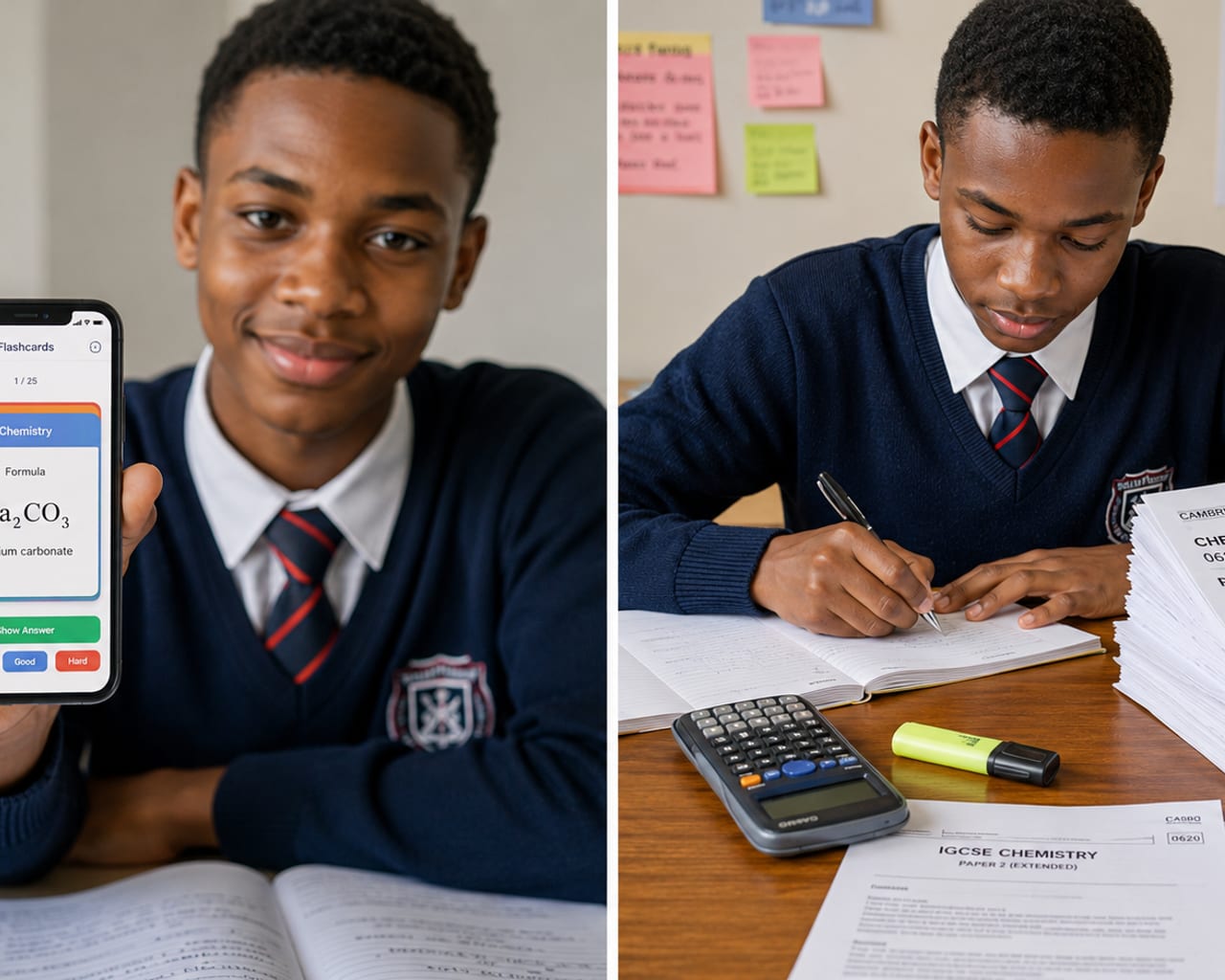
Every IGCSE student gets the same advice: "do past papers". And every IGCSE student also gets told "make flashcards". So which one is better? The honest answer, based on watching Kenyan candidates get A* versus stalling at C: you need both, but in a specific order and a specific ratio. Here is what actually works.
What flashcards are good for
Flashcards win for one thing: fact retrieval under time pressure. The brain needs to recall facts, formulae, and definitions instantly: within a second, without thinking. Flashcards train that recall using a technique called active retrieval. Each time you flip a card and force your brain to produce the answer before checking, you strengthen the memory. Re-reading notes doesn't do this; flashcards do.
What flashcards drill well:
- Definitions: "What is osmosis?", "Define electromagnetic induction"
- Formulae: "v = u + at", "F = ma", "PV = nRT"
- Reactions and ion colours: "Cu²⁺ colour?", "Test for chloride ions?"
- Single-fact recall: "Half-life of carbon-14?", "Standard form of 0.000056?"
- Command word meanings: "What does 'state' mean in Cambridge?"
If you can't recall these in under 5 seconds, you will spend exam time fishing for them and run out of time on the hard questions.
What flashcards are NOT good for
Flashcards do not train extended reasoning. They do not teach you how to structure a 6-mark question, time a Paper 4, or recognise that a question about "energy transfer in a kettle" is secretly testing specific heat capacity. For that you need past papers.
What past papers are good for
Past papers win for three things:
- Pattern recognition. Cambridge re-uses question structures session after session. The student who has done 20 Paper 4s in their subject has seen the patterns; the one who has done 2 hasn't.
- Timing. Knowing physics is not the same as doing physics in 75 minutes under exam pressure. Past papers under timed conditions train pacing.
- Mark scheme intuition. Reading mark schemes teaches you what Cambridge actually rewards. The student who marks their own papers using the official scheme develops a sixth sense for "this is a 1-mark question, don't write a paragraph".
The right ratio: and the right order
If you have 12 weeks before your exam, here is the ratio that works:
Weeks 1–3: 80% flashcards, 20% past papers. Lock in the fact base first. Build the recall. Do one past paper a week so you start seeing patterns, but most of your time is flashcard drilling.
Weeks 4–7: 50/50. Switch your time evenly. Past papers expose what facts you still don't know: go back and add those to your flashcard deck. Flashcards reinforce what past papers expose.
Weeks 8–11: 80% past papers, 20% flashcards. By now the facts should be solid. Now you need timed practice, pattern recognition, mark scheme study. Keep flashcards for the small handful of facts that stubbornly won't stick.
Week 12: Past papers only, light flashcard review of weakest facts. No new material. Sleep eight hours.
The mistake most students make
They go straight to past papers without building the flashcard base first. They sit a Physics Paper 4, get half the questions wrong because they don't recall formulae, get demoralised, and convince themselves they are "bad at Physics". The honest diagnosis: they tried to test reasoning before they had the inputs to reason with.
The flip side mistake: only doing flashcards, never past papers. They know every definition cold but melt under the timed structured questions because they have never practised the form.
How to make flashcards that work
Bad flashcards: "Photosynthesis" → "the process by which plants make food". Re-reads a definition; doesn't test recall hard enough.
Good flashcards: "Write the word equation for photosynthesis." → "carbon dioxide + water → glucose + oxygen (in chlorophyll, using light)". Forces you to produce a specific structured answer.
Better: "What are the four conditions needed for photosynthesis?" → "Light, chlorophyll, CO₂, water (and a suitable temperature)". Forces multi-fact recall.
Rules of thumb for flashcards:
- One concept per card. Don't try to fit a whole topic on one card.
- Question side should force production, not recognition. "Define osmosis" beats "Osmosis is the diffusion of water across…"
- Review cards you got wrong twice as often as cards you got right. The Leitner system (boxes by difficulty) automates this.
- Make them mobile. Cards on your phone get used in matatu queues; cards in a binder at home get forgotten.
What about online flashcards vs paper?
Paper flashcards work but you have to make and carry them. Digital flashcards (Anki, Quizlet, our own Smart Flashcards) win on three counts:
- Spaced repetition: the app automatically shows you cards more often when you get them wrong
- Portability: your whole deck is in your phone
- Pre-built decks: somebody else already made the cards for the Cambridge syllabus you are studying
How we built Smart Flashcards for Kenyan IGCSE
We launched Smart Flashcards specifically for Cambridge IGCSE syllabuses: Maths 0580, Physics 0625, Chemistry 0620, Biology 0610. Each card is tagged with strand and difficulty, tap-to-flip, with keyboard shortcuts for fast drilling. Free for 10 cards per subject per day; unlimited as a CBCEduKenya Plus member.
Try the Smart Flashcards now.
→ Open IGCSE Smart Flashcards: Maths · Physics · Chemistry · Biology. Free 10/day per subject.
Then add the past papers: → IGCSE Cambridge Hub: KSH 200 per subject revision pack or KSH 700 for the complete 7-subject bundle.
Flashcards build the foundation. Past papers prove the building stands. Use both, in that order, and you will outperform any classmate who chose only one.
Sources: cognitive science research on active retrieval and spaced repetition (Roediger, Karpicke); Cambridge International examiner reports; teaching observation across Nairobi IGCSE classrooms 2024-2026. Last updated: June 2026.
Online IGCSE tutoring for adults and private candidates: expert lessons, marked practice and a two-year plan, around your schedule.
See IGCSE Tutoring packages →
IGCSE Revision Materials
Notes and topical questions for the core IGCSE subjects, timed to the Oct/Nov series.
⏳ Only 39 days to the national assessments on 26 October. Start now.
from KSH 350 · Get it now → 📱 M-Pesa, instant download · join parents preparing nowHave a CBC question this article didn't answer?
Ask Somo, Kenya's first AI tutor. CBC-grounded, Kenyan examples, instant feedback. Five free questions a day with no signup, or start a 7-day free trial for 30 questions a day.
Try Somo Free →