
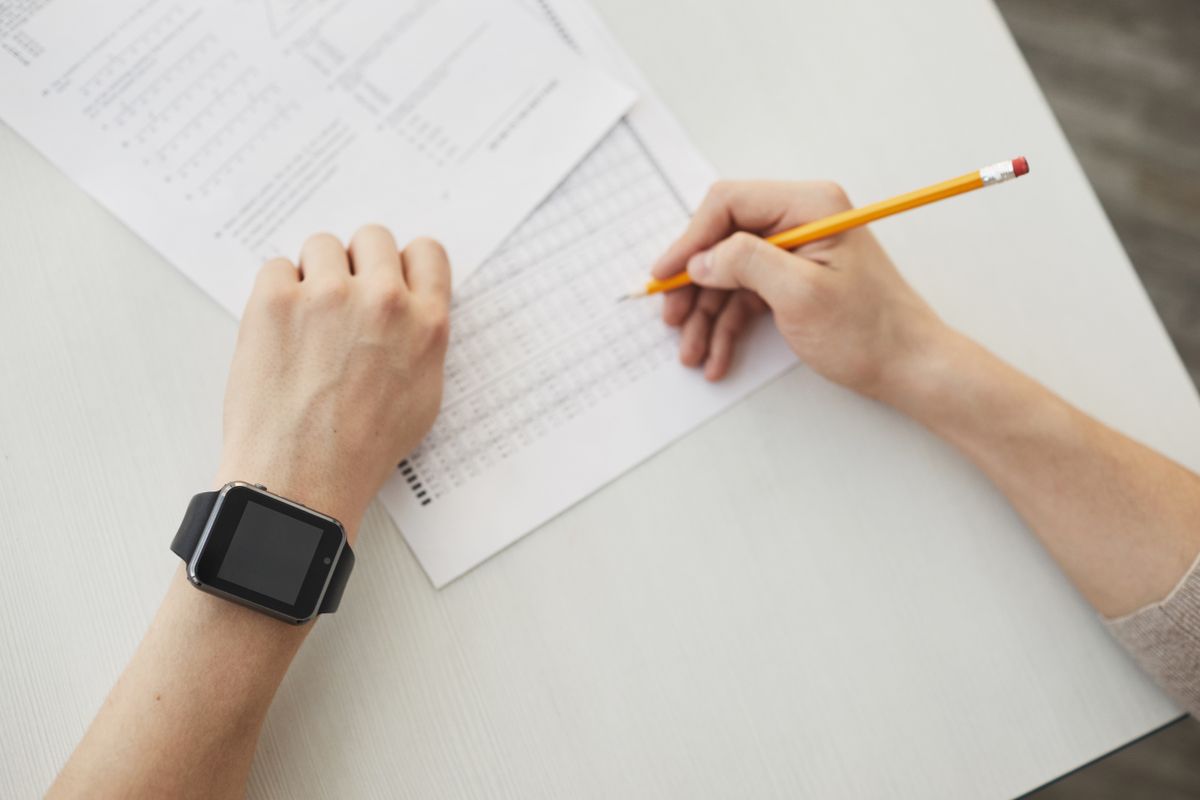
Ask any teacher what separates a good result from a great one, and many will give the same answer: mock papers. Reading notes builds knowledge, but sitting a full paper under timed conditions builds the skill of actually scoring on the day. This guide explains why mocks work and how to use them well for KJSEA and KPSEA 2026, using the format-accurate mock papers in our KJSEA and KPSEA Complete Revision Courses (with free samples).
- Mock papers build the skill of scoring under time, which reading notes cannot.
- The value is in the debrief: marking against the scheme and correcting, not just sitting the paper.
- Start mocks a few weeks in, once topics are covered, and repeat them to track improvement.
- Keep an error log so revision targets the exact topics that lost marks.
- KJSEA and KPSEA run 26 October to 20 November 2026, leaving time for several timed mocks per subject.
There is a well-established idea in learning science behind all this, the "testing effect": actively retrieving information under exam-like pressure strengthens memory and exposes gaps far more effectively than re-reading. A learner who reads a chapter five times often feels confident yet scores poorly, because recognition ("I've seen this") is mistaken for recall ("I can produce this from memory"). A mock paper forces genuine recall against the clock, which is exactly what the real assessment demands. This is why teachers lean on mocks in the final weeks, and why a single well-debriefed mock frequently teaches more than a week of passive revision.
Why mock papers lift grades
A mock paper does three things that revision alone cannot:
- It builds exam stamina and timing. Sitting a full paper teaches a child to pace themselves so they finish, and to move on from a hard question instead of freezing.
- It reveals the real weak spots. A child may feel confident until a full paper shows exactly which topics cost marks. That is gold, because now you know what to revise next.
- It removes fear of the format. When the exam looks familiar, on the day, a child stays calm and reads questions properly instead of panicking.
How to use a mock paper well
- Sit it under real conditions. A quiet table, the correct time limit, no notes. This is where the stamina and timing are built.
- Mark it against the scheme. Award marks point by point, exactly as a real marker would. Every subject in our courses now includes a detachable answer booklet, so you keep the marking scheme and mark afterwards.
- Go through the mistakes together. The learning happens in the correction, not the sitting. Understand why each mark was lost.
- Revise the weak topics, then try another paper. One mock shows the gaps; the next shows the improvement.
How mock technique differs by subject
A mock is not one skill but several, and each subject rewards a slightly different approach. Understanding this turns a general "do mocks" instruction into targeted practice.
- Mathematics. The single biggest mock lesson is to show every step, because method marks are awarded even when the final answer is wrong. In the debrief, look for answers with no working: those are marks thrown away. Timing matters most here too, since a stuck question can swallow ten minutes; the mock teaches the discipline of leaving it and returning.
- Languages (English and Kiswahili). Mocks train the composition clock above all: how long to plan, write and check within the section time. They also reveal comprehension habits, whether the child answers in full sentences and uses their own words, which a marked paper exposes instantly.
- Sciences. The debrief focus is the "explain" versus "state" distinction and giving the right number of points. Science mocks also reveal diagram habits: neat, labelled diagrams score; rushed ones lose easy marks.
- Social Studies and humanities. These reward structured factual answers and, at Grade 9, map-skill calculations. A mock quickly separates the strands a learner knows from those they have skipped.
Because each subject's mock teaches something different, a learner benefits from mocks across all subjects, not just the ones they enjoy. The subject a child avoids is usually the one where a mock reveals the most.
Common mistakes when using mocks
- Sitting mocks but never debriefing them. A pile of marked papers with no corrections is wasted effort; the grade lives in the debrief.
- Doing them open-book or untimed. That is topical practice, valuable, but not a mock. A mock must simulate the real conditions to build the real skill.
- Only revising after a bad score, not tracking the trend. One score is noise; the direction across several mocks is the signal.
- Cramming mocks into the final week. Mocks late are diagnosis with no cure. Spread them from August so there is time to act on each.
- Marking too generously. A parent who awards a mark for "nearly right" hides the very gaps the mock exists to reveal. Mark exactly as the scheme says, even when it feels harsh; it is kinder than a surprise in November.
- Using only past papers of unknown format. A mock is only useful if it matches the current assessment's structure and mark allocation; an out-of-date paper trains the wrong habits.
Timing: the skill most learners lack
Many able learners lose marks simply because they run out of time. A mock trains them to glance at the marks available, spend the right amount of time on each question, and leave a hard one to come back to. This single habit can lift a score without learning any new content. Our marking-scheme guide shows how to award the marks accurately.
A concrete way to teach timing: before starting a mock, have the learner write the finish time for each section at the top of the paper, worked out from the marks. In a two-hour paper worth 100 marks, that is roughly one minute per mark plus a little checking time, so a 20-mark section should be done in about 22 minutes. Glancing at those pre-written checkpoints during the paper is what stops a learner discovering, with ten minutes left, that they still have two full questions to write. After a few mocks this pacing becomes automatic, and it is one of the most reliable ways to add marks in the final month without learning a single new fact. Parents can help simply by being the timekeeper for the first two or three mocks until the child internalises the rhythm.
What a good mock debrief looks like
The sitting is the easy part; the debrief is where grades move. Here is the exact routine to follow after every mock, using a worked example.
Suppose a Grade 9 learner scores 58% on an Integrated Science mock. A weak debrief says "58, could be better, revise more". A strong debrief opens the marked paper and sorts the lost marks into three piles: knowledge gaps (a topic genuinely not understood, for example energy transfers), technique losses (knew it but gave two points where the scheme wanted three, or wrote "it moves" where "explain" needed a reason), and timing losses (the last two questions rushed or blank). Each pile has a different fix: knowledge gaps mean re-studying that topic's notes; technique losses mean practising the marking-scheme habit; timing losses mean the next mock is done with a visible clock and a per-question time budget. The same 58 that looked like a vague disappointment becomes a precise three-item action list. Repeat this after every paper and the score climbs because the corrections are targeted, not general.
Keep a simple error log, a single page listing each recurring problem topic. When the same topic stops appearing, it is fixed. When a topic keeps returning across several mocks despite revision, that is the clearest possible signal that it needs a different approach, a teacher, a tutor, or the worked examples in a revision course, rather than simply more re-reading.
When to start mocks, and how often
Begin with topic revision and topical questions, then bring in mock papers once your child has covered enough ground, usually a few weeks out, and repeat them as the exam approaches. The 2026 assessments run 26 October to 20 November, so there is time to sit several. A sensible schedule for the run-in looks like this:
| Phase | Mock activity |
|---|---|
| July | Notes and topical questions first; no full mocks yet, just building the content base |
| August (holiday) | First full timed mock in the two weakest subjects; debrief each carefully |
| September | One or two mocks per week across all subjects, error log kept, scores tracked |
| Early October | Final mocks in the weakest subjects only; then wind down to light review |
Fit this into a full plan with our KJSEA study plan or KPSEA timetable.
Setting up real mock conditions at home
The "real conditions" part is easy to say and easy to fudge, so make it concrete. Choose a clear table away from the television and other children, put the phone in another room (the child's and yours), and set a visible clock or timer for the exact paper length. Print the paper so the child writes on it as they would in the hall, rather than reading from a screen and answering in a book. Lay out only what the real exam allows: pens, pencil, ruler, mathematical set and an approved calculator where permitted, nothing else. Tell the household that the next two hours are exam time. These small touches matter because the goal is to rehearse not just the questions but the whole experience, so that on 26 October the room, the clock and the silence all feel familiar rather than frightening. A child who has sat six mocks in these conditions walks into the real assessment with the single biggest advantage revision can give: it feels like something they have already done.
Get format-accurate mocks for every subject
The KJSEA Grade 7-9 and KPSEA Grade 4-6 Complete Revision Courses include mock papers with full marking schemes for every examinable subject, alongside notes and topical questions. See a free sample, and join our free Facebook community for more tips.
Frequently asked questions
How many mock papers should my child do?
Enough to build confidence and timing, typically several per subject in the weeks before the exam, each followed by careful correction.
Should mocks be timed?
Yes. The timing is half the benefit. A mock done with notes and no clock builds knowledge but not exam skill.
My child scores badly on mocks and gets discouraged. Should we stop?
No, but change how you frame it. A low mock score in August is information, not a verdict; it is doing its job by finding the gaps while there is still time to fix them. Praise the effort and the corrections, track the score trend rather than any single result, and the discouragement usually fades as the numbers climb. A learner who never scores badly on a mock is sitting mocks that are too easy to be useful.
Is one big mock better than several short ones?
Several, spaced out, beat one. Each mock plus debrief is a full learning cycle, and repetition across weeks is what embeds both content and technique. One mock the night before the exam mostly creates anxiety with no time to act on what it reveals.
Can a parent mark a mock without knowing the subject?
Yes, if the mock comes with a marking scheme. The scheme tells you exactly what earns each mark, so you award points by matching your child's answer against it. Doing this together also teaches the child to think like a marker, which is itself worth marks.
The bottom line
Mocks are the closest thing to a shortcut that honest revision offers: they raise scores partly through better knowledge but mostly through better exam technique and timing, gains available to every learner regardless of ability. Sit them under real conditions, debrief them properly, keep an error log, and repeat. Do that from August to October and your child walks into the 26 October window having already sat the exam, in every way that matters, several times over.
Have a CBC question this article didn't answer?
Ask Somo: Kenya's first AI tutor. CBC-grounded, Kenyan examples, KNEC 1–7 feedback. 5 free questions/day, no signup.
Try Soma Free →