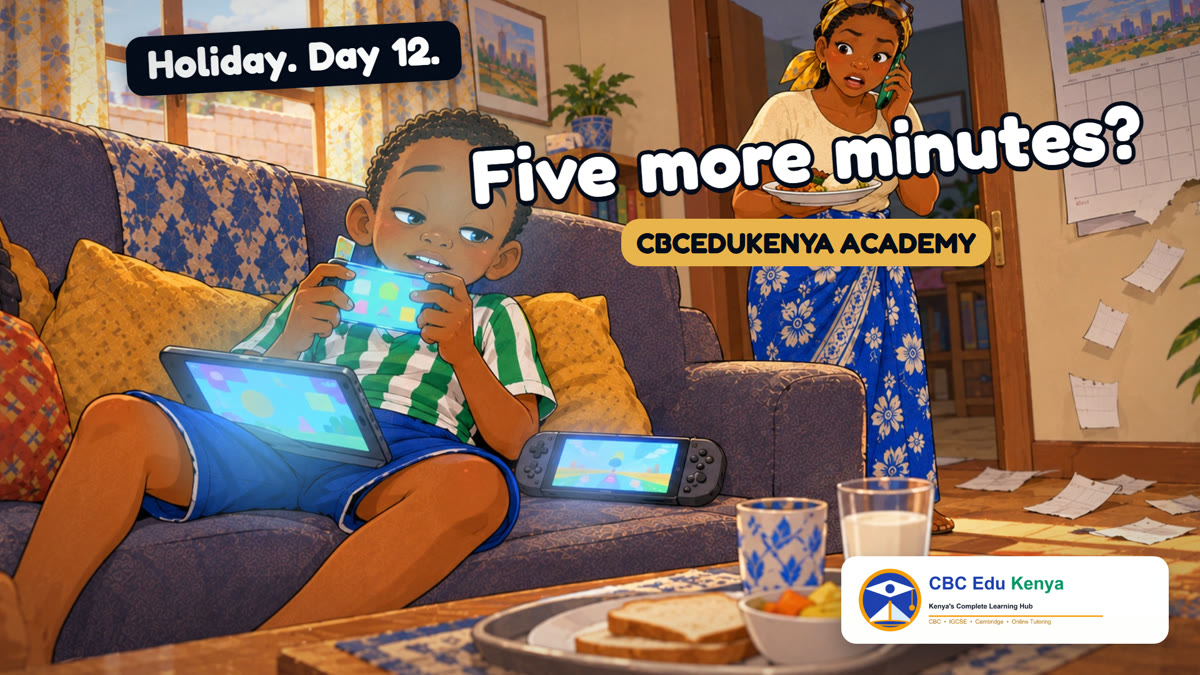
It is Day 12 of the school holiday. Your child has been on three screens since breakfast, lunch is going cold, and every call from the kitchen gets the same answer: "Five more minutes." Then five more. If that sounds like your house, you are not failing. You are meeting a very well-designed habit with no plan, and a plan is what this page gives you.
Below are seven moves to try this week and straight answers to the questions we hear most. We also made a short cartoon about it. Watch it with your child, then decide together what changes on Monday.
Watch the 89-second story: "Holiday, Day 12"
A story with cartoon characters, made by CBC Edu Kenya. Prefer YouTube? Open it here: youtu.be/pyxh7socsfc. For more information, click the link in the description on YouTube or use the button at the end of this page.
Why "five more minutes" wins every time
Games, videos and short clips are built so that there is always one more level, one more video, one more scroll. Nobody has to decide to keep going, because stopping is the part that takes effort. So an argument at the moment of stopping is the hardest place to win. The rules need to be set earlier, when everybody is calm and the screen is dark.
The problem is rarely one hour of cartoons. It is a whole day turning into screen time because nothing else has a fixed time. A holiday has no bell, so the screen becomes the timetable.
Seven moves to try this week
Pick one or two to start. Children push back less on a small change that sticks than on a big list that collapses by Wednesday.
| Move | What to do | Why it helps |
|---|---|---|
| 1. Set rules at breakfast | Agree when screens start and stop before anyone touches a device | No argument at the moment of stopping |
| 2. One visible timetable | Write the day on paper and stick it on the fridge or wall | The plan stays the same when your mood changes |
| 3. Plan first, screen second | Chores, a learning hour and outside time come before free screen time | Screens become the reward, not the default |
| 4. A clock is the referee | Use a kitchen timer or phone alarm, not your voice | The clock says stop, so you do not have to |
| 5. Devices sleep in the living room | Charge phones and tablets outside bedrooms at night | Protects sleep and the next morning |
| 6. Meals have no screens | Everyone, including adults, leaves devices away from the table | Lunch is eaten while it is hot, and you talk |
| 7. Replace, do not only remove | Give your child something real to do at the time the screen used to fill | An empty hour will refill with a screen |
A holiday day that does not feel like school
An example only. Change it to suit your home.
- Morning: breakfast, a chore, then a short outdoor or playing block.
- Mid-morning: one fixed learning hour. A live class counts here, and so does reading or maths practice at the table.
- Midday: lunch with no screens.
- Afternoon: free time, with screen time inside the limit you agreed.
- Evening: family time, then devices go to the charging spot.
For learners who are heading into KPSEA or KJSEA years, our guide to sleep, food and screens in the last two weeks before the exams shows the same ideas at exam pace, and the 70-day holiday revision plan shows how to spread a long break across weeks.
What not to do
- Do not confiscate in anger. It teaches your child to hide the device, not to manage it.
- Do not use exams as a threat.
- Do not break your own rules. If adults scroll through meals, the rule will not survive.
Where a live class fits in
An honest point first: an online class is also a screen. The difference is what happens on it. A live class starts at a fixed time, lasts about an hour, and has a real teacher who expects your child to answer and ask questions. When it ends, it ends. That gives the learning hour a start, a stop and a person, which is exactly what a holiday day is missing. If you want to compare live classes with other options, see online tuition, a home tutor and revision books compared and seven questions to ask before you pay for holiday tuition.
| Academy fact | What it is |
|---|---|
| Name | CBCEDUKENYA ACADEMY: live online classes by CBC Edu Kenya |
| Who it is for | CBC (CBE) learners in Grades 4 to 10, and IGCSE learners |
| Format | 4 live classes a week, about 60 minutes each, with a real teacher who answers questions live |
| After class | Notes after every class |
| CBC subjects | Mathematics, English, Kiswahili, Integrated Science, Social Studies, Business Studies |
| CBC price | KSh 3,000 a week, KSh 6,000 for 2 weeks, KSh 12,000 a month |
| IGCSE price | Exactly double: KSh 6,000 a week, KSh 12,000 for 2 weeks, KSh 24,000 a month |
| How to pay | M-Pesa |
| How to join | WhatsApp 0711 344 702 with the grade and subjects, we confirm the class group and timetable, pay, join live from a phone or laptop |
Start small, start this week
Choose one move from the table, tell your child at breakfast, and keep it for a week. In the film, Baraka is still saying "five more minutes" on Day 40, but for a different reason: he does not want his class to end. A holiday can go that way too. If you would like a real teacher in the plan, the Academy is one WhatsApp away.
Frequently asked questions
How many hours of screen time is too much for a child in the holidays?
There is no single number that fits every child. Pick a daily limit you can actually enforce, and protect sleep, meals, movement and a fixed learning hour first. Whatever time is left is free screen time.
How do I stop my child from arguing when screen time ends?
Agree the rule before the day starts, use a timer as the referee, and give a five-minute warning. The argument is smaller when the stop time was decided earlier and in a calm moment.
Is an online class just more screen time?
Yes, it happens on a screen. But a live class is time-boxed to about 60 minutes, has a real teacher, and your child takes part instead of scrolling. It can serve as the learning hour in the day.
Which learners can join CBCEDUKENYA ACADEMY?
CBC (CBE) learners in Grades 4 to 10, and IGCSE learners. WhatsApp 0711 344 702 with the grade and subjects, and we confirm the class group and timetable.
How much does it cost?
CBC is KSh 3,000 a week, KSh 6,000 for 2 weeks or KSh 12,000 a month. IGCSE is exactly double: KSh 6,000 a week, KSh 12,000 for 2 weeks or KSh 24,000 a month. You can pay by M-Pesa.
KJSEA and KPSEA revision courses
The Grade 9 KJSEA course covers all 9 learning areas for KSH 400. The Grade 6 KPSEA course covers all 5 subjects for KSH 300. Notes, worked examples, topical questions and full marking schemes in both.
KSH 300 or KSH 400 · Get it now → 📱 M-Pesa, sent to your email after payment · join parents preparing nowHave a CBC question this article didn't answer?
Ask Somo, Kenya's first AI tutor. CBC-grounded, Kenyan examples, instant feedback. Five free questions a day with no signup, or start a 7-day free trial for 30 questions a day.
Try Somo Free →