
Do you remember the first time a teacher read your composition aloud to the class? The flush of pride, the way your chest tightened with something between embarrassment and joy? Or the poem you scribbled in the back of an exercise book during a boring afternoon lesson, the one you never showed anyone but secretly hoped someone, somewhere, would one day read?
Most of us have a memory like that. And most of us, somewhere between school and adulthood, stopped writing.
It isn't because we ran out of things to say. It's because the world got faster. We started scrolling instead of reading, recording instead of writing, reacting with an emoji instead of a paragraph. We consume more content in a single day than our grandparents read in a month, and yet, somehow, we write less than they ever did. The diary entry, the handwritten letter, the composition book filled cover to cover: these are quietly disappearing from Kenyan homes and classrooms.
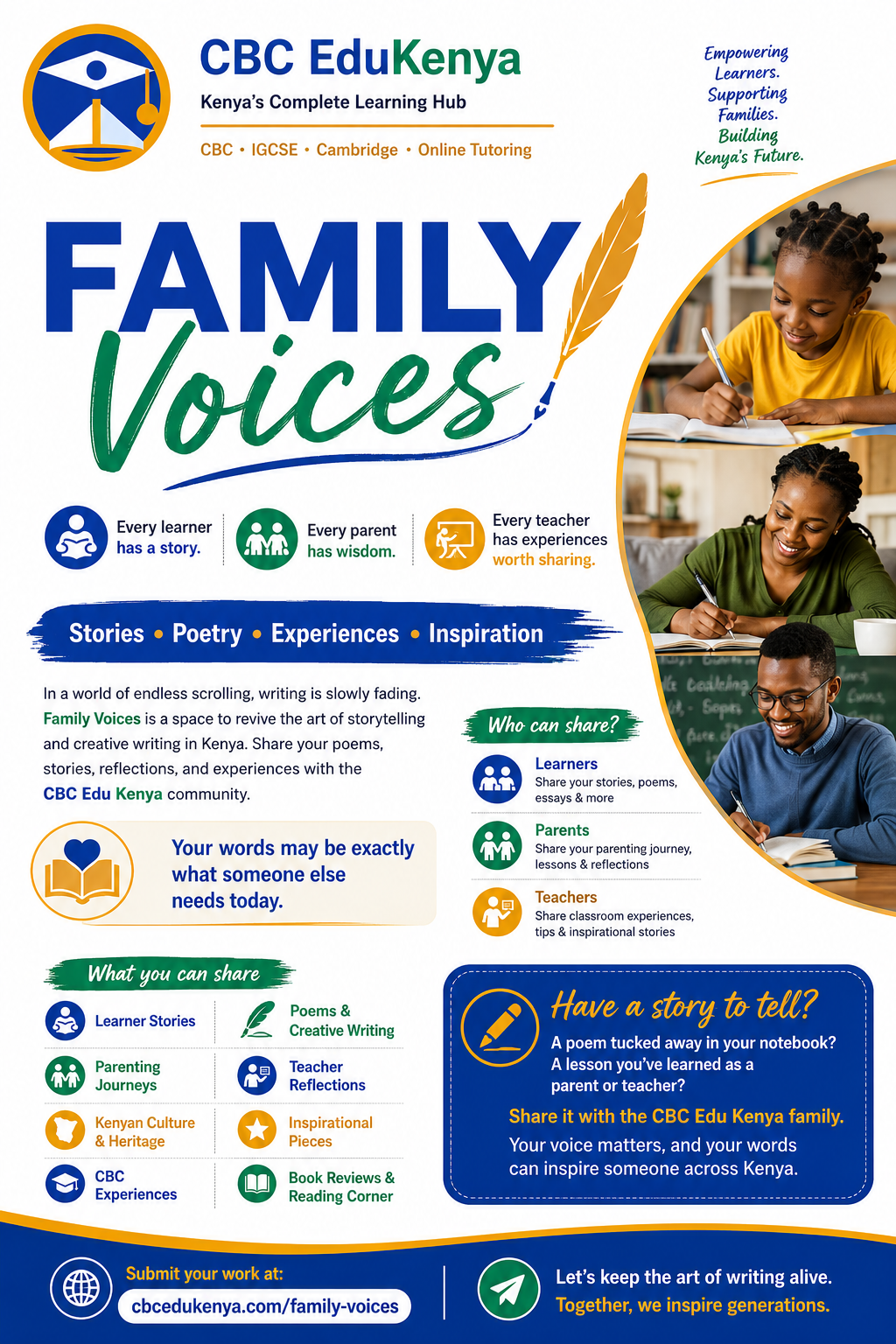
CBCEdu Kenya wants to change that. Today, we're launching CBCEdu Family Voices, a new home within CBCEdu where students, parents, and teachers can share stories, poems, reflections, and real-life experiences with the wider CBCEdu family.
Why We're Building This
CBCEdu has always been about more than past papers and revision packs. From the beginning, the goal was to build a platform that understands Kenyan families: the pressure of exam season, the pride of a child finally grasping long division, the late-night WhatsApp messages between parents comparing notes on a confusing new CBC strand. We've spent years organising notes, schemes of work, and rubrics. But information alone doesn't make a community. Stories do.
Think about what actually moves people. It's rarely a statistic. It's a mother's account of helping her son catch up after he fell behind in Grade 6. It's a teacher's honest reflection on a lesson that completely flopped, and what she changed the next day. It's a teenager's poem about waiting for KCSE results, written at 2 a.m. with a candle because there was no power. These are the moments that make education feel human, and right now, Kenya has nowhere built specifically to hold them.
We believe:
- Every learner has a story, even the ones who think they have nothing interesting to say.
- Every parent has wisdom, earned the hard way, through trial, worry, and small victories.
- Every teacher has experiences worth sharing, the kind that never make it into a staff meeting but would mean everything to a struggling colleague.
Somewhere in Kenya right now, there's a future journalist in a Grade 9 classroom in Kakamega. There's a poet in Eldoret who has never shown anyone her notebook. There's a teacher in Garissa who has quietly figured out something about reaching struggling learners that deserves to be heard nationally, not just in her staffroom. CBCEdu Family Voices exists so that those people don't have to wait for permission to be heard.
What You Can Share
Family Voices is deliberately broad, because real life doesn't sort itself neatly into categories. Here's what we're inviting:
Student stories and experiences. This could be about school life, friendship, a tough exam, a proud moment, or simply what an ordinary Tuesday looks like for a Grade 7 learner in your county. We want range: funny, painful, ordinary, extraordinary.
Poems and creative writing. Swahili, English, Sheng, or a mix. If it rhymes, if it doesn't, if it's about love or loss or your school's leaking roof, we want to read it.
Teacher reflections and classroom experiences. What's a lesson that taught you something about teaching itself? What do you wish you'd known in your first year? What's a moment with a learner that's stayed with you?
Parenting journeys and lessons learned. CBC has changed a lot for Kenyan parents: the language, the assessments, the homework that sometimes needs a parent to do research just to help. Tell us what you've learned, what surprised you, what you'd tell another parent starting the same journey.
Inspirational stories of resilience, hope, and success. The learner who almost dropped out and didn't. The family that found a way. The small win that felt enormous at the time.
You do not need to be a professional writer, and you do not need perfect grammar. You need a story worth telling, and the willingness to tell it in your own words.
How It Works
We've built Family Voices to be simple enough for a Grade 8 learner to use with a parent's help, and serious enough that a teacher can submit a polished reflection and feel proud to see it published.
Here's the flow, from submission to publication:
- You submit your piece through the Family Voices submission form: your name or pen name, a category (Story, Poem, or Reflection), your title, and your writing (anywhere from 200 to over 1,000 words). Age, class, county, and a photo are optional. If you used any AI tool to help write or polish your piece, you'll tell us that too, because we believe in being upfront about that.
- We check it. Every submission passes through a basic spam and originality check before a real person looks at it.
- A moderator reviews it. This isn't a rubber stamp; someone reads every submission with care, the same way a teacher reads a composition.
- We polish, never rewrite. If a piece needs light editing for grammar or formatting, we'll do that gently. Your voice stays yours. We are not in the business of turning your story into something it isn't.
- It gets published under CBCEdu Family Voices, where it lives permanently with your name (or pen name) attached, ready to be read, shared, and, if it's good enough, featured.
- The best work gets noticed. We're building recognition into Family Voices from day one: Featured Writer of the Month, Young Poet of the Month, an Inspiring Teacher Award, and a Parent Voice Award. Contributors build a profile with badges as they publish more, because showing up consistently to write deserves to be seen.
A Few Things You Should Know
We want Family Voices to feel safe, fair, and honest, so a few ground rules apply, written here in plain language rather than buried in fine print:
- Your work stays yours. We ask for a non-exclusive licence to publish, display, and lightly edit your submission, but you keep ownership of what you write, always.
- Submission doesn't guarantee publication. We genuinely read everything, but not every piece will be a fit, and that's okay. Keep writing anyway.
- No payment is involved. This is a community space, not a freelance marketplace; contributions are voluntary, made in the spirit of sharing rather than earning.
- If you're under 18, a parent, guardian, or teacher needs to be involved in the submission on your behalf. We take this seriously.
- We protect young writers' privacy. Where a contributor is a minor, we'll avoid publishing unnecessary personal details, and we may anonymise information where it makes sense to do so.
- If something's wrong, tell us. We can edit, unpublish, or remove content, including in response to a legitimate copyright concern, because getting this right matters more than getting it published fast.
Why This Matters More Than It Looks Like It Does
It's tempting to read all of this and think: it's just a blog section for personal stories. But step back for a second and think about what's actually happening in Kenyan classrooms and homes right now. An entire generation is growing up more fluent in scrolling than in sentence-writing. Composition lessons compete with TikTok for a learner's attention, and they are losing. Even strong students who can analyse a comprehension passage flawlessly sometimes freeze when asked to write 300 words about themselves, because nobody has asked them to in years.
Writing isn't just an academic skill tested in an exam room. It's how people process grief, celebrate wins, make sense of a confusing new curriculum, and leave something behind for the people who come after them. A grandmother's handwritten recipe. A father's letter to a son leaving for boarding school. A teacher's notes scrawled in the margin of a lesson plan that, twenty years later, still shape how a former student teaches their own class. These things matter because they are real, and because they outlast the moment they were written in.
CBCEdu Family Voices is our attempt to give that instinct, the human need to put feeling into words, a place to land. Not a polished literary journal that intimidates beginners. Not another social feed optimised for likes. A genuine, modest, growing archive of real Kenyan voices: a learner's poem read by another learner two counties away who needed exactly those words today; a teacher's hard-won classroom lesson read by a first-year teacher who needed exactly that advice this week; a parent's honest account of a difficult term read by another parent who thought they were the only one struggling.
Your Story Starts Here
We don't know yet who the first Featured Writer of the Month will be. We don't know if the next great Kenyan poet is sitting in a Form 2 classroom in Nyeri or helping her mother sell vegetables in Gikomba after school, writing in a notebook nobody has read yet. That's the whole point: we won't know until someone writes, and someone shares.
So if you've been carrying a story, a poem, or a reflection that you've never quite found the right place for, this is that place.
Write. Share. Inspire.
Because the next great Kenyan story might begin with you, and we'd be honoured to be the first ones to read it.
KJSEA and KPSEA: 36 days to the first paper
The Grade 9 KJSEA course covers all 9 learning areas for KSH 400. The Grade 6 KPSEA course covers all 5 subjects for KSH 300. Notes, worked examples, topical questions and full marking schemes in both.
⏳ Only 36 days to the national assessments on 26 October. Start now.
KSH 300 or KSH 400 · Get it now → 📱 M-Pesa, instant download · join parents preparing nowHave a CBC question this article didn't answer?
Ask Somo, Kenya's first AI tutor. CBC-grounded, Kenyan examples, instant feedback. Five free questions a day with no signup, or start a 7-day free trial for 30 questions a day.
Try Somo Free →