
Start here: Grade 10 SBA 2026 hub: the timeline to 31 October, the 15 percent, and the parent checklist, updated weekly.
If you have a Grade 10 learner, you have probably heard four letters that cause a little panic at home: CSL. Community Service Learning is a compulsory Senior School subject, its project is assessed, the score goes to the CBA portal, and because 2026 is the very first Senior School cohort, nobody has an older sibling's project to copy from. This guide walks you through the entire project, start to finish, including the marking rubric teachers use and a complete worked example, so your child can aim for the top level from day one.
What the CSL project actually is (and why it exists)
Under CBE, learning is judged by what a young person can do, not only what they can recall in an exam room. The CSL project is the clearest expression of that idea in Grade 10: the learner identifies a genuine problem in their own community, plans a small service activity to help, carries it out (usually in a group), documents evidence, writes a report with a personal reflection, and presents the work. The teacher then places the work at one of four levels: Below Expectation (BE), Approaching Expectation (AE), Meeting Expectation (ME), or Exceeding Expectation (EE), and uploads the score to the CBA portal.
Two things follow from this that most families miss. First, the project cannot be skipped or done overnight; it accumulates evidence over weeks. Second, big and expensive does not score well. The curriculum explicitly expects materials from the immediate community, improvised and low-cost. A KSH 250 project with honest evidence beats a KSH 5,000 project with none.
The six steps, properly explained
Step 1: Identify a real community problem
Walk the neighbourhood with open eyes. Talk to a shopkeeper, an elder, a teacher at the local primary. The question to ask is: what small problem here could a 15-year-old genuinely help with? Strong choices are local and visible: litter at the bus stage, younger pupils who cannot read fluently, no handwashing point at the market, an elderly neighbour's overgrown compound. Write down what you see and who you spoke to; that becomes your evidence of need.
The mistake that costs marks: choosing something enormous ("end poverty") or invented. If you cannot point to the actual people affected, the problem is not specific enough yet.
Step 2: Plan it like a small project manager
Turn the problem into two or three measurable objectives. "Help the environment" is weak; "raise 60 seedlings by week 4 and transplant at least 40 around the school compound" is strong, because at the end anyone can check whether it happened. List activities, resources, a budget in shillings, a timeline with dates, and who in the group does what. Then get permission: from the teacher, from parents, and from whoever owns the site (the school head, a landowner, the chief's office). Projects have been stopped on the day because nobody asked.
Step 3: Implement, safely and steadily
Do the work over several sessions, not one rushed afternoon. Share tasks so every group member has something to point to; teamwork is assessed. Work with an adult aware of where you are, and stop anything that feels unsafe. Steady beats spectacular: a watering rota kept for four weeks is exactly the kind of evidence that impresses.
Step 4: Document as you go
This is where projects are won and lost. Fill a logbook the same day as each activity: date, what was done, who took part, numbers, and what evidence was collected. Take dated photos, before and after shots especially. Count things: trees planted, pupils taught, sacks of litter, litres of water. Collect a short written comment from someone helped. A learner who documents daily can prove impact; one who tries to reconstruct it at the end cannot.
Step 5: Write the report and the reflection
Use these headings, in this order: Title, Background and Need, Objectives, Plan, Implementation, Results and Impact, Challenges, Reflection, Recommendations, Evidence/Appendix. The section most learners underweight is Results and Impact: state what changed, with numbers, against the objectives you set. The reflection is personal, and it is marked (more on it below).
Step 6: Present it
Prepare a short talk: the problem, what you did, the results, what you learned. Show the photos. Let every group member speak. Do not read the report aloud; talk about the project as something you actually did, because you did.
How it is marked: the rubric, level by level
Teachers assess across areas like these. Read the EE column with your child and treat it as the target.
| Assessed area | BE looks like | ME looks like | EE looks like |
|---|---|---|---|
| Problem identification | Vague or invented problem | A real, relevant problem, clearly identified with some evidence | A real, urgent need with strong evidence and insight into its causes |
| Planning | No objectives, budget or timeline | Clear plan with measurable objectives, budget and timeline | Thorough, realistic plan with roles, costed budget and back-up options |
| Implementation | Little actually done | Carried out largely as planned, with real effort | Fully carried out, adapted intelligently when things went wrong |
| Teamwork and citizenship | One person did everything | Tasks shared, genuine spirit of service | Led and united the group, drew the community in |
| Documentation | No usable evidence | Logbook, dated photos and records that show the work | Organised evidence with before and after numbers that prove impact |
| Report | Missing most headings | Complete, clear, all headings used | Results explicitly linked back to objectives; polished throughout |
| Reflection | Copied or one line | Honest, names competencies gained | Specific, self-aware, shows real personal growth |
| Presentation | Cannot explain the project | Clear, confident, uses evidence | Engaging, whole group contributes, handles questions with ease |
Notice the pattern down the EE column: numbers, honesty, adaptation, and everyone involved. None of it requires money.
Twelve project ideas that fit the criteria
Each of these is local, low-cost, measurable and safe, which is exactly the test your child should apply to any idea:
- Tree nursery in recycled containers at school, transplanted around the compound (count seedlings raised and surviving).
- Tippy-tap handwashing stations from jerricans at a local primary, plus a handwashing demonstration (count stations and pupils taught).
- Reading corner for a nearby primary: collect and repair storybooks, run read-aloud sessions (count books and readers).
- Marked litter clean-up of a defined stretch (metres covered, sacks collected, before and after photos).
- Compost pit and training for neighbouring homes (kilos of waste diverted).
- Adopt-a-grandparent: weekly visits to elderly neighbours for chores and company (visits logged).
- Digital literacy for elders: teach safe phone and M-Pesa use, make a picture guide (people trained).
- Road safety at the school gate: signage, a marked crossing, a talk for younger pupils.
- Homework club for lower-primary pupils, twice a week (pupils helped, sessions held).
- Rainwater harvesting demo: gutter and drum on one roof (litres captured).
- Anti-bullying peer campaign with a reporting box (pledges signed).
- Recycled-craft skills day: teach making items from waste, record any small sales.
A complete worked example
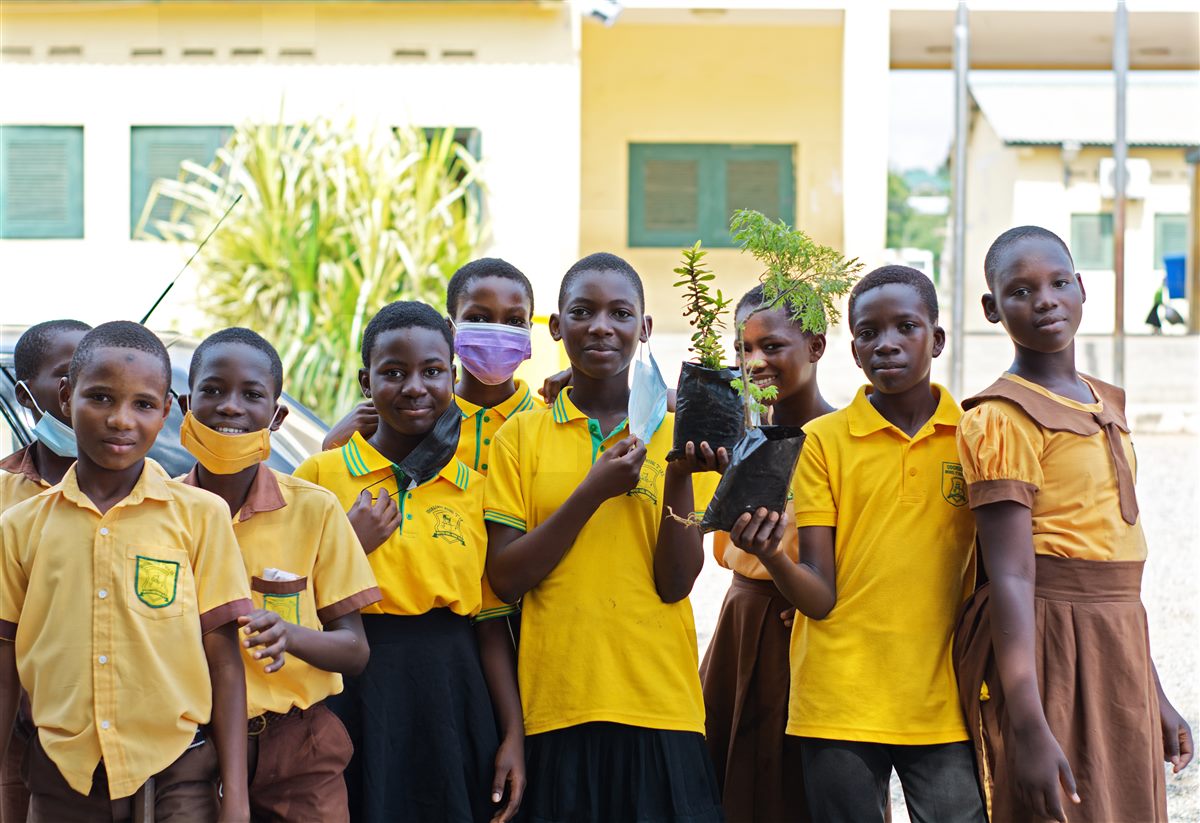
"Green Gate Tree Nursery", Kakamega County. Amina, Grade 10, with a group of five, noticed her school compound had almost no shade and soil washing away near the gate. Objectives: raise 60 seedlings by week 4; transplant at least 40; teach two Grade 8 classes to care for them. Budget: KSH 250 (a shared watering can, string and labels; containers, soil and seeds improvised free). Over four weeks the group raised 64 seedlings in recycled tins behind the classrooms, kept a daily watering rota in the logbook, photographed the nursery weekly, transplanted 46 labelled seedlings, and ran two care sessions reaching 58 pupils.
Why this scores EE: a visible local need, measurable objectives met and exceeded, a tiny improvised budget, four weeks of dated evidence, teamwork with a rota, community involvement through the Grade 8 pupils, and numbers everywhere: 64 raised, 46 planted, 58 taught.
The reflection: weak versus strong
Weak: "I enjoyed the project and learned teamwork. It was a good experience."
Strong: "Our seedlings kept drying out in week two, so we had to think critically: we moved the nursery into shade and built a watering rota, and survival improved. Leading five people tested my communication, especially settling who watered on Saturdays. Teaching the Grade 8 pupils grew my confidence, and seeing them protect 'their' trees made citizenship real to me, not just a word. Next time I would start two weeks earlier to beat the dry spell."
The difference is specificity: a named problem, the change made, a competency demonstrated rather than claimed, and one honest improvement. Teach your child that pattern and the reflection mark takes care of itself.
For parents: help without taking over
Ask open questions ("what did you notice? how will you measure it?"), keep them safe, provide small logistics (transport, a phone for photos), and hold the weekly rhythm: week 1 choose and propose, week 2 plan and get permission, weeks 3 and 4 implement and document, week 5 write, week 6 self-assess against the rubric, polish and present. Do not choose the project, do not write the report, and do not fund something expensive; moderators can tell, and the rubric rewards the opposite.
Common questions
Does the CSL project really affect my child's record? Yes. It is assessed, scored against the rubric, and uploaded to the CBA portal as part of Senior School assessment.
Can it be done alone? Group work is the norm and teamwork is assessed, but the reflection and report must be each learner's own.
How much should it cost? As little as possible. Improvised and borrowed materials are expected and rewarded. Most strong projects spend under KSH 500.
What if the project partly fails? Document it honestly. Challenges handled well score better than invented success; adaptation is an EE behaviour.
When should Grade 10s start? Now. The evidence trail needs weeks, and the write-up always takes longer than expected.
If you want the whole toolkit ready-made
Everything above is enough to run a strong project. If you want it packaged, our Grade 10 CSL Project Kit (KSH 200, instant M-Pesa download) contains the full printable versions: the proposal, action plan and budget, logbook, report and reflection templates as fill-in forms, the complete rubric, more than 50 project ideas across ten themes, two full worked examples, and a weekly parent checklist. Already drafting? The CSL Report Review (KES 1,500) gets your actual draft marked against the rubric by a teacher-reviewer within 48 hours, with a fix-list to push it toward EE. And if your child is also revising for the October exams, the Grade 10 Complete Revision and Exam Kit covers every subject with notes, revision, exams and answer keys. Questions? WhatsApp us on +254 711 344 702.
The Project Cycle in One Picture
Frequently Asked Questions
Does a bigger project earn a better mark? No. Assessment rewards the process evidenced and the reflection written, so a small project completed, logged and honestly evaluated outscores an ambitious one abandoned in week six. Choose what the class can finish.
What counts as evidence? The project log with dates and names, the budget with real figures, photographs of stages rather than only the final smile, questionnaires or tally sheets from the needs assessment, and permission letters. Evidence is collected during the work; it cannot be manufactured at report time, and assessors can tell.
What if the project partly failed? Write it honestly. A report that says the seedlings on the west line died, why, and what the class would do differently demonstrates exactly the learning the subject exists to produce, and marks better than suspicious perfection.
How is the individual learner marked inside a class project? Through their own contributions in the log, their role in the stages, and above all their personal reflection, which no two learners should be able to copy from each other.
When should the report be started? The day the project starts. A report written from a kept log takes an afternoon; a report reconstructed from memory takes a week and reads like it. The log template, budget sheets and report walkthrough are in the Grade 10 CSL Project Kit, with marking-eye detail in the CSL Teacher Pack.
GRADE 10: Term 3 Complete Bundle
Every subject for Term 3 in one download: notes, practice and full answer keys, with exam revision included.
⏳ Only 31 days to the national assessments on 26 October. Start now.
KSH 300 · Get it now → 📱 M-Pesa, instant download · join parents preparing nowHave a CBC question this article didn't answer?
Ask Somo, Kenya's first AI tutor. CBC-grounded, Kenyan examples, instant feedback. Five free questions a day with no signup, or start a 7-day free trial for 30 questions a day.
Try Somo Free →