
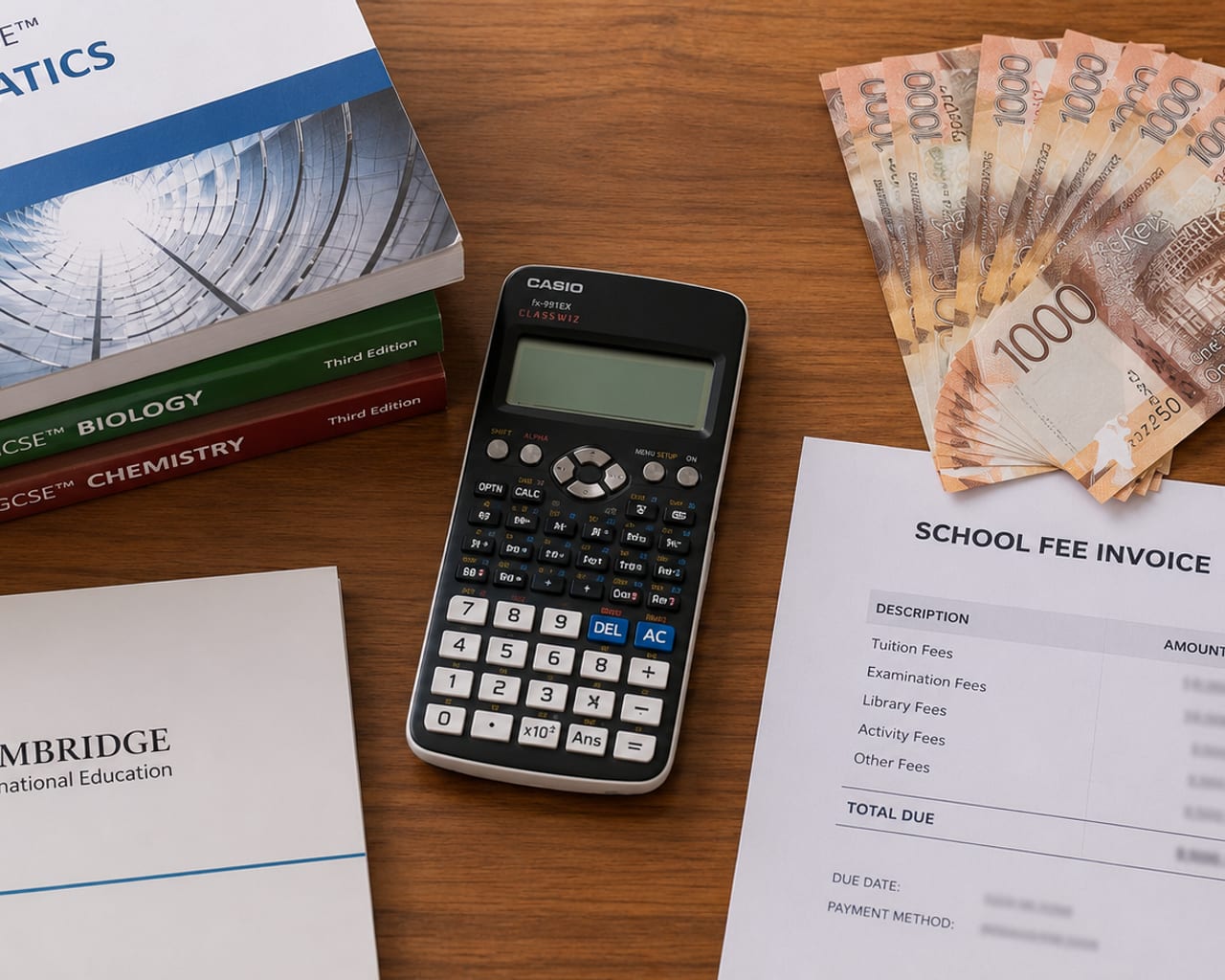
Updated for 2026. If you are a Kenyan parent weighing IGCSE for your child, the first question is almost always the same: how much will this actually cost me? Every school will tell you their fees, but very few will explain what sits underneath them: Cambridge exam-entry charges, materials, predicted-grade fees, AS / A Level extras two years later. This article lays out real ranges, by tier, in KSH for 2026, so you can budget honestly before you commit.
▶ Watch: IGCSE School Fees in Kenya 2026: Real Costs by School Tier (Budget to Premium)
The four cost layers: what you are actually paying for
Before the school-fee number, understand the four cost layers any IGCSE family pays. School fees are the largest but not the only one.
- 1. Tuition (school fees per term): your largest cost, varies wildly by school tier.
- 2. Cambridge exam-entry fees: paid in Year 11 (final IGCSE year), charged per subject, billed by the school but ultimately payable to Cambridge International.
- 3. Materials and uniform: Cambridge textbooks, calculators (Casio fx-991 is standard), set texts for English Literature, uniform, school transport.
- 4. Tuition top-ups: most IGCSE families hire 1–2 hour weekly tutors for Maths, Physics or Chemistry in Year 10–11. Standard Nairobi rate: KSH 2,000–5,000 per hour.
The four together, not just the school fees, is what the real annual cost looks like.
Tier 1: Premium international schools (KSH 450,000 – 650,000 per term)
These are the schools most Kenyans picture when they hear "IGCSE": pure international curriculum, predominantly expat or wealthy local intake, sports facilities to match, English-medium since pre-primary. Term fees in this tier in 2026 typically range from KSH 450,000 to KSH 650,000 per term, with three terms a year.
Schools in this tier include the International School of Kenya (ISK), German School Nairobi (DSN), and the more established Cambridge sections of Brookhouse Karen and Brookhouse Runda. Annual all-in is comfortably over KSH 1.5 million per child, before exam-entry fees in the final year.
Cambridge exam-entry fees in the final IGCSE year add another KSH 150,000–250,000 on top, depending on subject count (most students sit 8–10 IGCSE subjects).
Tier 2: Established Cambridge schools (KSH 200,000 – 400,000 per term)
This is the middle tier where the bulk of Kenyan Cambridge families actually sit. Strong academic results, smaller campuses, mostly local students with a sprinkle of international. Term fees in this range buy you good Cambridge teaching without the resort-grade campus of the premium tier.
Examples include Braeburn Garden Estate, Braeburn Imani, Hillcrest International School, Aga Khan Academy Nairobi (the IB / IGCSE blended programme), Peponi School, Banda School (transitioning students up), and several others. Expect KSH 600,000–1.2 million per year all-in plus the same Cambridge exam-entry fees in the final year.
Tier 3: Value Cambridge schools (KSH 80,000 – 180,000 per term)
Less talked about but growing fast: Kenyan-owned schools that run Cambridge IGCSE alongside (or instead of) 8-4-4 / CBC. Term fees here can be as low as KSH 80,000 in some Mombasa, Nakuru, Eldoret and outer-Nairobi schools, scaling up to about KSH 180,000 per term in better-known mid-tier institutions.
These schools deliver IGCSE genuinely: the syllabus is the same Cambridge syllabus, the exam is the same Cambridge exam: but campus facilities, sports breadth and class size will be more modest. For families who care about the Cambridge qualification rather than the international-school experience, this tier represents the best value in Kenya in 2026.
Annual all-in: KSH 240,000–540,000 per year. Even with Cambridge exam-entry fees in Year 11, total cost stays under KSH 800,000 in the final year: a fraction of Tier 1 or Tier 2.
The Cambridge exam-entry fees: the hidden bill in Year 11
Every IGCSE student pays Cambridge International an entry fee for each subject they sit. Schools collect this on Cambridge's behalf and pass it through. In 2026, the indicative per-subject entry fee ranges from KSH 18,000 to 28,000 per subject depending on the subject (sciences with practical components cost more because of the lab requirement).
A typical IGCSE student sits 8 subjects (English Language, English Literature, Maths, two or three Sciences, Business or Economics, a humanity, sometimes an additional language). Multiply 8 × KSH 20,000 = KSH 160,000 in exam-entry fees alone. Add late-entry penalties if you miss the deadline (Cambridge charges roughly double for late entries) and the bill stretches further.
This is the line item that catches families out. Budget for it in advance and you will not be surprised in October of Year 11 when the school presents the invoice.
Materials, uniform and the Casio bill
Textbooks for IGCSE are Cambridge-published or Cambridge-endorsed (Hodder, Collins, Oxford, Cambridge University Press). New, a full subject set costs KSH 35,000–60,000 per year. Many schools run a second-hand textbook system that brings this down significantly.
The non-negotiable Casio fx-991EX (or successor) costs around KSH 4,500–6,500 new at Text Book Centre or via online vendors. Set texts for English Literature 0475 change with the syllabus cycle: budget another KSH 3,000–5,000 per year. Uniform and PE kit vary by school but expect KSH 25,000–80,000 a year in the premium tier and KSH 8,000–20,000 in value-tier schools.
Tutoring: the cost most parents underestimate
Maths and Sciences are the subjects where IGCSE students most commonly need extra help. In Nairobi in 2026, qualified IGCSE tutors charge KSH 2,000–5,000 per hour; specialist Maths and Physics tutors at the upper end can charge KSH 6,000+. A typical Year 10–11 student doing two hours of tutoring per week across one or two subjects spends KSH 80,000–200,000 a year on tutors alone.
This is why structured Cambridge-aligned revision papers at KSH 200 per subject: or the Complete Cambridge Revision Bundle (all 7 core IGCSE subjects, 95 pages) at KSH 700: are an absurdly cheap supplement compared to one Nairobi tutoring hour at KSH 2,000-5,000. A single IGCSE revision paper on this site is KSH 200, or the Complete Cambridge Revision Bundle (all 7 core subjects, 95 pages) is KSH 700: less than one Nairobi tutoring hour.
So what does IGCSE actually cost a Kenyan family in 2026?
Putting it all together, expect total annual outlay (per child, per year) along these lines:
- Tier 1 (premium): KSH 1.7M – 2.2M per year; final IGCSE year add KSH 200,000.
- Tier 2 (established Cambridge): KSH 800,000 – 1.4M per year; final IGCSE year add KSH 200,000.
- Tier 3 (value Cambridge): KSH 300,000 – 700,000 per year; final IGCSE year add KSH 200,000.
The Cambridge qualification is the same across all three tiers. What you are paying for in Tier 1 and Tier 2 is the school experience, the facilities, the network and the small class sizes: not a better IGCSE certificate. Cambridge marks the same paper the same way regardless of which Kenyan school sat the exam.
Where this site fits in
If you are already paying Tier 1 or Tier 2 fees, the supplementary cost of IGCSE materials and tutoring sits within the normal household budget. If you are in Tier 3 or considering moving your child from CBC to IGCSE on a tighter budget, structured IGCSE revision materials are the highest-leverage spend per shilling you can make.
We currently stock 57 IGCSE products across 8 subjects: Maths 0580, Physics 0625, Chemistry 0620, Biology 0610, English Language 0510, English Literature 0475, Business Studies 0450 and Computer Science 0478: covering notes, schemes of work, revision papers, mark schemes and rubrics. Each individual revision paper is KSH 200, or get the Complete Cambridge Revision Bundle (all 7 core subjects, 95 pages) for KSH 700: a 50% saving versus buying each subject separately. The full IGCSE Literature setbook kit is KSH 3,000.
Plan your IGCSE budget realistically: and supplement smartly.
→ Browse the IGCSE / Cambridge Hub (notes · schemes · revision · mark schemes · setbook guides)
→ Try Somo (free Cambridge-trained AI tutor) for stuck questions
Bulk school orders or family-discount queries: WhatsApp +254 711 344 702.
Sources: Cambridge International (cambridgeinternational.org) for syllabus codes and entry-fee structure; published school fee schedules from Kenyan international schools (2025/26); current Nairobi tutoring rate ranges. Fee ranges given are 2026 estimates and vary by school, term and currency exposure. Last updated: May 2026.
Online IGCSE tutoring for adults and private candidates: expert lessons, marked practice and a two-year plan, around your schedule.
See IGCSE Tutoring packages →
IGCSE Revision Materials
Notes and topical questions for the core IGCSE subjects, timed to the Oct/Nov series.
⏳ Only 42 days to the national assessments on 26 October. Start now.
from KSH 350 · Get it now → 📱 M-Pesa, instant download · join parents preparing nowHave a CBC question this article didn't answer?
Ask Somo, Kenya's first AI tutor. CBC-grounded, Kenyan examples, instant feedback. Five free questions a day with no signup, or start a 7-day free trial for 30 questions a day.
Try Somo Free →